


Education and Treatment of Children, Vol 38
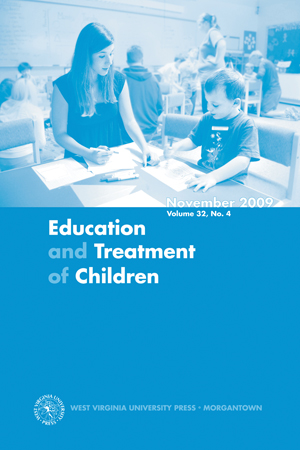
Editor: Dr. Bernie Fabry
E-ISSN: 0748-8491
Frequency: Quarterly
Click on listed price to corresponding product to order:
Volume 38: Institution (US): $100.00
Volume 38: Individual (US): $50.00
Volume 38: International Institution (Outside US): $115.00
Volume 38: International Individual (Outside US): $65.00
Scholarly Publishing Workshop with West Virginia University Press
How do you publish a book? Derek Krissoff, the director of West Virginia University Press, and Abby Freeland, sales and marketing manager and acquisition editor at WVU Press, will lead a workshop, panel discussion, and Q&A session about scholarly publishing for MA, PhD, and post-doc students at West Virginia University.
The panel will include professors Cheryl Ball (Digital Publishing Studies/English), Travis Stimeling (Music), and Jason Phillips (History). A light breakfast will be served.
When and where:
February 18, 2016, 9-11am
Rhododendron Room, Mountainlair
RSVP to abby.freeland@mail.wvu.edu by 2/11/16.
American Historical Association
West Virginia University Press will exhibit at the annual meeting of the American Historical Association January 7–9 in Atlanta. Stop by booth 1709 to meet our director, Derek Krissoff.
While you’re there you can check out WVU’s latest titles in history, including George Washington Written Upon the Land by Philip Levy, a book that contributes to studies of historical memory, landscape and environmental studies, and “big” history. Ari Kelman, winner of the Bancroft Prize for A Misplaced Massacre, calls the book “extraordinary” and says is it “casts one of the most famous and influential figures in American history in an entirely new light.”
You can also learn more about two new book series. Histories of Capitalism and the Environment is edited by Bart Elmore, author of Citizen Coke: The Making of Coca Cola Capitalism. Brian Black – author of many books on environment and energy, including Petrolia: The Landscape of America's First Oil Boom – edits our other new series, Energy and Society.
We’re excited to roll out these important new series and books and look forward to seeing you in Atlanta.
Forensic Accounting and Fraud Examination: Knowledge, Skills, and Abilities


Richard Dull and
Richard A. Riley, Jr.
November 2015
160pp
PDF 978-1-943665-25-9
$12.95
Summary
This book was written to provide a basic perspective of forensic accounting and fraud investigation. It includes topics such as the elements of fraud, the typical perpetrator of fraud (as well as predators), and the attributes of most fraudsters (such as the fraud triangle and diamond).There are also discussions of internal controls, and data analysis tools and techniques to help identify red flags that frequently exist long before a fraud is detected.
The authors also include a description of money laundering, including common schemes. The money laundering topic leads into the final topic of the book, which is whistleblowing. That topic includes best practices for effective anti-fraud hotlines. WorldCom is used as an example to demonstrate the outcome of a large fraud, and the impact on those involved, from the whistleblower to those who allegedly perpetrated the fraud.
Each of the book’s five chapters includes a fifteen-question quiz to facilitate knowledge proficiency.
While the book was initially designed to accompany a massive open online course (MOOC), it provides a reader with information to help understand the basics of fraud and forensic accounting, including anti-fraud tools and techniques.
Table of Contents
Coming Soon.
Author
Richard Dull is the GoMart Professor of Accounting Information Systems at West Virginia University. He is a CPA|CFF and CFE. His areas of teaching are primarily forensic accounting and information systems. Prior to his academic career his experience includes working as an auditor, computer programmer, and computer consultant.
Richard A. (Dick) Riley, Jr., is the Louis F. Tanner Distinguished Professor of Public Accounting at West Virginia University. He is also the Director of Research for the Institute for Fraud Prevention. Dr. Riley has been recognized nationally for his contributions in forensic accounting and fraud examination.
Reviews
Coming Soon.
Second Annual Bah Humbug Book Sale
Save 30% on all WVU Press titles with promo code HUMBUG2016 during our second annual Bah Humbug book sale.
Search books by title or browse books by the series or subject areas listed in the sidebar. Over three hundred WVU Press books are on sale until January 9, 2017.*
HOW TO ORDER AND SAVE 30%:
- Enter promo code HUMBUG2016 in the shopping cart on wvupress.com.
OR
- Phone (800) 621-2736 and quote promo code HUMBUG2016 while ordering.
*The 2016 Bah Humbug sale excludes forthcoming WVU Press books and all journals.
Bede and Aethelthryth: An Introduction to Christian Latin Poetics
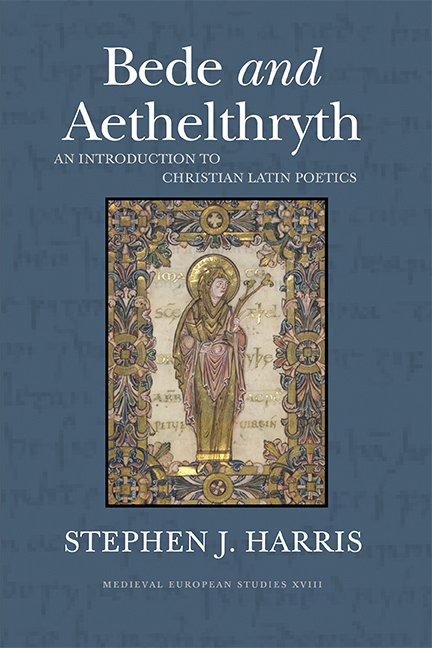
Stephen Harris
April 2016
335pp
PB 978-1-940425-93-1
$44.99
Medieval European Studies Series: Volume 18
Summary
Bede and Aethelthryth asks why Christians in Britain around the year 700 enjoyed Latin poetry. What did they see in it? What did they get from it? This book attempts to reconstruct the horizon of expectation of a highly learned, Latin-speaking nun as she encounters a fifty-line poem by the Venerable Bede, the Hymn to Aethelthryth.
The reconstruction is hypothetical and derived from grammatical manuals, learned commentaries from the early medieval period (especially Servius’s commentary on Virgil), and a wide variety of aesthetic observations by classical and medieval readers. The first four chapters describe basic expectations of a reader of Christian Latin poetry. The fifth chapter places the Hymn in its context within Bede’s Ecclesiastical History. A few pages after Bede records his hymn, Caedmon will recite his own hymn under the watchful eye of Whitby’s Abbess Hild, who was a friend of Aethelthryth.
Both hymns are attempts to reform the lyric traditions of pagan Rome and pagan Anglo-Saxon England in the light of Christian teaching. The last three chapters contain a line-by-line commentary on Bede’s alphabetic, epanaleptic elegy.
Contents
Coming Soon.
Author
Stephen Harris teaches in the Department of English and in the Department of German and Scandinavian Studies at the University of Massachusetts in Amherst, MA. His books include Race and Ethnicity in Anglo-Saxon Literature; Misconceptions about the Middle Ages, edited with Bryon Grigsby; and Vox Germanica: Essays on Germanic Literature and Culture in Honor of James E. Cathey, edited with Michael Moynihan and Sherrill Harbison.
Reviews
Coming Soon.
The Steam and Diesel Era in Wheeling, West Virginia: Photographs by J. J. Young Jr.
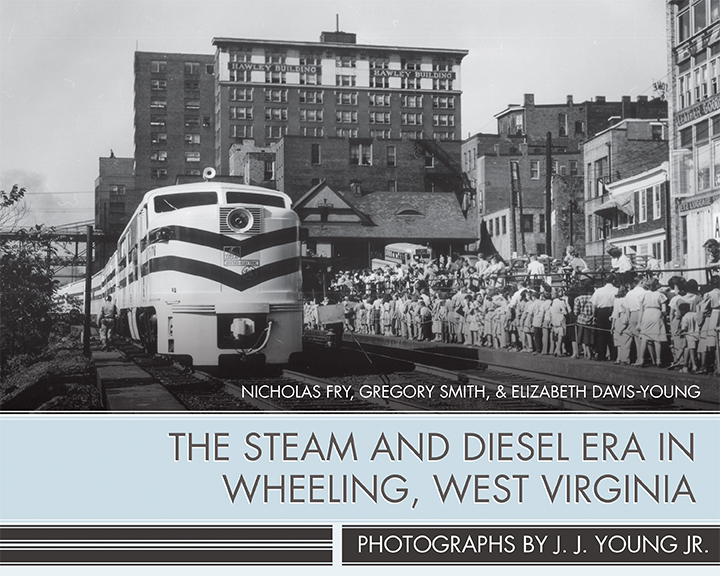
Nicholas Fry, Gregory Smith, Elizabeth Davis-Young
July 2016
224pp
178 b/w images
Litho 978-1-943665-03-7
$49.99
Summary
For nearly seventy years, John J. Young Jr. photographed railroads. With unparalleled scope and span, he documented the impact and beauty of railways in American life from 1936 to 2004.
As a child during the Great Depression, J. J. Young Jr. began to photograph railroads in Wheeling, West Virginia. This book collects over one hundred fifty of those images—some unpublished until now—documenting the railroads of Wheeling and the surrounding area from the 1930s until the 1960s.
The photographs within this book highlight the major railroads of Wheeling: the Baltimore & Ohio, the Pennsylvania, the Wheeling & Lake Erie, the Pittsburgh & West Virginia, the New York Central, and the industrial and interurban rail lines that crisscrossed the region. These images capture the routine activities of trains that carried passengers and freight to and from the city and its industries, as well as more unusual traffic, such as a circus-advertising car, the General Motors Train of Tomorrow, and the 1947 American Freedom Train.
Contents
- Acknowledgments
- Introduction: Welcome to Wheeling, West Virginia
- Chapter One: J. J. Young Jr.
- By Elizabeth Davis-Young
- Chapter Two: The Baltimore & Ohio Railroad
- Chapter Three: The Pennsylvania Railroad
- Chapter Four: The Wheeling & Lake Erie Railway, the Pittsburgh & West Virginia Railway, and the Nickel Plate Road
- Chapter Five: The New York Central
- Chapter Six: The Industrial and Interurban Lines of Wheeling
- Notes
- Bibliography
Author
Nicholas Fry is the curator of the Barriger Library and is the archivist of the B&O Railroad Historical Society.
Greg Smith is a retired educator and is currently president of the B&O Railroad Historical Society.
Elizabeth Davis-Young is the widow of J. J. Young Jr. This book realizes her desire to fulfill her husband’s unfinished plans for a book of his Wheeling area railroad photographs.
John J. Young Jr.’s (1929–2004) hobby of railroad photography began in Wheeling, WV, and continued after he moved to upstate New York in 1959. He was a member of the faculty of Broome Community College in Binghamton and taught photography until his retirement in 1995. His photographs of railroads across the country were published in books and periodicals throughout his life. He was working on this book before his death in 2004.
Reviews
“The photographs at this book’s heart are uniformly professional, both technically and artistically. They tell graphic stories about how railroads were operated in the industry’s ‘traditional’ era.”
Herbert H. Harwood Jr., author of The Railroad That Never Was: Vanderbilt, Morgan, and the South Pennsylvania Railroad
“These powerful and often unconventional action photos show an amazing variety of trains. Young's depictions of B&O's mighty EM-1-2-8-8-4s alone is worth the price of this book.”
Classic Trains
New in Paperback! Folk-Songs of the South
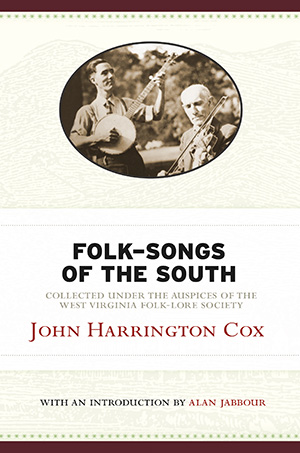
Edited by John Harrington Cox
Introduction by
Alan Jabbour
January 2016
660pp
PB 978-1-943665-14-3
$24.99
Summary
Folk-Songs of the South: Collected Under the Auspices of the West Virginia Folk-Lore Society is a collection of ballads and folk-songs from West Virginia. First published in 1925, this resource includes narrative and lyric songs that were transmitted orally, as well as popular songs from print sources.
Through 186 ballads and songs and 26 folk tunes, this collection archives a range of styles and genres, from English and Scottish ballads to songs about the Revolutionary and Civil Wars, the opening of the American West, and boat and railroad transportation. It includes children’s play-party and dance music, songs from African American singers, and post–Civil War popular music. The original introduction by Cox contains vibrant portraits of the singers he researched, with descriptions of performance style and details about personalities and attitudes.
With an introduction by Alan Jabbour, this edition renews the importance of this text as a piece of scholarship, revealing Cox’s understanding of the workings of tradition across time and place and his influence upon folk-song research.
Contents
Coming Soon.
Author
John Harrington Cox (1863-1945) was a pioneer in the field of American folk song scholarship. An academic educated at Brown and Harvard, he joined the Department of English at West Virginia University in 1903 as an expert in Old and Middle English and Medieval literature. In 1913, his interests in philology led him to begin collecting folk songs and within two years he presided over the founding of the West Virginia Folklore Society, serving as its first president, archivist, and editor. By 1925 he had published Folk-Songs of the South, the first major collection of American folk songs by an American editor, and he continued to collect folk songs for archiving, publishing Traditional Ballads Mainly From West Virginia and Folk-Songs Mainly From West Virginia in 1939. He died in Morgantown, West Virginia.
Alan Jabbour is a folklorist and folk music specialist who has undertaken extensive field and library research into the folk cultural traditions of West Virginia and the Appalachians. While at Duke University (M.A. 1966, Ph.D. 1968), he launched a project to document the older traditional fiddling of the Upland South. His work with Monroe County fiddler Henry Reed and other West Virginia fiddlers has helped make the older repertory of West Virginia fiddle tunes loom large in the contemporary instrumental folk music revival, and the Library of Congress has published a website featuring his entire Henry Reed Collection. His work with the Hammons Family in Pocahontas County has resulted in several important publications about this family’s extraordinary contributions to the reservoir of West Virginia folksong, folk music, and folklore.
Reviews
Coming Soon.