The Book of the Dead

Muriel Rukeyser
Introduction by
Catherine Venable Moore

144pp 
PB 978-1-946684-21-9
$17.99


Summary

Written in response to the Hawk’s Nest Tunnel disaster of 1931 in Gauley Bridge, West Virginia, The Book of the Dead is an important part of West Virginia’s cultural heritage and a powerful account of one of the worst industrial catastrophes in American history. The poems collected here investigate the roots of a tragedy that killed hundreds of workers, most of them African American. They are a rare engagement with the overlap between race and environment in Appalachia.

Published for the first time alongside photographs by Nancy Naumburg, who accompanied Rukeyser to Gauley Bridge in 1936, this edition of The Book of the Dead includes an introduction by Catherine Venable Moore, whose writing on the topic has been anthologized in Best American Essays.

Contents


Author

Muriel Rukeyser (1913–1980) was a prolific American writer and political activist. In 1935 her first collection of poetry, Theory of Flight, won the Yale Younger Poets Prize, and she went on to publish twelve more volumes of poetry. She received a National Institute of Arts and Letters award, a Guggenheim Fellowship, the Levinson Prize for Poetry, and the Shelley Memorial Award, among other accolades. Rukeyser’s writing consistently emphasized and utilized cinematic and graphic techniques, and she explored various connections between the visual and literary aspects of art. She originally intended The Book of the Dead to be published with multiple photos by Naumburg.

Catherine Venable Moore is a writer and producer in Fayette County, West Virginia. A graduate of Harvard University and the University of Montana, Moore is the recipient of fellowships from the MacDowell Colony, the Vermont Studio Center, the Highlander Center, the West Virginia Humanities Council, and others. Her nonfiction has recently appeared in Best American Essays, Oxford American, VICE, Columbia Journalism Review, and Yes! She is also an honorary member of the United Mine Workers of America. Currently, she is at work on a collection of essays.

Reviews

"Innovative, gorgeous, and deeply moving."
Publishers Weekly (starred review)

“If Rukeyser had left us only The Book of the Dead and The Life of Poetry, she would have made a remarkable contribution to American literature. But the range and daring of her work, its generosity of vision, its formal innovations, and its level of energy are unequalled among twentieth-century American poets.”
Adrienne Rich, introduction to Muriel Rukeyser, Selected Poems

“Muriel Rukeyser’s words are a painful, haunting memorial to an American crime. Catherine Venable Moore’s graceful essay sets the work in its time and place, and ties it to today’s struggles.”
Jedediah Purdy, author of After Nature: A Politics for the Anthropocene

"A poetic account of the value of human life in a world of commodity and extraction."
Elizabeth Catte, Literary Hub

Teaching the Literature Survey Course: New Strategies for College Faculty

Edited by 
Gwynn Dujardin,
James M. Lang,
and John A. Staunton

January 2018
276pp 
PB  978-1-946684-09-7
$28.99
CL  978-1-946684-08-0
$99.99
Epub  978-1-946684-10-3
$28.99
PDF  978-1-946684-11-0
$28.99

Teaching and Learning in Higher Education


Summary

Teaching the Literature Survey Course makes the case for maintaining—even while re-imagining and re-inventing—the place of the survey as a transformative experience for literature students. Through essays both practical and theoretical, the collection presents survey teachers with an exciting range of new strategies for energizing their teaching and engaging their students in this vital encounter with our evolving literary traditions.

From mapping early English literature to a team-based approach to the American survey, and from multimedia galleries to a “blank syllabus,” contributors propose alternatives to the traditional emphasis on lectures and breadth of coverage. The volume is at once a set of practical suggestions for working teachers (including sample documents like worksheets and syllabi) and a provocative engagement with the question of what introductory courses can and should be.


Receive a 30% discount on orders of 10 or more copies of this title with code HIGHEREDBULK30 at checkout.

Contents

Introduction, James M. Lang

Part One: Pedagogies
1. Mapping the Literature Survey: Locating London in British Literature I, Kevin Bourque
2. Creative Imitation: The Survey as an Occasion for Emulating Style, Scott L. Newstok
3. Bingo Pedagogy: Team-Based Learning and the Literature Survey, Desirée Henderson
4. Extended Engagement: In Praise of Breadth, Aaron Rosenfeld

Part Two: Projects
5. “Reacting to the Past” in the Survey Course: Teaching the Stages of Power: Marlowe and Shakespeare, 1592 Game, Joan Varnum Ferretti
6. The Blank Survey Syllabus, Chris Walsh
7. Errant Pedagogy in the Early Modern Classroom, or Prodigious Misreadings in and of the Renaissance, Melissa J. Jones
8. Digital Tools, New Media Survey, and the Literature Survey, Jennifer Page

Part Three: Programs
9. Thematic Organization and the First-Year Literature Survey, Kristin Lucas and Sarah Fiona Winters
10. Fear and Learning in the Historical Survey Course, Gwynn Dujardin
11. The Survey as Pedagogical Training and Academic Job Credential, Tim Rosendale
12. Revisioning the American Literature Survey for Teachers and Other Wide-Awake Humans, John A. Staunton
Contributor Biographies
Notes S

Editors

Gwynn Dujardin is assistant professor of English at Queen’s University in Kingston, ON, Canada.

James M. Lang is a professor of English and director of the Center for Teaching Excellence at Assumption College.

John A. Staunton is professor of English education and American literature at Eastern Michigan University.

Reviews

“An effectively organized collection that I believe will benefit college—and potentially, some high school—instructors at many levels and institutions. Even as I was reading it, I felt the gears in my mind turning and trying to think of ways to adapt some of its ideas right away.”
Jesse Kavadlo, Maryville University

The News Untold: Community Journalism and the Failure to Confront Poverty in Appalachia

Michael Clay Carey

252pp 
PB 978-1-943665-97-6
$26.99
CL 978-1-943665-96-9
$79.99
ePub 978-1-943665-98-3
$26.99
PDF 978-1-943665-99-0
$26.99

Summary

Association for Education in Journalism and Mass Communication Tankard Book Award winner
Weatherford Award winner, nonfiction

The News Untold offers an important new perspective on media narratives about poverty in Appalachia. It focuses on how small-town reporters and editors in some of the region’s poorest communities decide what aspects of poverty are news, how their audiences interpret those decisions, and how those two related processes help shape broader understandings of economic need and local social responsibility. Focusing on patterns of both media creation and consumption, The News Untold shows how a lack of constructive news coverage of economic need can make it harder for the poor to voice their concerns.

Critical and inclusive news coverage of poverty at the local level, Michael Clay Carey writes, can help communities start to look past old stereotypes and attitudes and encourage solutions that incorporate broader sets of community voices. Such an effort will require journalists and community leaders to reexamine some of the professional traditions and social views that often shape what news looks like in small towns.

Contents

Acknowledgments

1. Poverty and Community Media in Rural Appalachia

2. Greenburg, Priorsville, and Deer Creek: Community Case Studies

3. Dominant Frames in Local Poverty Coverage

4. Pressures, Philosophies, and the Encoding of Media Messages

5. Decoding Poverty Coverage and Broader Images of Appalachia

6. How Local Media’s Silence Influences Views of Poverty

Appendix A: Research Methodology

Appendix B: Action Steps for Journalists 0

Notes

Bibliography

Index

Author

Michael Clay Carey is an assistant professor of journalism and mass communication at Samford University in Birmingham. He researches the impacts of stereotypes and the roles media play in the formation and maintenance of individual and group identity. Carey spent ten years working as a newspaper reporter and editor.

Reviews

“Carey’s meticulously researched and beautifully written account of how local news outlets chronicle life in three Appalachian towns gets at the ways in which journalists sometimes cover poverty, and sometimes ignore it. He helps us understand how local people respond to those news discourses and to their disempowering silences. And he uses the research to make concrete suggestions for how a more inclusive, context-sensitive journalism can reinvigorate the local civic sphere.”
Linda Steiner, University of Maryland

“A compassionate and thoughtful exploration of an important topic. Carey draws on his skills as a journalist to create an intimate portrait of these three communities, while using his training as a scholar and social scientist to give us a rigorously researched book.”
John Hatcher, coeditor of Foundations of Community Journalism

Hollow and Home: A History of Self and Place

E. Fred Carlisle
August 2017
228pp
PB 978-1-943665-82-2
$26.99
ePub 978-1-943665-83-9
$26.99
PDF 978-1-943665-84-6
$26.99


Summary

Hollow and Home explores the ways the primary places in our lives shape the individuals we become. It proposes that place is a complex and dynamic phenomenon. Place refers to geographical and constructed places—
location, topography, landscape, and buildings. It also refers to the psychological, social, and cultural influences at work at a given location. These elements act in concert to constitute a place. 

Carlisle incorporates perspectives from writers like Edward S. Casey, Christian Norberg-Schulz, Yi-Fu Tuan, and Witold Rybczynski, but he applies theory with a light touch. Placing this literature in dialog with personal experience, he concentrates on two places that profoundly influenced him and enabled him to overcome a lifelong sense of always leaving his pasts behind. The first is Clover Hollow in Appalachian Virginia, where the author lived for ten years among fifth-, sixth-, and seventh-generation residents. The people and places there enabled him to value his own past and primary places in a new way. The story then turns to Carlisle’s life growing up in Delaware, Ohio. He describes in rich detail the ways the town shaped him in both enabling and disabling ways. In the end, after years of moving from place to place, Carlisle’s experience in Appalachia helped him rediscover his hometown—both the Old Delaware, where he grew up, and the New Delaware, a larger, thriving small city—as his true home. 

The themes of the book transcend specific localities and speak to the relationship of self and place everywhere. 

Learn more at Hollow and Home. 

Contents

List of Photographs and Illustrations

Acknowledgments

The Place Is the Thing1. James Melville Cox and Brookside Farm

2. Placeless in America

Hollow

3. Clover Hollow: Our Sanctuary

4. Three Meadow Mountain: Homage and Innovation

5. Clover Hollow: The Place

6. The 1875 Lafon Home Place

7. The 1892 Givens Home Place

8. Outsiders Fitting In

9. Interlude

Home

10. A Boy from Columbus. A Man of Delaware, Ohio

11. 208 West Lincoln Avenue

12. The Delaware City Schools

North Elementary 

Frank B. Willis High School

13. Downtown Delaware

14. The Road Out: Ohio Wesleyan University

15. A Moveable Place

16. New Delaware: The Place Is Still the Thing: 

17. Oaknoll Farm: Elizabeth Adair Obenshain

Notes

Index

Author

E. Fred Carlisle has been writing about identity and place for years. He is the author of four previous books—two memoirs and studies of Walt Whitman and of Loren Eiseley. A former provost at Virginia Tech, he grew up in Ohio, enjoyed a long academic career, lived for a decade in the rural Virginia mountains, and now divides his time between Virginia and South Florida. Learn more at www.hollowandhome.com.

Reviews

“Open, direct, economical, and vividly honest.”
Joseph A. Amato, author of Everyday Life: How the Ordinary Became Extraordinary

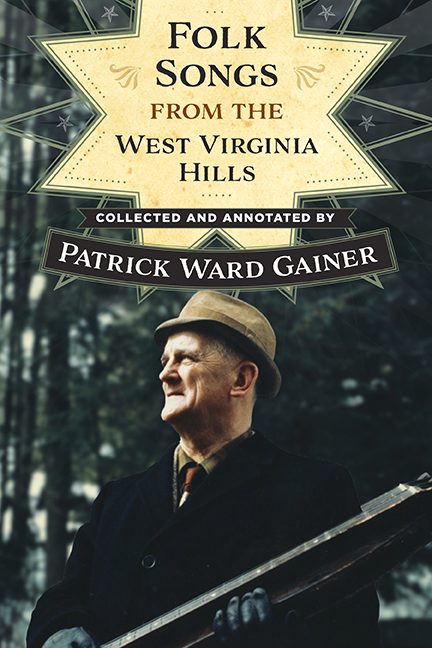
Folk Songs from the West Virginia Hills

Patrick Ward Gainer
Foreword by Emily Hilliard

264pp 
PB 978-1-946684-03-5
$24.99

Sounding Appalachia Series


Summary

First published in 1975 and long out of print, Folk Songs from the West Virginia Hills is a major work of folklore poised to reach a new generation of readers. Drawing upon Patrick Ward Gainer’s extensive ethnographic fieldwork around West Virginia, it contains dozens of significant folk songs, including not only the internationally famous “Child Ballads,” but such distinctively West Virginian songs as “The West Virginia Farmer” and “John Hardy,” among others.

Folk Songs from the West Virginia Hills stands out as a book with multiple audiences. As a musical text, it offers comparatively easy access to a rich variety of folk songs that could provide a new repertoire for Appalachian singers. As an ethnographic text, it has the potential to reintroduce significant data about the musical lives of many West Virginians into conversations around Appalachian music—discourses that are being radically reshaped by scholars working in folklore, ethnomusicology, and Appalachian studies. As a historical document, it gives readers a glimpse into the research methods commonly practiced by mid-twentieth-century folklorists. And when read in conjunction with John Harrington Cox’s Folk Songs of the South (also available from WVU Press), it sheds important light on the significant role that West Virginia University has played in documenting the state’s vernacular traditions.

Contents

Coming soon.

Author

Patrick Ward Gainer (1904–1981) was one of the leading scholars of Appalachian folk music in the mid-twentieth century. A member of the English faculty at West Virginia University, he taught an immensely popular course on Appalachian music that frequently showcased some of the leading practitioners of traditional Appalachian music as guest artists. He is the author of Witches, Ghosts, and Signs: Folklore of the Southern Appalachians, also available from WVU Press.

Reviews

"Patrick Gainer used his platform as a professor at West Virginia University to advocate vigorously for the preservation and dissemination of Appalachian culture, supporting the work of leading traditional musicians by documenting and presenting their work to others. Decades after his death, his work remains vitally important."
Travis Stimeling, West Virginia University

The Out-of-Sorts: New and Selected Stories

Gary Fincke
November 2017
420pp 
PB 978-1-943665-93-8
$24.99
ePub 978-1-943665-94-5
$24.99
PDF 978-1-943665-95-2
$24.99


Summary

The new and selected stories in this collection, written over a period of thirty years, are firmly entrenched in the culture and people of rust belt cities and rural Appalachia. 

These stories are often set against large, significant events like the Cold War, Vietnam, and the Kent State shootings, but are always uniquely local. A mother fends off the police by brandishing copperhead snakes. A woman cares for the dog of an alleged double murderer. A husband who has lost his job works at trying to save his wife from a debilitating phobia. 

This extensive collection by Gary Fincke, an accomplished poet and writer of fiction, gives rise to ordinary people living lives made fascinating by attention to the particulars of voice, place, and character. With precise language, surprising imagery, and sharp, evocative dialog, these stories deepen beyond the oddities of their characters, who are scarred and defeated by circumstance and choice, but also attain moments of grace, compassion, and generosity of the spirit.

Contents

Coming soon.

Author

Gary Fincke is the author of seven short story collections, including A Room of Rain; The Proper Words for Sin; Sorry I Worried You, a winner of the Flannery O’Connor Award for Short Fiction; and The Killer’s Dog, an Elixir Press Fiction Prize winner. His stories have appeared in such magazines as the Missouri Review, Kenyon Review, Black Warrior Review, and CrazyHorse.

Reviews

“Gary Fincke’s collected stories should reveal to thousands of readers what a few of us have known for a long time—he is a master of the form. These stories are ambitious and rigorous, and they aim for nothing less than an examination of what it means to be alive.”
Robert Boswell, author of Tumbledown and The Heyday of the Insensitive Bastards

“There’s no glamour in Gary Fincke’s world, just tough times and hard work. From early on his people know how uncertain life can be—how easy it is to lose hope, and how, sometimes, to get by, we bury what we can’t face.”
Stewart O’Nan, author of Snow Angels and Last Night at the Lobster

"These stories read like a collective bildungsroman of a region, giving voice to those in the Rust Belt who feel displaced and forgotten."
Lawrence Coates, author of The Goodbye House and Camp Olvido

"An impressive testament to Gary Fincke’s mastery of the short story. The quality about his work that has always appealed to me is how quickly his stories engage and how tenaciously they maintain their hold on the reader. He knows his characters as well as any writer I've come across, and the result is fiction that bursts with life. I enjoyed every page."
Steve Yarbrough, author of Safe from the Neighbors

“Finely drawn, swiftly paced, and authentically voiced, these stories offer a vivid glimpse of the lives behind the windows of boarded-up towns and houses set back from the road.”
Foreword Reviews

Unruly Creatures

Jennifer Caloyeras
October 2017
180pp
PB 978-1-943665-78-5
$17.99
eBook 978-1-943665-79-2
$17.99
PDF 978-1-943665-80-8
$17.99
Reading and discussion questions

Summary

Independent Publisher’s Book Awards, Silver Medal, Short Story Fiction

In this collection rife with humor and pathos, alienated characters struggle to subvert, contain, control, and even escape their bodies. A teenage girl grapples with pubic hair grown wild, a biologist finds herself in love with a gorilla, a prisoner yearns to escape her biological destiny.

In some stories, the bodies have surrogates: a high-school girl babysits an elderly woman’s plastic doll while negotiating her own sexual awakening, and a young man finds that he can only receive affection from his father when he is in costume. Dark humor and magical realism put in sharp relief the everyday trials of Americans in a story collection that asks, in what way are we more than the sum of our parts? 

Contents

Coming soon.

Author

Jennifer Caloyeras is the author of Strays. Her short stories have appeared in Booth, Storm Cellar, and other literary magazines. She recently served as the artist-in-residence at the Annenberg in Santa Monica and teaches writing at the the UCLA Extension Writers’ Program. She lives in Los Angeles with her husband and two sons.

Reviews

“A can’t-miss collection for readers who love a blend of humor, magical realism, and surrealism.”
Bustle

"Caloyeras guides us through her characters' states of mind, traversing the conscious and subconscious. Call it magical realism, or just refer to it as "weird stuff, dude." Either way, all the unbelievable-yet-somehow-believable worlds that Caloyeras creates feel easy for readers to fall into in an Alice down-the-rabbit-hole kind of way."
Alicia Eler, Minneapolis Star Tribune

“Jennifer Caloyeras is an enormously talented writer with a rare combination of great imagination and heart.”
Max Brooks, author of The Zombie Survival Guide and World War Z

“Jennifer Caloyeras’s stories snap, crackle, and pop with animal energy. Every one of these stories is an unruly creature, wild at heart, fierce and funny, and heartbreaking.”
Zsuzsi Gartner, author of Better Living through Plastic Explosives and All the Anxious Girls on Earth 

“When you read Unruly Creatures, the stories stare back at you like a caged gorilla.  Haunting, revelatory, and utterly breathtaking, Caloyeras is an astonishing talent.”
Matthew J. Trafford, author of The Divinity Gene

“Riotous, off-kilter, tender, magical—this collection is utterly accomplished and madly engaging. Jennifer Caloyeras’s writing is as wild and beautiful as the unruly creatures in her stories.”
Laura Trunkey, author of Double Dutch, a 2017 ABA Indies Introduce title

On Homesickness: A Plea

Jesse Donaldson

September 2017
252pp 
PB 978-1-946684-00-4
$17.99
120 illustrations

In Place Series


Summary

2017 Mountain Heritage Literary Festival Appalachian Book of the Year, nonfiction

One day, Jesse Donaldson wakes up in Portland, Oregon, and asks his wife to uproot their life together and move to his native Kentucky. As he searches for the reason behind this sudden urge, Donaldson examines both the place where he was born and the life he’s building. 

The result is a hybrid—part memoir, part meditation on nostalgia, part catalog of Kentucky history and myth. Organized according to Kentucky geography, with one passage for each of the commonwealth’s 120 counties, On Homesickness examines whether we can ever return to the places we’ve called home.


The120.


Author

Jesse Donaldson was born in Kentucky, educated in Texas, and now lives in Oregon. He is the author of the novel The More They Disappear.

Reviews

“A wonderful prose poem, a beautiful meditation on homesickness and connection to place, and a celebration of Kentucky and that strange and undeniable connection that Kentuckians have to the state.”
Silas House, author of Clay’s Quilt, The Coal Tattoo, and Eli the Good

"On Homesickness is a masterful meditation on nostalgia, founded in the tender device of riffs on the 120 counties of the Commonwealth of Kentucky. For this Kentucky native the device is so obvious that it borders on genius, because what is genius but incarnating in art the beauty in the details everyone else has taken for granted?  My first thought on opening it was:  Why didn’t I think of that?—a sure sign the author is onto something sweet.  The riffs are lyrical, poignant, evocative—they call to mind Vladimir Nabokov, our high priest of nostalgia.  Everyone who has left home, any home, anywhere, will want to read these, for a sobering assessment of why you left—along with all those who remained, for an equally rich assessment of the price of staying put."
Fenton Johnson, author of The Man Who Loved Birds

"In his ambitious and elegant long essay, Jesse Wilcox Donaldson, modern day voyager, passionately wrestles with the question of home: where is home, how is a home imagined, why do we leave, and how might we (do we want to?) return. Donaldson sets out to root himself far from his origins, and finds himself beckoned back, in surprising and unsettling ways. At turns strict and indulgent, bold and resigned, he fearlessly questions the conventional terms of nostalgia, and finds it to be both a constructed fantasy, and as sharply real as Kentucky bluegrass. Certainties emerge from such rigorous internal voyaging: love roots us in. Children root us in. Places in our past will hold out their hands in temptation and reproach, in friendship and with patience while we find our way backif we’re lucky enough to hail from land that loves us, and that kindled our deepest longings."
Lia Purpura, author of Rough Likeness

"Donaldson’s text is a celebration of everything Kentucky. It lifts up the stories of those who settled and shaped it as an American state; it records the marks made by those who lived in and formed it before it was taken over. Jesse James is a persistent personality in the text; Donaldson drinks to him in spirit, saluting and mimicking his untamed nature. Daniel Boone and Wendell Berry are among the other Kentuckians who factor in—pointedly, with their wives, who either reluctantly or willingly made new homes there with their men."
Foreword Reviews

"On Homesickness is both an advertisement for Donaldson’s abilities as a writer and the lyric essay as a form. The short, dense bursts of intricate writing in On Homesickness make for a collection of impressions, of short stories about Daniel Boone and the fauna of Kentucky, with the overarching narrative of Donaldson’s growing love for his family threaded throughout."
The Collapsar

Praise for The More They Disappear

“Donaldson is a soulful writer.”
The New York Times

“Forget genre labels. This is a stunning novel, period.” 
Booklist (starred review)

“Delivers everything a reader could want.”
Philipp Meyer, author of The Son

120-County Tour

Kentucky native to read in all 120 counties during book tour

To mark the publication of On Homesickness, Jesse Donaldson, author of The More They Disappear and native of Lexington, will read passages from his new book in all 120 counties in Kentucky.

In On Homesickness—a book organized according to Kentucky geography, with one passage for each of the commonwealth’s 120 counties—Jesse Donaldson wonders if we can ever return to the places we’ve called home. One day he wakes up in Portland, Oregon, and asks his wife to uproot their life together and move to his native Kentucky. As he searches for the reason behind this sudden urge, Donaldson examines both the place where he was born and the life he’s building. 

His 120-county tour will begin on Sunday, October 22 in Powell County atop Natural Bridge and will continue through November 17, where he’ll read at the Kentucky Book Fair. During his tour, he’ll stop at bookstores including Brier Books, Roebling Books, Carmichael’s, Karen’s Book Barn, Poor Richard’s, The Cat’s Tale, Coffee Tree Books, Books-A-Million, and Barnes and Noble.

He’ll also read at libraries, book clubs, coffee shops, historical sites, and road stops along the way, including the original KFC, an abandoned movie theater, a house party, a haunted bar, Fort Knox, cemeteries, distilleries, caves, mountaintops, ferries, log cabins, and more.

View the 120-county tour schedule.

Download the press release.

To arrange publicity with Jesse Donaldson, including interviews, ride-alongs, or coverage of specific events, contact Abby Freeland, sales and marketing director at West Virginia University Press, 304 916-7730, abby.freeland@mail.wvu.edu

Maranatha Road

Heather Bell Adams 
September 2017
300pp
PB 978-1-943665-75-4
$18.99
ePub 978-1-943665-76-1
$18.99
PDF 978-1-943665-77-8
$18.99

Reading and discussion questions

Summary

2018 Independent Publisher Book Awards winner
2018 Thomas Wolfe Memorial Literary Award finalist

After Sadie’s son, Mark, is gone, she doesn’t have much use for other people, including her husband. The last person she wants to see is Tinley Greene, who shows up claiming she’s pregnant with Mark’s baby. 

Sadie knows Tinley must be lying because Mark was engaged and never would have betrayed his fiancée. So she refuses to help, and she doesn’t breathe a word about it to anybody. But in a small, southern town like Garnet, nothing stays secret for long. 

Once Sadie starts piecing together what happened to Mark, she discovers she was wrong about Tinley. And when her husband is rushed to the hospital, Sadie must hurry to undo her mistake before he runs out of time to meet their grandchild.

Learn more about Heather Bell Adams's book tour.

Contents

Coming soon.

Author

Heather Bell Adams is from Hendersonville, North Carolina, and now lives in Raleigh with her husband and son. She is the winner of the 2016 James Still Fiction Prize and her short fiction appears in the Thomas Wolfe Review, Clapboard House, Pembroke Magazine, Broad River Review, and elsewhere. This is her first novel and is the winner of the Knoxville Writers’ Guild Contest. Learn more at heatherbelladams.com.

Reviews

“It is a special pleasure to welcome this novel of kinship, loss, and love set in the mountains of North Carolina. Heather Adams is an exciting new voice in Appalachian fiction.”
Robert Morgan, author of Gap Creek and Chasing the North Star

"Maranatha Road is an ode to beauty and suffering, grief and hope in a small mountain town. Within its pages, Heather Bell Adams brings to vivid life two strong, Southern women, at odds yet bound by love’s saving grace. I’ll be thinking of Sadie and Tinley for a long time to come, and waiting eagerly for more to read from this gifted new writer.
Amy Greene, author of Bloodroot, Long Man, and The Nature of Fire

"Accomplished, knowing, and memorable, Marantha Road, by Heather Bell Adams, is a book to be enjoyed on many levels, not the least of which is that it is a darned good read."
Foreword Reviews

“In prose as pure and clear and resonant as a mountain ballad, Adams takes us directly into the hearts of her characters.”
Kim Church, author of Byrd

"Moving and deeply satisfying." 
Gregg Cusick, author of My Father Moves Through Time Like a Dirigible

“Rare is the book that has the power to change our way of thinking, and ever rarer is the writer who can blow the dust off our hearts and remind us what it means to feel, to love, and to rediscover the pathways to our own humanity. You are well advised to follow what will undoubtedly be the rapid rise of this stunning new voice in the literary arena.”
Wil Mara, author of Frame 232 and The Nevada Testament

"Filled with the poetry of shattered lives, Maranatha Road is the novel of the desperado. A haunting debut."
Harriet Levin Millan, author of How Fast Can You Run

“The prose in Heather Adams's exquisite novel Maranatha Road sparkles with honesty and vitality—both poetic and musical in the way of the best southern writing. Her characters crackle with humanity and their alternating voices tell a sweeping story of love, compassion, and the timeless bonds of family.”
Mary Akers, author of Bones of an Inland Sea

Marked, Unmarked, Remembered: A Geography of American Memory

Andrew Lichtenstein
Alex Lichtenstein

Foreword by
Edward T. Linenthal 

180pp 
PB 978-1-943665-89-1
$34.99
57 images  


Marked, Unmarked, Remembered

A Geography of American Memory

Summary

From Wounded Knee to the Edmund Pettus Bridge, and from the Upper Big Branch mine disaster to the Trail of Tears, Marked, Unmarked, Remembered presents photographs of significant sites from US history, posing unsettling questions about the contested memory of traumatic episodes from the nation’s past. Focusing especially on landscapes related to African American, Native American, and labor history, Marked, Unmarked, Remembered reveals new vistas of officially commemorated sites, sites that are neglected or obscured, and sites that serve as a gathering place for active rituals of organized memory.

These powerful photographs by award-winning photojournalist Andrew Lichtenstein are interspersed with short essays by some of the leading historians of the United States. The book is introduced with substantive meditations on meaning and landscape by Alex Lichtenstein, editor of the American Historical Review, and Edward T. Linenthal, former editor of the Journal of American History. Individually, these images convey American history in new and sometimes startling ways. Taken as a whole, the volume amounts to a starkly visual reckoning with the challenges of commemorating a violent and conflictual history of subjugation and resistance that we forget at our peril.

Visit this book's website to preview photographs in the book, as well as to learn more about events, publicity, and contributors.

Read Stephen Kantrowitz's essay:


Contents

Contributors:
Kevin Boyle
Douglas Egerton
Scot French
Michael Honey
Stephen Kantrowitz
Ari Kelman
Gary Okihiro
Julie Reed
Christina Snyder
Clarence Taylor

Author

Alex Lichtenstein, current editor of the American Historical Review, is a professor of history at Indiana University. The author of many articles on labor, prison, and civil rights history, his previous work on photography is Margaret Bourke-White and the Dawn of Apartheid.

Andrew Lichtenstein is a photographer, journalist, and educator from Brooklyn, New York. His first book Never Coming Home was published in 2007.

Reviews

"Andrew Lichtenstein sees history all around, even when it’s not evident at first glance. A pastoral, sun-drenched Mississippi cotton field turns out to be where Emmett Till was murdered. A tranquil suburban subdivision was the site of untold suffering in 1838, when Cherokee Indians had to endure a brutal winter as the government forced them westward on the Trail of Tears. He admits that making pictures of seemingly-ordinary places where tragedy, conflict or rebellion took place isn’t easy. But as has been seen in recent weeks, there has been a growing movement to not just remove memorials honoring Confederate generals but to make sure the counter-narrative is recognized and heard. That sentiment informs his coming book, Marked, Unmarked, Remembered: A Geography of American Memory, which will be published in October by the West Virginia University Press."
New York Times Lens Blog

"A remarkable and essential work of visual documentary history of interest to the scholarly and general reader alike."
Publishers Weekly (starred review)

"A thought-provoking addition to the literature on sites of public memory, complementing titles such as Kenneth Foote’s Shadowed Ground."
Library Journal

"Brilliant and memorable."
Los Angeles Review of Books

"Marked, Unmarked, Remembered is a call to both see and recall."
Shelf Awareness

"There's an eerie silence that permeates throughout Andrew Lichtenstein's photographs taken at the sites of racial tragedies in the US. These are places where blood was spilled and unspeakable horrors inflicted, the consequences of which we are still grappling with today. Turn on the TV or listen in at any dinner table in America and you'll undoubtedly hear a slew of opinions on US race relations — but here, in these dark and melancholic pictures, the spaces are allowed to speak for themselves."
Gabriel H. Sanchez, photo essay editor, BuzzFeed News

“Marked, Unmarked, Remembered is startling and extraordinary. From its images of the past as officials wish us to remember it, to those of a past that is largely unknown to us because those with power have deemed it destabilizing, to the capturing of our past as it has been reclaimed by those invested in rescuing its lessons for the present, this book is a true gift. It both unsettles our sense of who we thought we were, and it makes us see the imperative of forging a more just future for all.”
Heather Ann Thompson, winner of the Pulitzer Prize for Blood in the Water: The Attica Prison Uprising of 1971 and Its Legacy

“When Jacob awoke from his dream of a heavenly ladder in the Book of Genesis, he piled stones to mark the spot. We do much the same today, recognizing certain landscapes as holy or haunted, erecting markers and memorials—piling stones—to conjure or contain their uncanny power. In this quietly moving book, Andrew and Alex Lichtenstein examine some of America’s haunted landscapes, offering a meditation on history, catastrophe, and the wages of memory and forgetting.”
James T. Campbell, author of Middle Passages: African American Journeys to Africa, 17872005

“Photographer Andrew Lichtenstein has said that ‘acknowledgment is the first step towards healing.’ In his powerful work, which explores places of historic—and often forgotten—conflict and trauma, he does more than acknowledge. He testifies. He testifies to the past, to the present, to the pains that have broken us—and most of all, to the humanity that defines us. He is setting us on a badly needed path of healing.”
Sara Terry, Founder and Director, The Aftermath Project