
An American Phoenix: A History of Storer College from Slavery to Desegregation, 1865–1955, Commemorative Edition

Dawne Raines Burke
June 2015
176pp
HCJ 978-1-940425-77-1
$29.99

Dawne Raines Burke
June 2015
176pp
HCJ 978-1-940425-77-1
$29.99
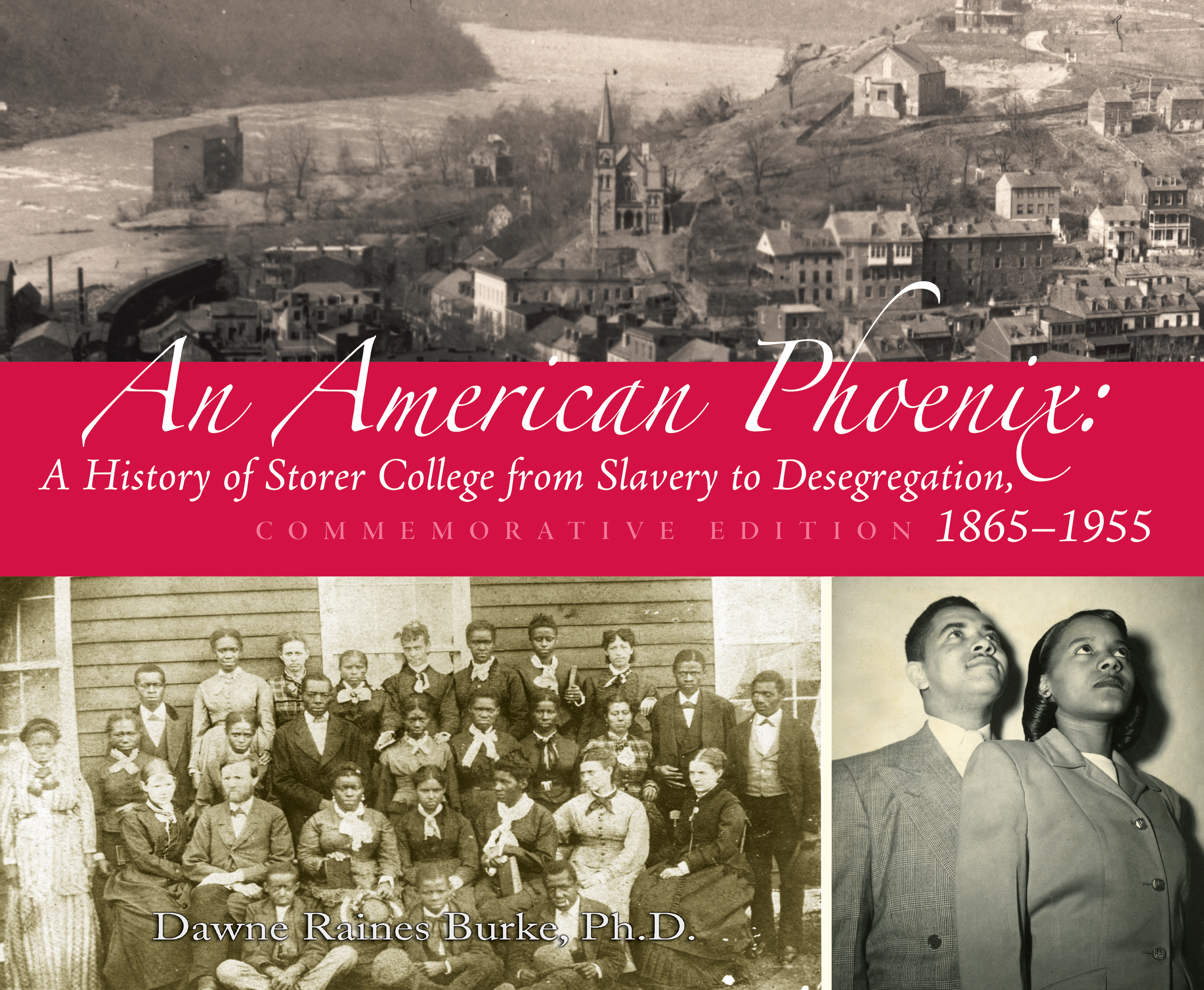
In the first book-length study of Storer College, Dawne Raines Burke tells the story of the historically black institution from its Reconstruction origins to its demise in 1955. Established by Northern Baptists in the abolitionist flashpoint of Harpers Ferry, Storer was the first college open to African Americans in West Virginia, and it played a central role in regional and national history. In addition to educating generations of students of all races, genders, and creeds, Storer served as the second meeting place (and the first on US soil) for the Niagara Movement, a precursor to the National Association for the Adavancement of Colored People.
An American Phoenix provides a comprehensive and extensively illustrated history of this historically black college, bringing to life not just the institution but many of the individuals who taught or were educated there. It fills a significant gap in our knowledge of African American history and the struggle for rights in West Virginia and the wider world.
Coming Soon.
Dawne Raines Burke is an assistant professor of education at Shepherd University in Shepherdstown, West Virginia. Burke began her investigation into the history of Storer College as part of her doctoral research at Virginia Polytechnic Institute and State University.
“Uncovers the significant role which the students of Storer College, its faculty, the Board of Trustees, and its alumni played in early education and the American civil rights movement. We all owe a great debt to Dawne Raines Burke for exploring and seeking out the story of this great institution and its impact on this country.”
James A. Tolbert Sr., President, NAACP, West Virginia
David A. Corbin
October 2015
328pp
PB 978-1-940425-79-5
$24.99
PDF 978-1-940425-80-1
$24.99
Between 1880 and 1922, the coal fields of southern West Virginia witnessed two bloody and protracted strikes, the formation of two competing unions, and the largest armed conflict in American labor history—a week-long battle between 20,000 coal miners and 5,000 state police, deputy sheriffs, and mine guards. These events resulted in an untold number of deaths, indictments of over 550 coal miners for insurrection and treason, and four declarations of martial law. Corbin argues that these violent events were collective and militant acts of aggression interconnected and conditioned by decades of oppression. His study goes a long way toward breaking down the old stereotypes of Appalachian and coal mining culture. This second edition contains a new preface and afterword by author David A. Corbin.
Coming Soon.
David A. Corbin served as a Senate staffer for twenty-six years—six years on the leadership staff of Senate majority leader Byrd and ten years on the leadership staffs of Senate majority leaders George Mitchell and Tom Daschle. He also served as Senator Byrd’s speechwriter for the last ten years of his career. Corbin is the editor of The West Virginia Mine Wars: An Anthology and the author of The Last Great Senator: Robert C. Byrd’s Encounters with Eleven U.S. Presidents. He received his PhD in history from the University of Maryland and lives in Annapolis.
“Corbin’s study offers detailed insights into the intricacies of life in both the coal camps and among the operators, with deserved attention given to a documentation of operators’ strategies of control through company towns, control of the legislature and influence in the judicial system. As such his study provides a much needed analysis both of a particular region during a crucial stage of its socio-economic transformation, and the growth of unionization as a manifestation of occupational consciousness and the struggle to assert power by a major section of the region’s labor force.”
Ian M. Taplin, Journal of Social History
“David Corbin has provided us with an original and well written history of the southern West Virginia miners, as well as reminded us of the central lessons of labor history.”
Alexander MacKenzie Thompson III, The Journal of Economic History
“This book undoubtedly stands as an important contribution to its field.”
Perry K. Blatz, Industrial and Labor Relations Review
“David Alan Corbin tells this provocative story in great detail largely from the viewpoint of miners who, he says, were ‘probably the most exploited and oppressed coal diggers in the United States.’”
James E. Fell Jr, American Historical Review
“Thus the author rejects “feuding,” “gun-totin,” and “moonshining” as well as Sheldon Hackney’s emphasis on educational deficiencies, rapid industrialization, and urbanization to explain the miners’ proclivity to violence. Instead, he emphasizes the evolution of working-class culture, increased class consciousness, the adoption of a radical ideology, and the development of class solidarity in the period following the signing of the World War I armistice.”
Gary M. Fink, Journal of American History
“Corbin’s account of these epic struggles is more than history. It is a compelling documentation of social, cultural, and religious change in a violent, laissez-faire “republic” where rights were enforced only for the rich.”
Harry M. Caudill, The Register of the Kentucky Historical Society
“Corbin has painted a bold portrait of life, labour, and rebellion in the coalfields, and presented a compelling analysis of indigenous American labour radicalism.”
Allen Seager, Labour / Le Travail
“This is an excellent work that should be in most academic and large public libraries.”
Kevin M. Rosswurm, Library Journal
“This is certainly the stuff of provocative and insightful history. Corbin’s account contributes mightily to the dawning realization that culture and class were far from mutually exclusive in industrial America.”
John Bodnar, Indiana Magazine of History
“Marked by objectivity, clarity, and scholarship, this is unquestionably one of the finest monographs ever written about the American labor movement. With a fine taste for language, an admirable mastery of his materials, and a keen insight, Corbin leads his readers through an especially frightening episode of United States domestic history.”
Andre Kuczewski, Journal of American Culture
“The coal miners of southern West Virginia have found a historian worthy of their militant traditions. David Corbin has looked behind the spectacular strikes of the 1912–22 period and the well-publicized grime of Appalachian industrialization to analyze the development of class consciousness among these coal miners. He has sifted an amazing quantity and variety of sources to recover West Virginia miners’ self-expressed views of their experiences.”
Peter Gottlieb, International Labor and Working-Class History
“This is excellent. Corbin analyzes the coal miners’ culture splendidly, focusing on the sense of regionwide solidarity produced by high levels of geographic mobility, the prominence and self-reliance of black miners, and the generation of miner-preachers as rival to the contemptible ministry of the company-sponsored churches. . . .a fine polished piece of work.”
David Montgomery, author of Beyond Equality
David A. Corbin
October 2015
384pp
PB 978-1-940425-61-0
$24.99
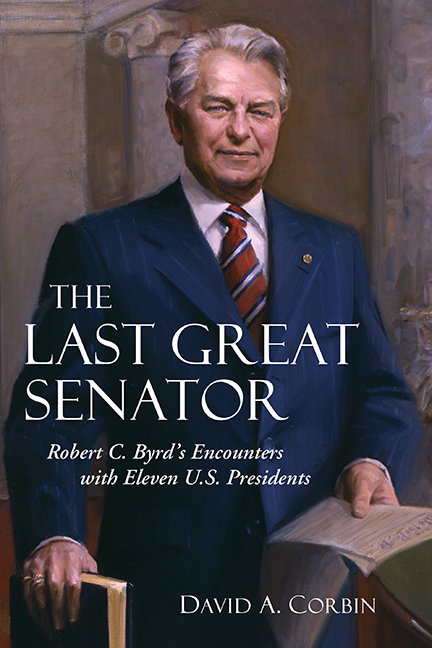
No person involved in so much history received so little attention as the late Robert C. Byrd, the longest-serving U.S. senator. In The Last Great Senator, David A. Corbin examines Byrd’s complex and fascinating relationships with eleven presidents of the United States, from Eisenhower to Obama. Furthermore, Byrd had an impact on nearly every significant event of the last half century, including the Cold War, the civil rights movement, the Vietnam War, Kennedy’s New Frontier, the Watergate scandal, the Reagan Revolution, the impeachment of President Clinton, and the Iraq War. Holding several Senate records, Byrd also cast more votes than any other U.S. senator.
In his sweeping portrait of this eloquent and persuasive man’s epic life and career, Corbin describes Senator Byrd’s humble background in the coalfields of southern West Virginia (including his brief membership in the Ku Klux Klan). He covers Byrd’s encounters and personal relationship with each president and his effect on events during their administrations. Additionally, the book discusses Byrd’s interactions with other notable senators, including Lyndon B. Johnson, Richard Russell, Mike Mansfield, and especially Robert and Edward Kennedy. Going beyond the boundaries of West Virginia and Capitol Hill, The Last Great Senator presents Byrd in a larger historical context, where he rose to the height of power in America.
Coming Soon.
David A. Corbin served as a Senate staffer for twenty-six years—six years on the leadership staff of Senate majority leader Byrd and ten years on the leadership staffs of Senate majority leaders George Mitchell and Tom Daschle. He also served as Senator Byrd’s speechwriter for the last ten years of his career. Corbin is the editor of The West Virginia Mine Wars: An Anthology and the author of Life, Work, and Rebellion in the Coal Fields: The Southern West Virginia Miners, 1880–1920. He received his PhD in history from the University of Maryland and lives in Annapolis.
“Sen. Robert C. Byrd was my predecessor as the majority leader of the U.S. Senate. When he cast his twelve thousandth vote in the Senate, I stated, ‘There are few honors greater than to be able to say that we served in the U.S. Senate with Robert Byrd.’ Now David Corbin has produced this much-needed account of Byrd’s life and career: how he embodied the Senate as an institution, how he was a powerful reminder to presidents and senators of the need to abide by the Constitution, and how he was a crucial part of American history for more than a half century. And he always remained so proud of his southern West Virginia roots. This is an important story that needed to be told, and David tells it so well.”
Sen. George Mitchell (D-ME), former Senate Majority Leader
“In my Senate leadership lecture on July 14, 1998, I discussed how Sen. Robert Byrd and I made an agreement to work together to make the Senate operate smoothly and productively. ‘It was an agreement,’ I said, that ‘we never broke, not once in the eight years we served together as Republican and Democratic leaders of the Senate.’ Determined to document Byrd’s place in American history, David Corbin has detailed Senator Byrd’s incredible career and accomplishments by focusing on his encounters with the last eleven presidents. I hope this book will become a must read for people interested not only in Senator Byrd, but the U.S. Senate and the presidency. I thank David for putting this book together about my good friend and former colleague.”
Sen. Howard Baker (R-TN), former Senate majority leader
“From his beginning as a self-described ‘rustic boob from West Virginia,’ Senator Robert C. Byrd rose to become the mighty ‘conscience of the Senate’—one of the few brave enough to oppose George W. Bush’s unnecessary Iraq invasion. I was Byrd’s first press secretary when he entered the Senate in 1959 and am the current editor of the largest newspaper in West Virginia. From these unique perspectives, I have closely observed Byrd’s career, his six decades in Congress and his rise in political statute. David Corbin does a superb job of telling this important American story.
James A. Haught, Editor, The Charleston Gazette
“Superbly written, enhanced with extensive notes, a bibliographic essay, and a comprehensive index, The Last Great Senator: Robert C. Byrd’s Encounters with Eleven U.S. Presidents is a unique and highly recommended contribution..."
The Midwest Book Review

John Antonik
August 2015
312pp
HC 978-1-940425-65-8
$34.99
For decades, hundreds of photographs chronicling some of the greatest moments in West Virginia University football history have been hidden away beneath piles of dusty media guides, tattered game programs, and yellowed newspaper clippings. Within the annals of the WVU athletic department, these archival treasures have been overlooked and forgotten over the years. That is until now.
With nearly twenty-five years of experience in intercollegiate athletics at West Virginia University, John Antonik brings these long-lost photographs to life with a narrative that highlights the key players, coaches, and the greatest moments in Mountaineer football history. Saturday Snapshots spotlights the dirt and grime, the sweat and tears, and the pageantry and tradition behind a team that has captivated the Mountain State from its inception. With stunning pictures, exclusive stories, and fascinating facts and statistics, it is the ultimate resource for the faithful West Virginia University football fan.
By spanning WVU football’s entire history—from that first game in snowy Morgantown on Saturday, November 28, 1891, to West Virginia’s appearance in the AutoZone Liberty Bowl in Memphis, Tennessee, on December 29, 2014—these snapshots will keep you turning the pages until the clock runs out.
INTRODUCTION
FROM HUMBLE BEGINNINGS
The Pre-1920s
Player of the Era: Ira Errett Rodgers
THE DOCTOR IS IN THE HOUSE
1920s
Player of the Decade: Marshall Glenn
DEPRESSING TIMES
1930s
Player of the Decade: Joe Stydahar
THE WINDS OF WAR
1940s
Player of the Decade: Jimmy Walthall
THE VIOLENT WORLD OF SAM HUFF
1950s
Player of the Decade: Bruce Bosley
THE MILL
1960s
Player of the Decade: Garrett Ford
BREAKING BARRIERS
1970s
Player of the Decade: Danny Buggs
COUNTRY ROADS, TAKE ME HOME
1980s
Player of the Decade: Major Harris
THE VOICE GOES SILENT
1990s
Player of the Decade: Canute Curtis
TWO LEGS ARE BETTER THAN ONE
2000s
Player of the Decade: Pat White
A LONG, STRANGE TRIP
Post-2000s
Player of the Decade: Tavon Austin
Top 100 Mountaineer Players of All-Time
Top 100 Opposing Players of All-Time
Sources/Credits
About the Author
John Antonik is Director of Digital Media for Intercollegiate Athletics, West Virginia University and author of West Virginia University Football Vault: The History of the Mountaineers, Roll Out the Carpet: 101 Seasons of West Virginia University Basketball, and The Backyard Brawl: Stories from One of the Weirdest, Wildest, Longest Running and Most Intense Rivalries in College Football History.

Kristin FitzPatrick
September 2015
224pp
PB 978-1-940425-72-6
$16.99
epub 978-1-940425-74-0
$16.99
The nine stories in My Pulse Is an Earthquake take place in the clutches of grief. Characters struggle to make sense of sudden losses of life, love, and community. From 1970 to the present day, children and young adults from the Rockies to the Appalachian Mountains guide readers through the valleys of their lives as dog breeders, immigrants, Catholic school delinquents, rookie policewomen, drummers, ballerinas, teenage brides, and an accountant who keeps a careful inventory of losses.
In each story, we see the darkness that can surface during the happy moments in life—weddings, births, promotions, the opening night of a director’s favorite play, or the best performance of a dancer’s career, when no one important is there to watch. We enter daydreams and night terrors where the dead are within reach, pointing out how they could have been saved. We wear their clothes and carry their teddy bears or vinyl records everywhere. We crawl around in caves and pound hammers into walls until our own hearts stop beating.
This collection explores how the unexpected harm to young, vibrant loved ones—from murder, kidnapping, battle, accident, natural disaster, swift illness, or stillbirth—can rupture families, and how the most unlikely healers can bring together those who remain.
My Pulse Is an Earthquake was performed on stage by L.A.'s longest running spoken word series, The New Short Fiction Series, an event sponsored by Barnes & Noble. The New Short Fiction Series hosted launch party on September 20, 2015 as well, which included a performance by musical guest Lucy Peru.
Queen City Playhouse 1
Canis Major 15
A New Kukla 41
White Rabbit 66
The Lost Bureau 93
Representing the Beast 118
The Music She Will Never Hear 143
Center of Population 170
The Cliffs of Dover 189
Acknowledgments 219
Reading and Discussion Questions 223
About the Author 227
Kristin FitzPatrick grew up in suburban Detroit and earned degrees from Michigan State University, DePaul University in Chicago, and California State University, Fresno. A semifinalist for the 2014 Mary McCarthy Prize in Short Fiction, Kristin is the recipient of residencies from Jentel and The Seven Hills School in Cincinnati. Her work has been chosen for the Thomas Wolfe Fiction Prize and has appeared in publications such as Colorado Review, The Southeast Review, Epiphany, and The Best of Gival Press Short Stories, as well as on stage in Sacramento and Los Angeles. Kristin and her husband live in Southern California, where she is working on a novel and teaching writing at CSU Channel Islands. Learn more at kristinfitzpatrick.com.
"In this wonderfully diverse collection Kristin Fitzpatrick demonstrates over and over how well she knows the world and how deeply she understands her fierce and reckless characters. Her vivid plots and immaculate prose carry her readers to the edge of darkness. My Pulse Is an Earthquake is a terrific debut."
Margot Livesey, author of Eva Moves the Furniture and The New York Times best seller The Flight of Gemma Hardy. She now teaches at Iowa Writers' Workshop.
"My Pulse Is an Earthquake offers some of the most beautiful prose I've read in a long time, along with some of the most memorable characters. There's magic between these covers. I loved every word, and I'll be reading every word she writes from now on."
Steve Yarbrough, author of The Realm of Last Chances
"Kristin FitzPatrick has a gift for creating wholly formed worlds—simultaneously familiar and unique—that she invites us to enter while she spins out richly layered stories quite unlike any we’ve heard before. My Pulse Is an Earthquake is a truly masterful debut collection to settle into and savor."
Stephanie G’Schwind, editor of Colorado Review
“With a mesmerizing economy of language, Kristin FitzPatrick fathoms how people either rise to or fail each other in the crucial occasions of their lives. Each finely made story contributes to the book’s cumulative emotional power, which is--miraculously--both restrained and shattering."
Elise Blackwell, author of Hunger and The Lower Quarter
“Bold and refreshingly original, this debut work of fiction is astonishing. FitzPatrick spins out intriguing and richly textured stories, and in doing so reveals the dreams and struggles of children, aspiring artists, and working-class adults. With compassion and insight, these interlinked stories help us fathom the extraordinary vividness of ordinary life.”
Laura Long, author of Out of Peel Tree
"Kristin FitzPatrick possesses an extraordinary ability to place fascinating characters into situations that reveal profound mysteries and nuances of the human condition. Long after you’ve closed the cover on her debut short story collection, you’ll find yourself longing to know what happens beyond the small precious glimpse you’ve been lucky to catch of her characters’ vibrant, astonishing worlds."
Bridget Boland, author of The Doula and owner of ModernMuse: Energetic Tools for Writers
“FitzPatrick's debut collection is a stunning and intricately woven group of short stories exploring the topic of grief. Grief takes many forms, a concept elegantly articulated in this series of chronologically arranged stories that dips in and out of several characters' lives. With nimble structuring and evocative prose, FitzPatrick's pleasingly cohesive collection offers as many artful callbacks and codas as dazzling explorations of emotional vacancy and rebirth.”
Kirkus Reviews
Philip Levy
December 2015
224pp
PB 978-1-940425-90-0
$22.99
epub 978-1-940425-91-7
$22.99
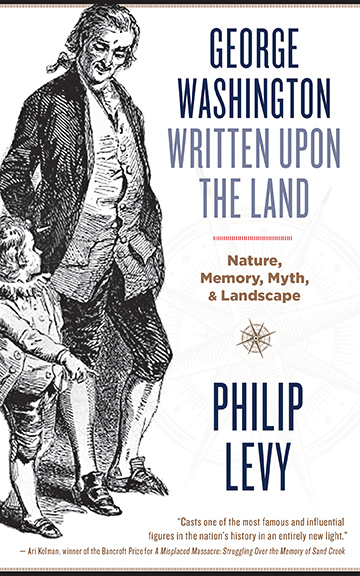
George Washington’s childhood is famously the most elusive part of his life story. For centuries biographers have struggled with a lack of period documentation and an absence of late-in-life reflection in trying to imagine Washington’s formative years. In George Washington Written upon the Land, Philip Levy explores this most famous of American childhoods through its relationship to the Virginia farm where much of it took place. Using approaches from biography, archaeology, folklore, and studies of landscape and material culture, Levy focuses on how different ideas about Washington’s childhood functioned—what sorts of lessons they sought to teach and how different epochs and writers understood the man and the past itself.
In a suggestive and far-reaching final chapter, Levy argues that Washington was present at the onset of the Anthropocene—the geologic era when human activity began to have a significant impact on world ecosystems. Interpreting Washington’s childhood farm through the lens of “big” history, he encourages scholars to break down boundaries between science and social science and between human and nonhuman.
Coming Soon.
Philip Levy is professor of history at the University of South Florida and was part of the team that discovered and excavated George Washington’s boyhood home, a project that made national news in 2008. He is the author of Where the Cherry Tree Grew: The Story of Ferry Farm, George Washington’s Boyhood Home and Fellow Travelers: Indians and Europeans Contesting the Early American Trail.
"In this beautifully written and deeply researched book, Philip Levy reveals connections that have eluded generations of scholars. Which is to say, George Washington Written upon the Land accomplishes the impossible: it casts one of the most famous and influential figures in the nation's history in an entirely new light. Readers will be delighted and surprised in equal measure by this extraordinary work."
Ari Kelman, winner of the Bancroft Prize for A Misplaced Massacre: Struggling Over the Memory of Sand Creek
"This book is a paradigm shifter for those of us involved not only with the study of American memory but for the larger subfield of cultural history."
Gretchen A. Adams, author of The Specter of Salem: Remembering the Witch Trials in Nineteenth-Century America
West Virginia University Press is pleased to announce Teaching and Learning in Higher Education, a new series edited by James M. Lang.
Teaching and Learning in Higher Education will feature compact, practical books about how to teach at the college level. Series books will be attentive to challenges and opportunities related to new technologies, and will incorporate the latest insights from the burgeoning field of cognitive science to impart perspectives on how students actually learn. Emphasizing the importance of “books written by human beings,” the series promises to provide a welcome antidote to jargon-heavy prose more typical of books about higher education. All books in the series will have a solid theoretical foundation in the learning sciences, offer practical strategies to working faculty, and provide guidance for further reading and study.
The series seeks to publish books on a number of broad topics, including teaching in flipped classroom environments, writing instruction in the digital age, large-class learning, and the role of emotions in motivating student learning.
Series Editors: James M. Lang
James M. Lang is professor of English and the Director of the Center for Teaching Excellence at Assumption College. He writes a monthly column on teaching for The Chronicle of Higher Education and is the author of several books, including Cheating Lessons: Learning from Academic Dishonesty (Harvard); On Course: A Week-by-Week Guide to Your First Semester of College Teaching (Harvard); and Life on the Tenure Track: Lessons from the First Year (Johns Hopkins). He is a member of the Fulbright Senior Specialist roster in higher education.
For more information:
Authors interested in submitting proposals for consideration should contact series editor James M. Lang at lang@assumption.edu or Derek Krissoff at West Virginia University Press at derek.krissoff@mail.wvu.edu.
Melville Davisson Post
West Virginia Classics: Volume 5
March 2015
226pp
CL 978-1-940425-40-5 $24.99
eBook 978-1-940425-42-9 $24.99
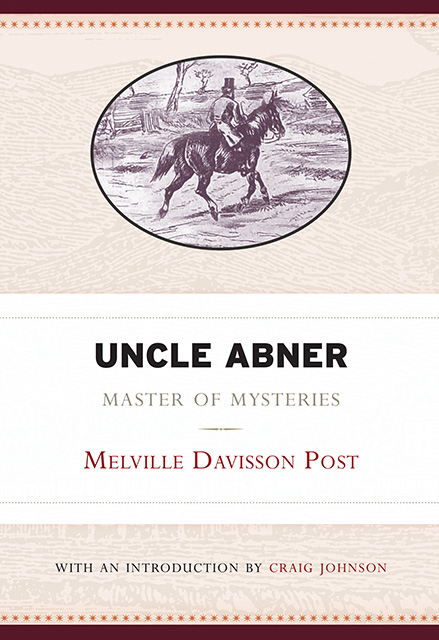
First published in 1918, Uncle Abner: Master of Mysteries is an anthology of detective stories written by Melville Davisson Post. The popular stories within this collection were serialized in national magazines such as the Saturday Evening Post in the early twentieth century.
Uncle Abner is an amateur detective in present-day Harrison County, West Virginia. Throughout his journeys around this antebellum wilderness, long before the nation had a proper police system, the honest Uncle Abner is confronted by murders and mysteries that cannot be ignored. With uncanny intuition, impressive logic, and keen observation of human actions, Uncle Abner is Melville Davisson Post’s most celebrated literary creation and is considered to be one of the most important texts in American detective and crime fiction.
This new edition contains an introduction by Craig Johnson, author of the Walt Longmire novels.
Coming Soon.
Melville Davisson Post (1869–1930) was a native of Harrison County, West Virginia. He is the author of The Strange Schemes of Randolph Mason, the Randolph Mason series, the Uncle Abner: Master of Mysteries series, the Monsieur Jonquelle series, and the Walker of the Secret Service series, as well as many articles, essays, and treatises.
Craig Johnson is the New York Times bestselling author of the Walt Longmire novels, which are the basis for Longmire, the hit Netflix original drama. The Cold Dish won Le Prix du Polar Noir; Death Without Company, the Wyoming Historical Association’s Book of the Year; and Another Man’s Moccasins, the winner of both the Western Writers of America’s Spur Award and the Mountains and Plains Book of the Year. The Dark Horse was a Publisher’s Weekly Best Book of the Year, and Hell Is Empty was selected by Library Journal as the Best Mystery of the Year, as well as being a New York Times bestseller along with the next two books in the series, As The Crow Flies and A Serpent’s Tooth. Any Other Name, the tenth Longmire novel, debuted at #6 on the New York Times list. Johnson lives in Ucross, Wyoming, population twenty-five.
Coming Soon.
Mercedes Salvador-Bello
Medieval European Studies Series
May 2015
512pp
PB 978-1-935978-51-0 $44.99
ePub 978-1-935978-52-7 $44.99
International Society of Anglo-Saxonists's 2017 Best First Book Prize winner
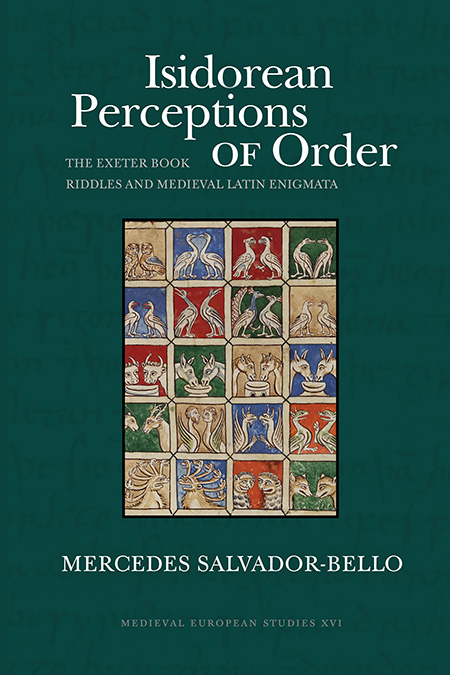
This book discusses the considerable influence exerted by Isidore’s Etymologiae on the compilation of early medieval enigmata. Either in the form of thematic clusters or pairs, Isidorean encyclopedic patterns are observed not only in major Latin riddle collections in verse but can also be detected in the two vernacular assemblages contained in the Exeter Book.
As with encyclopedias, the topic-centered arrangement of riddles was pursued by compilers as a strategy intended to optimize the didactic and instructional possibilities inherent in these texts and favor the readers’ assimilation of their contents. This book thus provides a thoroughgoing investigation of medieval riddling, with special attention to the Exeter Book Riddles, demonstrating that this genre constituted an important part of the school curriculum of the early Middle Ages.
Coming Soon.
Mercedes Salvador-Bello is associate professor of English at the Universidad de Sevilla, where she teaches, among other subjects, Anglo-Saxon literature. Her research interests include Anglo-Saxon and Insular Latin literature with a particular focus on the Exeter Book, the Old English Riddles, and Latin enigmata. She is co-editor of SELIM, Journal of the Spanish Society for the Study of English Language and Literature.
“A most substantial and authoritative contribution to the study of its subject. . . .It can be predicted to have considerable influence on work in this field in the years ahead."
Hugh Magennis, Professor Emeritus, Queen's University Belfast, English Studies
Recognition:
2016 Asociación española de estudios anglo-norteamericanos/Spanish Association of Anglo-American Studies (AEDEAN) publication award for research on English Literature
http://aedean.org/wp-content/uploads/listado-de-premios-1.pdf).
The European Society for the Study of English Book Award, short-listed
Category A, Literatures in the English Language
http://essenglish.org/shortlist-for-2016/
Edited by Kenneth O. St. Louis
West Virginia University Books: Volume 1
March 2015
384pp
PB 978-1-940425-39-9 $55.99
eBook 978-1-940425-37-5
$55.99
More than a century of research has sought to identify the causes of stuttering, describe its nature, and enhance its clinical treatment. By contrast, studies directly focused upon public and professional attitudes toward stuttering began in the 1970s. Recent work has taken this research to new levels, including the development of standard attitude measures; addressing the widely reported phenomena of teasing, bullying, and discrimination against people who stutter; and attempting to change public opinion toward stuttering to more accepting and sensitive levels.
Stuttering Meets Stereotype, Stigma, and Discrimination: An Overview of Attitude Research is the only reference work to date devoted entirely to the topic of stuttering attitudes. It features comprehensive review chapters by St. Louis, Boyle and Blood, Gabel, Langevin, and Abdalla; an annotated bibliography by Hughes; and experimental studies by other seasoned and new researchers. The book leads the reader through a maze of research efforts, emerging with a clear understanding of the important issues involved and ideas of where to go next. Importantly, the evidence base for stuttering attitude research extends beyond research in this fluency disorder to such areas as mental illness, obesity, and race. Thus, although of interest primarily to those who work, interact, or otherwise deal with stuttering, the book has potential for increasing understanding, ameliorating negative attitudes, and informing research on any of a host of other stigmatized conditions.
Coming Soon.
Kenneth O. St. Louis is a professor in the Department of Communication Sciences & Disorders at West Virginia University with 40 years of experience in teaching, treating, and researching fluency disorders. St. Louis is a cofounder of the International Fluency Association and the International Cluttering Association, with recognitions of ASHA Fellowship, the Deso Weiss Award for Excellence in cluttering, WVU’s Benedum Distinguished Scholar Award, and WVU’s Heebink Award for Outstanding Service to the State of West Virginia. In 1999, he founded the International Project on Attitudes Toward Human Attributes and has collaborated with numerous colleagues internationally on measuring public attitudes toward stuttering.
Coming Soon.
You are being redirected to The Chicago Distribution Center.
West Virginia University Press is not responsible for content on external sites.