Ecological Governance: Toward a New Social Contract with the Earth

Ecological Governance

Bruce Jennings

June 2016
256pp
PB 978-1-943665-18-1
$18.99
epub 978-1-943665-17-4
$18.99
PDF 978-1-943665-16-7 
$19.99

Summary

As our economic and natural systems continue on their collision course, Bruce Jennings asks whether we have the political capacity to avoid large-scale environmental disaster. Can liberal democracy, he wonders, respond in time to ecological challenges that require dramatic changes in the way we approach the natural world? Must a more effective governance be less democratic and more autocratic? Or can a new form of grassroots ecological democracy save us from ourselves and the false promises of material consumption run amok?

Ecological Governance is an ethicist’s reckoning with how our political culture, broadly construed, must change in response to climate change. Jennings argues that during the Anthropocene era a social contract of consumption has been forged. Under it people have given political and economic control to elites in exchange for the promise of economic growth. In a new political economy of the future, the terms of the consumptive contract cannot be met without severe ecological damage. We will need a new guiding vision and collective aim, a new social contract of ecological trusteeship and responsibility.

Contents

Introduction    

Part I: Rethinking Life, Liberty, and the Pursuit of Happiness on a Planet in Crisis           

1. The Social Contract           

2. Political Economy  

Part II: Natural Being, Cultural Becoming: Nature in Humans          

3. The Roots and Logic of Social Contract Theory   

4. The Uses of Nature and Culture: Artifice and Accommodation   

5: Re-enchanting the Social Contract  

Part III: Terms of an Ecological Contract: Humans in Nature           

6. Agency, Rules, and Relationships in an Ecological Social Contract          

7. Wealth: From Affluence to Plenitude        

8. Property: From Commodity to Commons

9. Freedom: Relational Interdependence        

10. Citizenship: From Electoral Consumer to Ecological Trustee      

Part IV: The Political Economy of Climate Change—Democracy, If We Can Keep It        

11. The Ecological Contract and Climate Change      

12. An Inquiry into the Democratic Prospect            

Conclusion      

Acknowledgments     

About the Author      

Notes

Author

Bruce Jennings is director of bioethics at the Center for Humans and Nature, adjunct associate professor of health policy at Vanderbilt University, and senior advisor and fellow at The Hastings Center. He has written widely on health, environment, and public policy issues. He is editor-in-chief of Bioethics 4th Edition (formerly the Encyclopedia of Bioethics).

Reviews

"Bruce Jennings is a world-class expert on bioethics and public policy whose work is widely read by academics in a variety of disciplines. His ambitious and remarkable new book makes a convincing case that we must adopt new moral values and ethical standards for behavior informed by an ecological worldview and predicated on our best scientific understanding of human survival on planet Earth."
Robert Nadeau, author of The Environmental Endgame: Mainstream Economics, Ecological Disaster, and Human Survival

"The grace of Jennings's prose and the relative brevity of the text make this an especially approachable and appealing contribution to environmental political theory."
Ben A. Minteer, author of Refounding Environmental Ethics: Pragmatism, Principle, and Practice

Introduction

Read the introduction to Ecological Governance.

Attachment
EmailFacebookInstagramPinterestTwitter

My Radio Radio

My Radio Radio

Jessie van Eerden

April 2016
160pp
PB 978-1-943665-08-2
$16.99
epub 978-1-943665-09-9
$16.99
PDF 978-1-943665-10-5
$16.99

Summary

The members of Dunlap Fellowship of All Things in Common share everything from their meager incomes to the only functioning toilet in the community house—everything, that is, except secrets. When Omi Ruth Wincott, the youngest member of the disintegrating common-purse community in this small Indiana town, loses her only brother, Woodrun, she withdraws from everyone and fixates on a secret desire: she wishes only for an extravagant headstone to mark Woodrun’s grave, an expense that the strict, parsimonious community can’t—or won’t—pay for.  In her loneliness, Omi Ruth’s only ties to the world remain her National Geographic magazines and a new resident in the house, Northrop, an old man caught between living and dying, maintained in a vegetative state by hospice care. 

Observing everything with the keen eye of a girl with a photographic memory, Omi Ruth finds herself learning to grieve in the company of unlikely strangers.  With the help of a homeless and pregnant Tracie Casteel, a rebellious Amish boy named Spencer Frye, and the smooth-talking Vaughn Buey who works third shift at Dunlap’s RV plant, Omi Ruth discovers that there are two things of which there is no shortage in the world’s common purse—love and loss.

Contents

Finding North

Quiet Terrors of the Body

My Radio Radio

Diving for Abalone

Home Economics

Tiny Zinnias

Today I Am Asma

Entertaining Angels

Old Souls

Dark Before It’s Dark

Requests

Signal 

Author

Jessie van Eerden holds an MFA in nonfiction from the University of Iowa. Her debut novel Glorybound won Foreword Reviews' fiction prize. Her work has appeared in The Oxford American, Bellingham Review, Best American Spiritual Writing, and other publications. She directs the low-residency MFA program at West Virginia Wesleyan College. Learn more at jessievaneerden.com.

Reviews

"There are few contemporary novels that I truly admire. Van Eerden’s novel rises to the top of my list."
Margot Singer, author of The Pale of Settlement

"A book of surprises—surprises that emanate not so much from dramatic action but as a rich consequence of the crafting of character through language.  Page after page, the reader is treated to beautifully cadenced, strikingly voiced observations and reflections that shape the poetic sensibility of the coming-of-age narrator, Omi Ruth.   The reader reads and keeps reading for the wonder of Omi Ruth’s utterances, for her quirky and tender insights."
Karen Brennan, author of little dark and Monsters

"It’s rare to fall for a voice, to want nothing more than just to listen. So I finished Jessie van Eerden’s My Radio Radio feeling something like grief, lovelorn, my heart captive to the voice of Omi Ruth, a girl who sees the world so fresh she makes it new."
Kevin Oderman, author of White Vespa and Cannot Stay: Essays on Travel

"Reading My Radio Radio is like swimming under the luminous skin of life, above us ghostly insights come and go, below us the deep unknown threatens, and then we poke through pores of enlightenment and recognize things hidden since the foundation of the world. Jessie van Eerden is a writer that makes it seem the rest of us are merely scratching the surface."
Richard Schmitt, author of The Aerialist

"My Radio Radio will tune you in from the beginning and leave you wanting more by the end. Jessie van Eerden is at her tender and lyrical best in this story of longing and belonging.  Her young narrator, Naomi Ruth, is a kissing cousin to Ellen Foster but finally in a league and family of her own. Welcome her with open arms."
Paul J. Willis, author of The Alpine Tales 

EmailFacebookInstagramPinterestTwitter

The Rope Swing

The Rope Swing

Jonathan Corcoran

April 2016
144pp
PB 978-1-943665-11-2
$16.99
epub 978-1-943665-12-9
$16.99
PDF 978-1-943665-13-6
$16.99


Summary

2017 Lambda Literary Award Finalist

A once-booming West Virginia rail town no longer has a working train. The residents left behind in this tiny hamlet look to the mountains that surround them on all sides: The outside world encroaches, and the buildings of the gilded past seem to crumble more every day. 

These are the stories of outsiders—the down and out. What happens to the young boy whose burgeoning sexuality pushes him to the edge of the forest to explore what might be love with another boy? What happens when one lost soul finally makes it to New York City, yet the reminders of his past life are omnipresent? What happens when an old woman struggles to find a purpose and reinvent herself after decades of living in the shadow of her platonic life partner? What happens to those who dare to live their lives outside of the strict confines of the town’s traditional and regimented ways? 

The characters in The Rope Swing—gay and straight alike—yearn for that which seems so close but impossibly far, the world over the jagged peaks of the mountains. 

Contents

Appalachian Swan Song

The Rope Swing

Pauly’s Girl

Through the Still Hours

Felicitations

Corporeal

Hank the King

Excavation

Brooklyn, 4 a.m.

A Touch

Author

Jonathan Corcoran received a BA in Literary Arts from Brown University and an MFA in Fiction Writing from Rutgers University-Newark. He was born and raised in a small town in West Virginia and currently resides in Brooklyn, NY. Learn more at jonathancorcoranwrites.com.

Reviews

"Jonathan Corcoran's Appalachian voice, so fierce, so tender, portrays tradition as both weapon and soothing balm. The Rope Swing takes us inside quiet revolutions of the soul in mountain towns far from Stonewall: we can never go home again, but we recognize ourselves in these linked stories of love, loss, the economic tyranny of neglect and exploitation, and the lifelong alliance between those who stay and those who leave. The Rope Swing establishes a new American writer whose unerring instincts are cause for celebration."
Jayne Anne Phillips, author of Quiet Dell, Lark and Termite, and Black Tickets

"In this debut book of interconnected stories, Corcoran writes fiercely about the lifelong effects of growing up in a small town on those who leave and those who stay. Corcoran is a remarkably empathetic writer whose subtle portraits capture undeniably tender moments in the lives of his characters. These stories are particularly poignant for anyone who grew up gay in America’s desolate places, but Corcoran speaks eloquently to all facets of the human condition."
Kirkus Reviews

"A powerful, moving, and beautifully-written book. Corcoran writes both queer and straight characters with insight and empathy. He is an observant writer who understands people’s pain, regrets, heartache, and hope. This much needed, important book explores rural America and queer identity, two subjects rarely portrayed together."
Carter Sickels, author of The Evening Hour

"The Rope Swing is an astute, stereotype-busting triumph that shines a light on gay Appalachia. Corcoran unflinchingly exposes hard truths about a complicated region and its people who grapple with identity in more ways than one."
Marie Manilla, author of Still Life with Plums and The Patron Saint of Ugly

"This rainbow of West Virginia lives – gay and straight, old and young, rich and poor – is a marvel from every angle. A stirring and absorbing meditation on rural origins and desires."
Katherine Hill, author of The Violet Hour

"These are the queer stories I have been searching for my entire life—aching and honest narratives of what it means to be both tied to a geography and excluded from it. The characters in this collection exist now in my memory as fully and significantly as people I’ve loved for years."
Megan Kruse, author of Call Me Home

EmailFacebookInstagramPinterestTwitter

Energy and Society

West Virginia University Press is pleased to announce Energy and Society, a new book series edited by Brian Black.

Unrestricted by borders, technology, or discipline, the Energy and Society book series seeks to provide a space for the unfettered expansion of the discourse on the human relationship with energy: from the processes of developing fuels to the policies governing them; from the consumers who require energy to the governments that administer and seek it; and from the very way we define the idea of energy to promising frontiers of the future. Books in the series may be organized as specific case studies; however, they will each strive to confront larger issues and concepts in the complex, ongoing relationship between energy and society.

Feeding off the development of the environmental humanities and the recognition of the Anthropocene epoch in Earth’s history, the editor and editorial board seek book-length manuscripts that cross national borders as well as boundaries of our understanding of energy in human life. These manuscripts can include more traditional histories of business, politics, policy, environment, labor, technology, diplomacy, and culture, but the series editorial team also encourages submission of work engaged with philosophy, the arts, and the social sciences. 

Series Editor: Brian Black
Brian Black is a professor in the departments of history and environmental studies at Penn State University, Altoona. He is the author of Crude Reality: Petroleum in World History and Petrolia: The Landscape of America's First Oil Boom. Black has edited a number of collections and reference works, including Climate Change: An Encyclopedia of Science and History. His book Declaring Our Dependence: The Ecology of Petroleum in Twentieth Century American Life is forthcoming from the University of Chicago Press.

Editorial Advisory Board:
Ann Greene, History and Sociology of Science, University of Pennsylvania
Amy Hessl, Geography, West Virginia University
Robert Johnson, History and Social Science, National University of San Diego
Martin Melosi, Center for Public History, University of Houston
David Nye, History, University of Southern Denmark 
Martin J. Pasqualetti, Geographical Sciences and Urban Planning, Arizona State University 
Myrna Santiago, History, St Mary’s College, California
Peter Shulman, History, Case Western Reserve
Imre Szeman, Cultural Studies and English, Film Studies, and Sociology, University of Alberta

For more information:

Authors interested in submitting proposals for consideration should contact Brian Black at bcb4@psu.edu or Derek Krissoff at derek.krissoff@mail.wvu.edu.


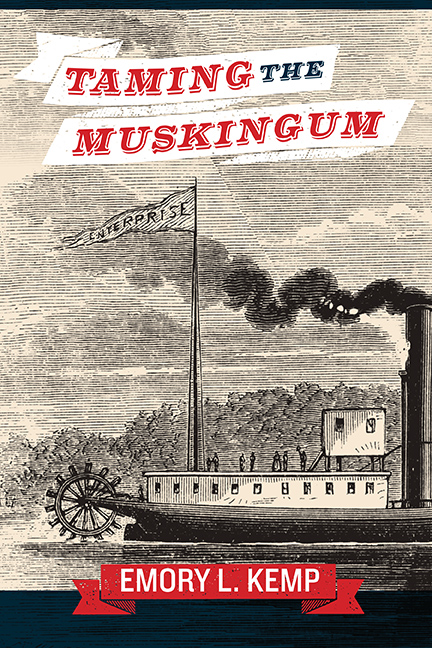
Taming the Muskingum

Taming the Muskingum

Emory L. Kemp

December 2015
208pp
PB 978-1-940425-83-2
$49.99
ePub 978-1-940425-85-6
$49.99

Summary

A tributary of the Ohio River and significant commercial route in the nineteenth century, the Muskingum River in southeastern Ohio presents a remarkable case study of how Americans have managed their waterways. In Taming the Muskingum, esteemed scholar Emory Kemp traces this history, emphasizing the engineering and construction aspects of river navigation and the fourteen related flood control dams built under the direction of the U.S. Army Corps of Engineers. Kemp’s study ranges from early settlement and navigation of the uncontrolled Muskingum to the state-of-the-art engineering projects undertaken during the New Deal to more recent conservation and recreation uses.

Illustrated with drawings, photographs, and maps showing many aspects of the dam and reservoir system as well as the Muskingum slackwater navigation, Taming the Muskingum is a rich evocation of a navigation system that is today recognized as a national Historical Civil Engineering Landmark. 

Contents

Coming Soon.

Author

Emory L. Kemp, a distinguished engineer in the American Society of Civil Engineers, has been a practicing engineer for more than half a century. He is the founder and director of the Institute for the History of Technology and Industrial Archaeology at West Virginia University, where he was also chair and a professor of civil engineering and history. He has served as president of the Public Works Historical Society and is a codirector of the Smithsonian Institution/West Virginia University Joint Project for the History of Technology. He is the author of Essays on the History of Transportation and Technology and American Bridge Patents:The First Century (1790-1890), both available from West Virginia University Press.

Reviews

Coming Soon.

EmailFacebookInstagramPinterestTwitter

An American Phoenix: A History of Storer College from Slavery to Desegregation, 1865–1955, Commemorative Edition

Dawne Raines Burke

June  2015
176pp
HCJ 978-1-940425-77-1
$29.99

Summary

In the first book-length study of Storer College, Dawne Raines Burke tells the story of the historically black institution from its Reconstruction origins to its demise in 1955. Established by Northern Baptists in the abolitionist flashpoint of Harpers Ferry, Storer was the first college open to African Americans in West Virginia, and it played a central role in regional and national history. In addition to educating generations of students of all races, genders, and creeds, Storer served as the second meeting place (and the first on US soil) for the Niagara Movement, a precursor to the National Association for the Adavancement of Colored People.

An American Phoenix provides a comprehensive and extensively illustrated history of this historically black college, bringing to life not just the institution but many of the individuals who taught or were educated there. It fills a significant gap in our knowledge of African American history and the struggle for rights in West Virginia and the wider world.

Contents

Coming Soon.

Author

Dawne Raines Burke is an assistant professor of education at Shepherd University in Shepherdstown, West Virginia. Burke began her investigation into the history of Storer College as part of her doctoral research at Virginia Polytechnic Institute and State University.

Reviews

“Uncovers the significant role which the students of Storer College, its faculty, the Board of Trustees, and its alumni played in early education and the American civil rights movement. We all owe a great debt to Dawne Raines Burke for exploring and seeking out the story of this great institution and its impact on this country.”
James A. Tolbert Sr., President, NAACP, West Virginia

EmailFacebookInstagramPinterestTwitter

Life, Work, and Rebellion in the Coal Fields: The Southern West Virginia Miners, 1880-1922, Second Edition

Life, Work, and Rebellion in the Coal Fields

David A. Corbin

October 2015
328pp
PB 978-1-940425-79-5
$24.99
PDF 978-1-940425-80-1
$24.99


Summary

Between 1880 and 1922, the coal fields of southern West Virginia witnessed two bloody and protracted strikes, the formation of two competing unions, and the largest armed conflict in American labor history—a week-long battle between 20,000 coal miners and 5,000 state police, deputy sheriffs, and mine guards. These events resulted in an untold number of deaths, indictments of over 550 coal miners for insurrection and treason, and four declarations of martial law. Corbin argues that these violent events were collective and militant acts of aggression interconnected and conditioned by decades of oppression. His study goes a long way toward breaking down the old stereotypes of Appalachian and coal mining culture. This second edition contains a new preface and afterword by author David A. Corbin.

Contents

Coming Soon.

Author

David A. Corbin served as a Senate staffer for twenty-six years—six years on the leadership staff of Senate majority leader Byrd and ten years on the leadership staffs of Senate majority leaders George Mitchell and Tom Daschle. He also served as Senator Byrd’s speechwriter for the last ten years of his career. Corbin is the editor of The West Virginia Mine Wars: An Anthology and the author of The Last Great Senator: Robert C. Byrd’s Encounters with Eleven U.S. Presidents. He received his PhD in history from the University of Maryland and lives in Annapolis.

Reviews

“Corbin’s study offers detailed insights into the intricacies of life in both the coal camps and among the operators, with deserved attention given to a documentation of operators’ strategies of control through company towns, control of the legislature and influence in the judicial system. As such his study provides a much needed analysis both of a particular region during a crucial stage of its socio-economic transformation, and the growth of unionization as a manifestation of occupational consciousness and the struggle to assert power by a major section of the region’s labor force.”
Ian M. Taplin, Journal of Social History

“David Corbin has provided us with an original and well written history of the southern West Virginia miners, as well as reminded us of the central lessons of labor history.”
Alexander MacKenzie Thompson III, The Journal of Economic History

“This book undoubtedly stands as an important contribution to its field.”
Perry K. Blatz, Industrial and Labor Relations Review

“David Alan Corbin tells this provocative story in great detail largely from the viewpoint of miners who, he says, were ‘probably the most exploited and oppressed coal diggers in the United States.’”
James E. Fell Jr, American Historical Review

“Thus the author rejects “feuding,” “gun-totin,” and “moonshining” as well as Sheldon Hackney’s emphasis on educational deficiencies, rapid industrialization, and urbanization to explain the miners’ proclivity to violence. Instead, he emphasizes the evolution of working-class culture, increased class consciousness, the adoption of a radical ideology, and the development of class solidarity in the period following the signing of the World War I armistice.”
Gary M. Fink, Journal of American History

“Corbin’s account of these epic struggles is more than history. It is a compelling documentation of social, cultural, and religious change in a violent, laissez-faire “republic” where rights were enforced only for the rich.”
Harry M. Caudill, The Register of the Kentucky Historical Society

“Corbin has painted a bold portrait of life, labour, and rebellion in the coalfields, and presented a compelling analysis of indigenous American labour radicalism.”
Allen Seager, Labour / Le Travail

“This is an excellent work that should be in most academic and large public libraries.”
Kevin M. Rosswurm, Library Journal

“This is certainly the stuff of provocative and insightful history. Corbin’s account contributes mightily to the dawning realization that culture and class were far from mutually exclusive in industrial America.”
John Bodnar, Indiana Magazine of History

“Marked by objectivity, clarity, and scholarship, this is unquestionably one of the finest monographs ever written about the American labor movement. With a fine taste for language, an admirable mastery of his materials, and a keen insight, Corbin leads his readers through an especially frightening episode of United States domestic history.”
Andre Kuczewski, Journal of American Culture

“The coal miners of southern West Virginia have found a historian worthy of their militant traditions. David Corbin has looked behind the spectacular strikes of the 1912–22 period and the well-publicized grime of Appalachian industrialization to analyze the development of class consciousness among these coal miners. He has sifted an amazing quantity and variety of sources to recover West Virginia miners’ self-expressed views of their experiences.”
Peter Gottlieb, International Labor and Working-Class History

“This is excellent. Corbin analyzes the coal miners’ culture splendidly, focusing on the sense of regionwide solidarity produced by high levels of geographic mobility, the prominence and self-reliance of black miners, and the generation of miner-preachers as rival to the contemptible ministry of the company-sponsored churches. . . .a fine polished piece of work.”
David Montgomery, author of Beyond Equality

EmailFacebookInstagramPinterestTwitter

The Last Great Senator: Robert C. Byrd’s Encounters with Eleven U.S. Presidents

The Last Great Senator

David A. Corbin

October 2015
384pp
PB 978-1-940425-61-0
$24.99

Summary

No person involved in so much history received so little attention as the late Robert C. Byrd, the longest-serving U.S. senator. In The Last Great Senator, David A. Corbin examines Byrd’s complex and fascinating relationships with eleven presidents of the United States, from Eisenhower to Obama. Furthermore, Byrd had an impact on nearly every significant event of the last half century, including the Cold War, the civil rights movement, the Vietnam War, Kennedy’s New Frontier, the Watergate scandal, the Reagan Revolution, the impeachment of President Clinton, and the Iraq War. Holding several Senate records, Byrd also cast more votes than any other U.S. senator. 

In his sweeping portrait of this eloquent and persuasive man’s epic life and career, Corbin describes Senator Byrd’s humble background in the coalfields of southern West Virginia (including his brief membership in the Ku Klux Klan). He covers Byrd’s encounters and personal relationship with each president and his effect on events during their administrations. Additionally, the book discusses Byrd’s interactions with other notable senators, including Lyndon B. Johnson, Richard Russell, Mike Mansfield, and especially Robert and Edward Kennedy. Going beyond the boundaries of West Virginia and Capitol Hill, The Last Great Senator presents Byrd in a larger historical context, where he rose to the height of power in America.

Contents

Coming Soon.

Author

David A. Corbin served as a Senate staffer for twenty-six years—six years on the leadership staff of Senate majority leader Byrd and ten years on the leadership staffs of Senate majority leaders George Mitchell and Tom Daschle. He also served as Senator Byrd’s speechwriter for the last ten years of his career. Corbin is the editor of The West Virginia Mine Wars: An Anthology and the author of Life, Work, and Rebellion in the Coal Fields: The Southern West Virginia Miners, 1880–1920. He received his PhD in history from the University of Maryland and lives in Annapolis.

Reviews

“Sen. Robert C. Byrd was my predecessor as the majority leader of the U.S. Senate. When he cast his twelve thousandth vote in the Senate, I stated, ‘There are few honors greater than to be able to say that we served in the U.S. Senate with Robert Byrd.’ Now David Corbin has produced this much-needed account of Byrd’s life and career: how he embodied the Senate as an institution, how he was a powerful reminder to presidents and senators of the need to abide by the Constitution, and how he was a crucial part of American history for more than a half century. And he always remained so proud of his southern West Virginia roots. This is an important story that needed to be told, and David tells it so well.”
Sen. George Mitchell (D-ME), former Senate Majority Leader

“In my Senate leadership lecture on July 14, 1998, I discussed how Sen. Robert Byrd and I made an agreement to work together to make the Senate operate smoothly and productively. ‘It was an agreement,’ I said, that ‘we never broke, not once in the eight years we served together as Republican and Democratic leaders of the Senate.’ Determined to document Byrd’s place in American history, David Corbin has detailed Senator Byrd’s incredible career and accomplishments by focusing on his encounters with the last eleven presidents. I hope this book will become a must read for people interested not only in Senator Byrd, but the U.S. Senate and the presidency. I thank David for putting this book together about my good friend and former colleague.”
Sen. Howard Baker (R-TN), former Senate majority leader

“From his beginning as a self-described ‘rustic boob from West Virginia,’ Senator Robert C. Byrd rose to become the mighty ‘conscience of the Senate’—one of the few brave enough to oppose George W. Bush’s unnecessary Iraq invasion. I was Byrd’s first press secretary when he entered the Senate in 1959 and am the current editor of the largest newspaper in West Virginia. From these unique perspectives, I have closely observed Byrd’s career, his six decades in Congress and his rise in political statute. David Corbin does a superb job of telling this important American story.
James A. Haught, Editor, The Charleston Gazette

“Superbly written, enhanced with extensive notes, a bibliographic essay, and a comprehensive index, The Last Great Senator: Robert C. Byrd’s Encounters with Eleven U.S. Presidents is a unique and highly recommended contribution..."
The Midwest Book Review

EmailFacebookInstagramPinterestTwitter