

Just Three Minutes, Please: Thinking Out Loud on Public Radio

Michael Blumenthal

March 2014
120pp
PB  978-1-938228-77-3
$16.99
ePub 978-1-938228-78-0
$16.99


Summary

What’s wrong with the contemporary American medical system? What does it mean when a state’s democratic presidential primary casts 40% of its votes for a felon incarcerated in another state? What’s so bad about teaching by PowerPoint? What is truly the dirtiest word in America?

These are just a few of the engaging and controversial issues that Michael Blumenthal, poet, novelist, essayist, and law professor, tackles in this collection of poignant essays commissioned by West Virginia Public Radio. 

In these brief essays, Blumenthal provides unconventional insights into our contemporary political, educational, and social systems, challenging us to look beyond the headlines to the psychological and sociological realities that underlie our conventional thinking. 

As a widely published poet and novelist, Blumenthal brings along a lawyer’s analytical ability with his literary sensibility, effortlessly facilitating a distinction between the clichés of today’s pallid political discourse and the deeper realities that lie beneath. This collection will captivate and provoke those with an interest in literature, politics, law, and the unwritten rules of our social and political engagements.

Contents

Introduction

I. ACHES AND PAINS

The Unkindest Cut of All

The Quality of Our Mercy

Sum of Its Parts

Vote With Your Feet! 

The Lame of the Earth

II. ALMOST HEAVEN

The Wild, Not-So-Wonderful Whites of West Virginia 

Tale of Two Countries

Voting, In Black and White

Foul Play!

III. COUNTRY OF THE SECOND CHANCE

Unwired

Country of the Second Chance

Immigration Nation

Some Truly Affirmative Action: A Farmer on the Supreme Court  

The Business of America

BP And Our Human Shadow

Change We Don’t Believe In

Taking Back the Saddle

Right to Bear Harms

The Dirtiest Word in America

Gay Marriage and the Pursuit of Happiness

The Sweetest Dream That Labor Knows

Heroes with a Thousand Faces

A Modest Proposal

Encore!

Lynched

IV. OF MINDS AND MINDFULNESS

A Mind of Winter

College Days, Danger Days

On-Line & On Point, But Way Off Course

None of Your Business

In Praise of Doing Nothing

Author

Michael Blumenthal is a Visiting Professor of Law and Co-Director of the Immigration Clinic at West Virginia University College of Law. A former Director of Creative Writing at Harvard University, he is the author of eight books of poetry, as well as All My Mothers and Fathers, a memoir; Weinstock Among The Dying, a novel; When History Enters the House, a collection of essays; and “Because They Needed Me”: The Incredible Struggle of Rita Miljo To Save The Baboons of South Africa, a book-length account of his work with orphaned infant chacma baboons in South Africa. His first collection of short stories, The Greatest Jewish-American Lover in Hungarian History, is forthcoming.

Reviews

 “The intellect of a scholar, the sensitivity of a poet, the objectivity of a professor of law: it hardly seems possible that so many virtues can be embodied in one book of short talks.”
C.K. Williams, American poet, critic and translator, and recipient of the Pulitzer Prize for poetry.

“Engaging, astute, and eloquent.”
Meenakshi Gigi Durham, author of The Lolita Effect and Professor and Collegiate Scholar at University of Iowa

 "David Sedaris and Ira Glass have a brother from another mother, and his name is Michael Blumenthal. His soulful NPR essays are profound thought-clouds from one of America's finest poets."
Dalton Delan is an Executive Producer of In Performance at the White House for PBS

“Michael  Blumenthal has had many professions—lawyer, psychotherapist, poet, professor, travel writer, novelist—and somehow these different  professional  perspectives blend together perfectly in his latest incarnation as a commentator for NPR. He writes with prickly piquancy and gleeful eclecticism  over a broad range of topics—but is always, in the tradition of our  best essayists, speaking from the  baseline of his own humanity.“
Ross McElwee, Professor of Visual and Environmental Studies at Harvard University

“An enjoyable and liberating read.”
Craig Manning, Independent Publisher

EmailFacebookInstagramPinterestTwitter

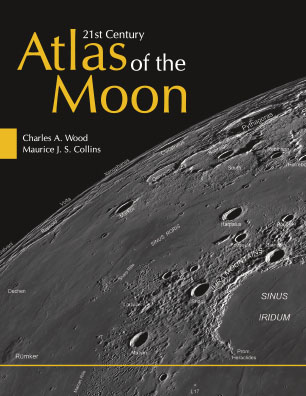
21st Century Atlas of the Moon

Charles Wood, 21st Century Atlas of the Moon

Charles A. Wood and Maurice J.S. Collins

June  2013
109pp
Spiral 978-1-938228-80-3
$33.99


Summary

On most nights and days, the Moon is visible somewhere in the sky. For many, simply noticing it is a pleasure, yet it is also a fascinating world of craters, mountains, and volcanoes worthy of a closer look.

The 21st Century Atlas of the Moon is uniquely designed for the backyard, amateur astronomer. As an indispensable guide to telescopic moon observation, it can be used at the telescope or as a desk reference. It is both accessible to the novice and valuable to the expert.

With over two hundred Lunar Reconnaissance Orbiter images, the highest quality images of the moon ever taken, this atlas illustrates the Moon in high resolution. With special maps of the limb and far side, LRO altimetry-based images of major basins and their mare ridge, and maps of the Apollo and Soviet landing sites, this guide offers a level of detail never before seen in an atlas of the Moon. The Atlas clearly provides unprecedented detail on more than one thousand named Moon features while recommending additional features and images to observe.

Contents

Coming Soon.

Author

Charles A. Wood is a planetary scientist who has worked at the Smithsonian Institution, Johnson Space Center, and the Planeary Science Institute in Tucson, AZ. He has taught and led education and research groups at the University of North Dakota, Biosphere 2 in Arizona, Haile Sellassie I University in Ethiopia, and at Wheeling Jesuit University. He is currently the chair of the Lunar Task Group of the International Astronomical Union Working Group for Planetary System Nomenclature.

Maurice J. S. Collins is a skilled amateur astronomer who enjoys exploring the moon through datasets now publicly available from spacecraft, as well as observing and imaging the moon from his backyard. He won the 2011 Murray Geddes Prize, New Zealand’s highest astronomy award.

Reviews

Coming Soon.

EmailFacebookInstagramPinterestTwitter

New Books Catalogs

Download a PDF of our Spring 2026 New Books Catalog:
Cover of catalog showing an illustration by William Henry Bartlett of the “Oxbow” on the Connecticut River, reading New Books Spring 2026, West Virginia University Press

Download a PDF of our Fall 2025 New Books Catalog:

Colorful diagram of shapes reading New Books Fall 2025, West Virginia University Press, with a gold WVU Press logo

Download a PDF of our Spring 2025 New Books Catalog:

Catalog cover reading New Books Spring 2025, West Virginia University Press, with a WVU Press logo

Download a PDF of our Fall 2024 New Books Catalog:

Geometric diagram of shapes reading New Books Fall 2024, West Virginia University Press, with a light green WVU Press logo

Download a PDF of our Spring 2024 New Books Catalog:

fish-scale tile pattern with color gradient from orange to deep read to blue, text in yellow and white reading New Books Spring 2024, West Virginia University Press, with a red WVU Press logo

Download a PDF of our Fall 2023 New Books Catalog:

dark purple arc with a lighter purple cloud inside with rainbow colors beneath, text in yellow and white with a red WVU Press logo

Download a PDF of our Spring 2023 New Books Catalog:

white and yellow text on a blue background

Download a PDF of our Fall 2022 New Books Catalog:
large footprint composed of textured dark gray rocks with smaller rocks surrounding on a green background

Download a PDF of our Spring 2022 New Books Catalog:

WVU Press Spring 22 New Books Catalog pictures of 4 hand drawn bears and punching gloves

Download a PDF of our Fall 2021 New Books Catalog:

WVU Press Fall 2021 New Books Catalog

Download a PDF of our Spring 2021 New Books Catalog:

WVU Press Spring 2021 New Books Catalog

Download a PDF of our Fall 2020 New Books Catalog:

WVU Press Fall 2020 New Books Catalog

Download a PDF of our Spring 2020 New Books Catalog:

Download a PDF of our Fall 2019 New Books Catalog:

Download a PDF of our Spring 2019 New Books Catalog:

Download a PDF of our Fall 2018 New Books Catalog:

Download a PDF of our Spring 2018 New Books Catalog:

Download a PDF of our Fall 2017 New Books Catalog:

Download a PDF of our Spring 2017 New Books Catalog:



Blog
Attachment

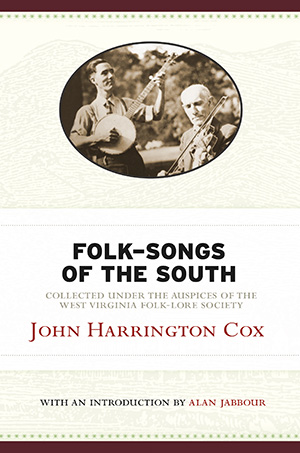
Folk-Songs of the South: Collected Under the Auspices of the West Virginia Folk-Lore Society

Folk Songs of the South

Edited by John Harrington Cox
Introduction by
Alan Jabbour
October  2013
600pp
HC/J 978-1-938228-68-1
$29.99

West Virginia Classics: Volume 4

Summary

Folk-Songs of the South: Collected Under the Auspices of the West Virginia Folk-Lore Society is a collection of ballads and folk songs from West Virginia. First published in 1925, this resource includes narrative and lyric songs that were transmitted orally, as well as popular songs from print sources. 

Through 186 ballads and songs and 26 folk tunes, this collection archives a range of styles and genres, from English and Scottish ballads to songs about the Revolutionary and Civil Wars, the opening of the American West, and boat and railroad transportation. It includes children’s play-party and dance music, songs from African American singers, and post-Civil War popular music. The original introduction by Cox contains vibrant portraits of the singers he researched, with descriptions of performance style and details about personalities and attitudes. 

With a new introduction by Alan Jabbour, this reprint renews the importance of this text as a piece of scholarship, revealing Cox’s understanding of the workings of tradition across time and place and his influence upon folk-song research.

Contents

Coming Soon.

Author

John Harrington Cox (1863-1945) was a pioneer in the field of American folk song scholarship. An academic educated at Brown and Harvard, he joined the Department of English at West Virginia University in 1903 as an expert in Old and Middle English and Medieval literature. In 1913, his interests in philology led him to begin collecting folk songs and within two years he presided over the founding of the West Virginia Folklore Society, serving as its first president, archivist, and editor. By 1925 he had published Folk-Songs of the South, the first major collection of American folk songs by an American editor, and he continued to collect folk songs for archiving, publishing Traditional Ballads Mainly From West Virginia and Folk-Songs Mainly From West Virginia in 1939. He died in Morgantown, West Virginia.

Alan Jabbour is a folklorist and folk music specialist who has undertaken extensive field and library research into the folk cultural traditions of West Virginia and the Appalachians. While at Duke University (M.A. 1966, Ph.D. 1968), he launched a project to document the older traditional fiddling of the Upland South. His work with Monroe County fiddler Henry Reed and other West Virginia fiddlers has helped make the older repertory of West Virginia fiddle tunes loom large in the contemporary instrumental folk music revival, and the Library of Congress has published a website featuring his entire Henry Reed Collection. His work with the Hammons Family in Pocahontas County has resulted in several important publications about this family’s extraordinary contributions to the reservoir of West Virginia folksong, folk music, and folklore.

Reviews

Coming Soon.

EmailFacebookInstagramPinterestTwitter

Over the Alleghenies: Early Canals and Railroads of Pennsylvania

Over the Alleghenies

Robert J. Kapsch
November 2013
376pp
134 maps & line art images
PB 978-1-933202-69-3
$39.99

Summary

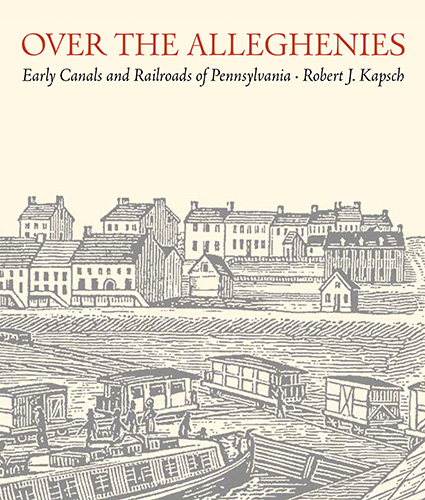
Between 1826 and 1858 the state of Pennsylvania built and operated the largest and most technologically advanced system of canals and railroads in North America – almost one thousand miles of transport that stretched from Philadelphia to Pittsburgh and beyond.

The construction of this ambitious transportation system was accompanied by great euphoria. It was widely believed that the revenue created from these canals and railroads would eliminate the need for all taxes on state citizens. Yet with the Panic of 1837, a financial crisis much like the boom and bust cycle that ended in 2008, a deep recession fell across the country. By 1858, Pennsylvania had sold all canals and railroads to private companies, often for pennies-on-the-dollar.

Over the Alleghenies: Early Canals and Railroads of Pennsylvania is the definitive history of the state of Pennsylvania’s incredible canal and railroad system. Although often condemned as a colossal failure, this construction effort remains an innovative, magnificent feat that ushered in modern transportation to Pennsylvania and the entire country. With extensive primary research, over one hundred illustrations, newspapers clippings, and charts and graphs, Over the Alleghenies examines and dissects the infrastructure project that bankrupted the wealthiest state in the Union.

Contents

1. Early America and the Coming of the Transportation Revolution

2. The State of Pennsylvania’s Program of Canals and Railroads (1826-1858)                    

3. The Eastern Division of the Pennsylvania Canal                            

4. The Western Division of the Pennsylvania Canal                         

5. The Juniata Division of the Pennsylvania Canal                           

6. The Philadelphia and Columbia Railroad                                                   

7. The Allegheny Portage Railroad                                                                            

8. The Susquehanna, West Branch, and North Branch Divisions                 

9. The Delaware Division of the Pennsylvania Canal                                               

10. Pittsburgh to Lake Erie — The French Creek Division, the Beaver Division, and the Erie Extension                                       

11. The Gettysburg Extension and the Demise of the State of Pennsylvania’s Canals and Railroads                                                          

Bibliography  

Index

About the Author

Author

Robert J. Kapsch, PhD, Hon. AIA, ASCE, holds doctorates in American studies, engineering, and architecture, as well as master’s degrees in historic preservation and management. Kapsch spent fifteen years as the Chief of Historic American Buildings Survey/Historic American Engineering Record, the U.S. government’s premier documentation program, and has served as project engineer for numerous historic restoration and rehabilitation projects along the Chesapeake and Ohio Canal and other parks.

Following this successful career as an historic architect and engineer for the National Park Service, Kapsch began a second career as an author, penning several books and articles on historic architecture and engineering, including The Potomac Canal: George Washington and the Waterway West, Historic Canals and Waterways of South Carolina, and CANALS, the Norton/Library of Congress Visual Sourcebook in Architecture, Design and Engineering

Reviews

Over the Alleghenies: Early Canals and Railroads in Pennsylvania is an insightful book about one of Pennsylvania’s greatest public works efforts. Kapsch weaves together the era’s politics, engineering, financing, and boosterism to reveal the history of nineteenth-century transportation in Pennsylvania. Over the Alleghenies is extremely well researched, crisply written, and richly illustrated, and fits nicely into Kapsch’s “ever-growing” body of work on transportation systems.”

Sam Tamburro, Historian, Chesapeake & Ohio Canal National Historical Park

“Robert Kapsch has done it again, with yet another fine book describing and explaining America’s nineteenth century transportation systems. Over the Alleghenies: The Early Canals and Railroads of Pennsylvania is a lavishly illustrated, thoroughly researched, and clearly written essay that tells the complex story of Pennsylvania’s publically-funded response to New York’s Erie Canal. Ultimately deemed a failure, this complex interaction of technology, finance and politics is elegantly explicated by Engineer and Historian Robert Kapsch in a style we have grown to expect.”

Patrick Martin, Professor of Archaeology and Department Chair, Department of Social Sciences, Michigan Technological University

"Robert Kapsch’s achievement cannot be overestimated. He has succeeded where others have failed in creating one of the most imported manuscripts on early American Transportation systems. Over the Alleghenies is a monument to Kapsch’s wide knowledge of early American engineering and his study of the particular ways in which Pennsylvania applied and expanded both civil and mechanical engineering knowledge to create a functioning transportation system."

Lance E. Metz, Emeritus Historian, National Canal Museum
EmailFacebookInstagramPinterestTwitter

Aspiring to Greatness: West Virginia University Since World War II

Aspiring to Greatness

Ronald L. Lewis
Foreword by Charles Vest

September 2013
600pp
HC/J 978-1-938228-42-1
$19.99
ePub 978-1-938228-40-7
$19.99
PDF 978-1-938228-41-4
$19.99

Summary

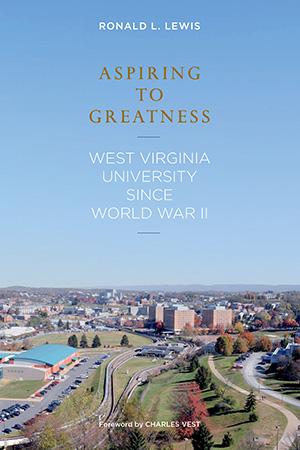
Aspiring to Greatness: West Virginia University since World War II chronicles the emergence of WVU as a major land-grant institution. As a continuation of the work of Doherty and Summers in West Virginia University: Symbol of Unity in a Sectionalized State, this book focuses on the modern historical developments that elevated WVU from a small regional institution to one of national prominence.

West Virginia University’s growth mirrors the developmental eras that have shaped American higher education since World War II. The University’s history as an innovative, pioneering force within higher education is explored through its major postwar stages of expansion, diversification, and commercialization.

Institutions of higher education nationwide experienced a dramatic increase in enrollments between 1945 and 1975 as millions of returning World War II and Korean War veterans took advantage of the GI Bill of Rights. Their children, the “baby boom” generation, continued to supply the growth in college enrollment and the corresponding increase in institutional complexity until the mid-1970s. During this period WVU followed the national trend by growing from a few thousand students to nearly fifteen thousand.

From 1975 to the early 1990s, expansion gave way to diversification. The traditional student population stopped growing by 1975, and  “boomers” were replaced by students from nontraditional backgrounds. An unprecedented gender, racial, and ethnic diversification took place on college campuses, a trend encouraged by federal civil rights legislation. To a lesser degree WVU was no exception, although its location in a rural state with a small minority population forced the University to work harder to attract minorities than institutions in proximity to urban areas.

The commercialization of higher education became a full-fledged movement by the 1990s. Major changes, such as globalization, demographic shifts, a weak economy, and the triumph of the “market society,” all accelerated the penetration of business values and practices into university life.  Like other public universities, WVU was called upon to generate more of its own revenues. The University’s strategic responses to these pressures reconstructed the state’s leading land grant into the large complex institution of today.

As the only modern history of West Virginia University, this text reaches into the archives of the President’s Office and makes exhaustive use of press accounts and interviews with key individuals to produce a detailed resource for alumni, friends, and supporters of WVU, as well as administrators and specialists in higher education. 

Contents

Coming Soon.

Author

Ronald L. Lewis received the BA degree from Ohio University in 1966, and from the University of Akron earned the MA (1971) and PhD (1974) in American history. He taught at the University of Delaware for eleven years (1974-1985) prior to becoming professor of history at West Virginia University in 1985. At WVU he offered undergraduate and graduate courses in American labor, West Virginia, and Appalachian history. He served as department chair for six years (1989-1995), was appointed Eberly Family Professor of History (1993-2001), and then Stuart and Joyce Robbins Chair in History (2001-2008), a position he held until his retirement in 2008. He is currently professor emeritus and Historian Laureate of West Virginia. His publishing career includes numerous journal articles, book chapters, and essays, along with fourteen co-edited books that include Transnational West Virginia: Ethnic Communities and Economic Change, 1840-1940 (WVU Press, 2002). In addition to Aspiring to Greatness, he is the author of: Coal, Iron, and Slaves: Industrial Slavery in Maryland and Virginia, 1715-1865 (1979); Black Coal Miners in America: Race, Class, and Community Conflict, 1780-1980 (1987); Transforming the Appalachian Countryside: Railroads, Deforestation, and Social Change in West Virginia, 1880-1920 (1998); and most recently Welsh Americans: A History of Assimilation in the Coalfields (2008).

Charles Vest, President Emeritus and Professor of Mechanical Engineering at the Massachusetts Institute of Technology, was a native of Morgantown, West Virginia. Dr. Vest earned a B.S. in mechanical engineering from West Virginia University in 1963, and M.S.E. and PhD degrees in mechanical engineering from the University of Michigan in 1964 and 1967, respectively. He served on the boards of several non-profit organizations and foundations devoted to education, science, and technology, including the West Virginia University Board of Governors. He authored a book on holographic interferometry, and two books on higher education. He received honorary doctoral degrees from seventeen universities. He was awarded the 2006 National Medal of Technology by President Bush and received the 2011 Vannevar Bush Award from the National Science Board. 

Reviews

Coming Soon.

EmailFacebookInstagramPinterestTwitter

West Virginia University: Symbol of Unity in a Sectionalized State

West Virginia University

William T. Doherty, Jr. and Festus P. Summers

Introduction by
Charles C. Wise Jr.

September 2013
404pp
HC/J 978-1-938228-37-7
$19.99
PDF 978-1-938228-39-1
$19.99

Summary

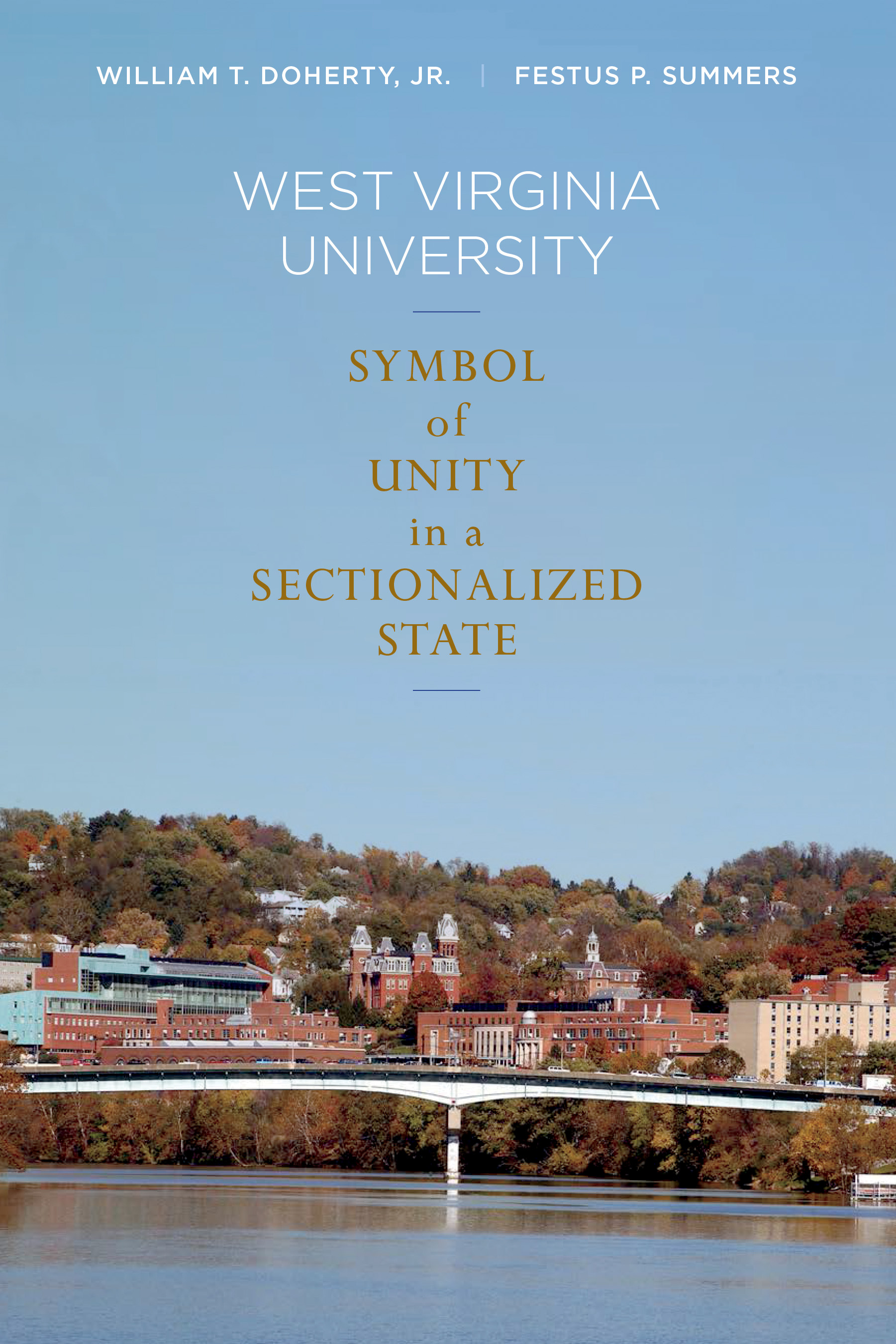
First published in 1982, West Virginia University: Symbol of Unity in a Sectionalize State details the history of WVU from its inception as the Agricultural College of West Virginia in 1867 to its expansion and development in the 1980s. This comprehensive history includes an index of people, places and events; photographs and illustrations; and in-depth descriptions of campuses, buildings, colleges, and academic and sports programs. As a joint effort between William T Doherty, Jr., a Professor Emeritus History at WVU, and Festus P. Summers, the first University Historian who passed away before this project was complete, this new edition once again grants access to the diverse and complex elements which shaped the institution. 

Contents

Coming Soon

Author

William T. Doherty, Jr., is Professor of History Emeritus at West Virginia University where he also served as University Historian. He is author of Louis Houck: Missouri Historian and Entrepreneur; Berkeley County, U.S.A.: A Bicentennial History of a Virginia and West Virginia County, 1772-1972; and was editor of the journal West Virginia History. Doherty, who received his doctoral degree in history from the University of Missouri, was chair of the WVU Department of History from 1963-1979.  He retired in 1988.

Festus P. Summers, who died in 1971 at the age of 76, began the work in this first comprehensive history of West Virginia University where he was the first University Historian and chair of the Department of History from 1946-1962.  He was the author of biographies of Johnson N. Camden and William L. Wilson, The Baltimore and Ohio in the Civil War: A Borderland Confederate, co-author of West Virginia: The Mountain State, co-editor of The Thirty-Fifth State, and editor of The Cabinet Diary of William L. Wilson, 1896-1897

Reviews

Coming Soon.

EmailFacebookInstagramPinterestTwitter

Listening to the Land: Stories from the Cacapon and Lost River Valley

Listening to the Land

Jamie S. Ross
Photographs by Tom Cogill
Introduction by Peter Forbes

October 2013
224pp
PB 978-1-935978-40-4
$25.99


Summary

The Cacapon and Lost River is located in the Appalachian Mountains of West Virginia’s eastern panhandle. Well loved by paddlers and anglers, this American Heritage River is surrounded by a lush valley of wildlife and flora that is part of the Chesapeake Bay watershed.

Although this area is still rural and mostly forested, development and land fragmentation in the Cacapon and Lost River Valley have increased over the last decades. Listening to the Land: Stories from the Cacapon and Lost River Valley is a conversation between the people of this Valley and their land, chronicling this community’s dedication to preserving its farms, forests, and rural heritage.

United around a shared passion for stewardship, the Cacapon and Lost Rivers Land Trust and local landowners have permanently protected over 11,000 acres by incorporating local values into permanent conservation action. Despite the economic pressures that have devastated nearby valleys over the past twenty years, natives and newcomers alike have worked to protect this valley by sustaining family homesteads and buying surrounding parcels.

This partnership between the Land Trust and the people of this Valley, unprecedented in West Virginia and nationally recognized for its success, greatly enriches historic preservation and conservation movements and brings to light the need to investigate, pursue, and listen to the enduring connection between people and place.

Contents

Coming Soon

Author

Project Director and Writer Jamie S. Ross, has worked for over thirty years writing, directing, and producing documentary work on American history and culture. Most recently she was producer and co-writer of the acclaimed four-part PBS environmental history series, A History of Mountains and People, (www.appalachiafilm.org) , selected as the Best Video of the Year by the American Library Association. For her work on the series, Ross received the Mountain Hero award from the Mountain Institute. She has been named a National Scholar by the Council on Basic Education and has served as a Fellow at the Virginia Foundation for the Humanities. Ross is also director of Red Dirt Productions, and along with Red Dirt Productions, is currently at work on a documentary that will explore the history of the South as told through the foods of the Southern table.

Tom Cogill is a freelance photographer, born in Hollywood, California, and for the past thirty-five years has been a resident of Charlottesville, Virginia. He photographs mostly non-famous people for magazines, university publications, and annual reports. His work has appeared in US News & World Report, American Heritage, National Geographic, NG Traveler, Science, Nature, the Chronicle of Higher Education and other publications. For the past 10 years he has worked increasingly in documenting the work of individuals and foundations doing social projects in Latin America. See www.tomcogill.com.

Peter Forbes is the founder of the Center for Whole Communities, a writer and farmer, facilitator and speaker, and lives in Vermont and works across the country. His story is told at www.peterforbes.org. When not farming with his family in the Mad River Valley of Vermont, Peter travels the country helping communities, organizations, and citizen leaders be their wisest selves.

Nancy Ailes is the Executive Director or the Cacapon & Lost Rivers Land Trust. She represents the eighth generation of her family that has lived in Hampshire County, West Virginia. Having had varied career opportunities and accomplishments, Nancy is most proud of her work permanently protecting land in the Cacapon & Lost River Valley.

Rodney Bartgis is State Director of The Nature Conservancy in West Virginia. He is a native of Berkeley County, has a biology degree from Shepherd University and a Master of Science degree from West Virginia University. He currently lives in Randolph County.

Reviews

"When I owned property in the Lost River Valley, where my life’s work was inspired, I admired the principles and values of the landowners. I also realized that if the special beauty of this place was to be conserved, it would only happen if this was what the local people wanted. As you read the history of these individuals, you will understand how the Cacapon River Watershed became what it is today.  This precious resource could not have been placed in more loving and caring hands.  These hardworking people have passed along a national treasure so unique and important to future generations and the environmental health of the entire Chesapeake Bay Watershed, that we cannot ignore its presence. By more fully understanding their love of this community and the land, we can join with them in their quest to preserve the natural habitat and their heritage.  Together we have the rare opportunity to protect one of the most biodiverse, and one of the last remaining intact watersheds in the entire Chesapeake Bay drainage."

Patrick Noonan, Founder, American Farmland Trust and The Conservation Fund

"After years of building relationships with communities throughout the nation, the Land Trust Alliance has discovered something truly essential to land conservation – people love to hear stories about their land.  The Cacapon and Lost Rivers Land Trust truly celebrates these connections in Cacapon Voices  through the stories of people who love a place so much that they put its protection ahead of their own needs. These stories give me hope for the future of land conservation because these are stories about the why of saving land, not just the how."

Rand Wentworth, President, Land Trust Alliance

EmailFacebookInstagramPinterestTwitter

Central Appalachian Natural History

Stretching from central Pennsylvania to southern Virginia, Central Appalachia’s linear ridges, valleys, and dissected plateaus produce a globally significant biodiversity and fascinating adaptations of the region’s plants and animals to their surroundings and to each other. The Central Appalachian Natural History series investigates the region in depth—the development of these natural processes and the myriad details of the resulting flora and fauna, geology, woodlands, and wetlands.

Please send brief book proposals and/or project overviews to:

George Constantz
Series Editor, Central Appalachian Natural History
Rte 1, Box 328
High View, WV   26808

Central Appalachian Natural History Series: Volume 1