


Victorian Poetry: Volume 58, Issues 1-4

Victorian Poetry: Volume 58, Issues 1–4
Editor: John B. Lamb, West Virginia University
E-ISSN: 1530-7190
Print ISSN: 0042-5206
Click on listed price to corresponding product to order:
Institution (US): $140.00
Individual (US): $65.00
Institution (Outside US, including Canada): $165.00
Individual (Outside US, including Canada): $90.00
Victorian Poetry: Volume 59, Issues 1-4
Victorian Poetry: Volume 59, Issues 1–4
Editor: John B. Lamb, West Virginia University
E-ISSN: 1530-7190
Print ISSN: 0042-5206
Click on listed price to corresponding product to order:
Institution (US): $140.00
Individual (US): $65.00
Institution (Outside US, including Canada): $165.00
Individual (Outside US, including Canada): $90.00
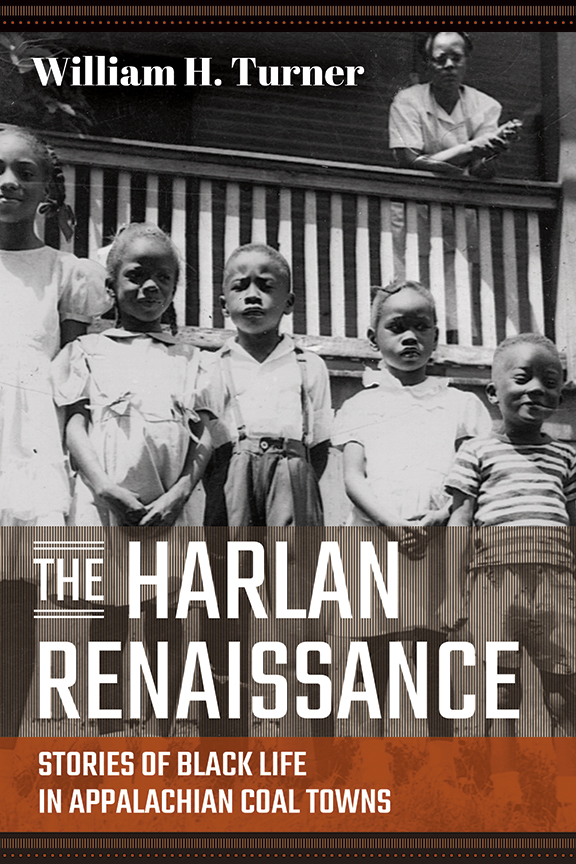
The Harlan Renaissance: Stories of Black Life in Appalachian Coal Towns

William H. Turner
October 2021
352pp
PB 978-1-952271-21-2
$26.99
CL 978-1-952271-20-5
Out of print
eBook 978-1-952271-22-9
$26.99
The Harlan Renaissance
Stories of Black Life in Appalachian Coal Towns
Summary
Weatherford Award Winner, Nonfiction
The Harlan Renaissance is an intimate remembrance of kinship and community in eastern Kentucky’s coal towns written by one of the luminaries of Appalachian studies, William Turner. Turner reconstructs Black life in the company towns in and around Harlan County during coal’s final postwar boom years, which built toward an enduring bust as the children of Black miners, like the author, left the region in search of better opportunities.
The Harlan Renaissance invites readers into what might be an unfamiliar Appalachia: one studded by large and vibrant Black communities, where families took the pulse of the nation through magazines like Jet and Ebony and through the news that traveled within Black churches, schools, and restaurants. Difficult choices for the future were made as parents considered the unpredictable nature of Appalachia’s economic realities alongside the unpredictable nature of a national movement toward civil rights.
Unfolding through layers of sociological insight and oral history, The Harlan Renaissance centers the sympathetic perspectives and critical eye of a master narrator of Black life.
Contents
Foreword by Loyal Jones
Acknowledgments
Introduction
1. Alex Haley—The Taproot
2. Between Alex Haley, W. E. B. Du Bois, Ed Cabbell, and the Affrilachian Poets
3. Black Mountain Mantrips and Woman Trips
4. What’s in a Name?
5. Black Folk Done Lost Their Stuff
6. The Common Narrative of Black Appalachian Coal-Camp Families
7. Blacks Moving between Central Alabama and Central Appalachia
8. Close-Knit Central Appalachian Coal-Camp Black Communities
9. On Trash-Talking and Signifying along Looney Creek
10. In a Coal Mine, Everybody Is Black; Outside, Not So Much
11. School Integration Was Worse than a Kick in the Head by an Alabama Mule
12. The Principal of the White School Became a Lifelong Friend
13. Not Bad for Some Colored Kids from Harlan County, Kentucky
14. King Coal Leaves the Throne
15. The Graying of the Eastern Kentucky Social Club
16. Meditating on the Future at the Mountaintop
Notes
Index
Author
William H. Turner is a sociologist now based near Houston, Texas. He received a lifetime of service award from the Appalachian Studies Association in 2009, which joined other career highlights that include induction into the Kentucky Civil Rights Hall of Fame.
Reviews
“A warm and insightful memoir of Black life in Appalachia’s coal camps that offers a bounty of correctives to the persistent myth that all mountain people are white and all poverty is self-made.”
Elizabeth Catte, author of What You Are Getting Wrong About Appalachia and Pure America: Eugenics and the Making of Modern Virginia
“Heartfelt portraits that are original, compelling, revelatory, and deeply human.”
David Ritz, author of Respect: The Life of Aretha Franklin
“One of the oldest and most enduring myths about the Appalachian Mountains is that they are now and always have been overwhelmingly populated by white Scots-Irish. Dr. William H. Turner has written a new book, The Harlan Renaissance: Stories of Black Life in Appalachian Coal Towns, that kills that myth about whiteness and, for good measure, buries several more myths as well.”
Daily Yonder
“It’s a book only Turner could write, and without it, this slice of American culture would be lost forever.”
Berea College Magazine
Perfect Dirt: And Other Things I've Gotten Wrong

Keegan Lester
November 2021
272pp
PB 978-1-952271-29-8
$23.99
eBook 978-1-952271-30-4
$23.99
Perfect Dirt
And Other Things I've Gotten Wrong
Summary
Words have meaning and meaning evolves over time. In Perfect Dirt, Keegan Lester drags us through his failure to grasp the meaning that always seems to be just beyond his fingertips. These lyrical vignettes depict a lifelong search for home, identity, and the language to say the things we wish we could tell people in the moment.
Born in Southern California to parents who had migrated from West Virginia and South Florida, Lester spent summers with his grandparents in Morgantown, which instilled a deep anchor of place that continued to call to him, an Appalachian at heart even while living in New York City as a poet. As small successes started to come his way—a book and numerous tours—so did crises. Lester’s father, meanwhile, experiencing his own life crisis, embarked on a journey to sail the Caribbean. Both end up lost.
Part memoir, part tour diary, part homage to the places and people who have made him who he is, Perfect Dirt digs into the sometimes painful, sometimes jubilant questions of identity and success. This is a book searching to better understand the world and our place in it, the family we’re born into, and the family we make along the way.
Contents
part one
for all my strangers
welch
a snapshot
cardinals staining the air we breathe
shane rooney
the way in which wind moves
part two
tour diary: huntington, west virginia
peaches
a year later, in philly
on writing a book
political poem
train gravity
part three
tour diary: alabama
grandma
christmas is a big deal in my family
a few weeks before thanksgiving my dad says
ernest
my flatbush friends
west virginia day
part four
tour diary: day off in morgantown
my grandpa rice
tour diary: charleston show
sometimes my sister is too good at giving christmas presents
tour diary: lewisburg
tour diary in the south: putting more heart in our heartbreak
there were also readings
graduation
part five
the doldrums
when my father got lost at sea i start doing things i normally don’t do
ain’t, ain’t a word
another thing i wonder about while my father is lost at sea
not long ago, i’d gone to a class in west virginia
my mother is speaking in a voice, but it’s not my mother’s voice
i don’t think he knows how to use his phone
one day while i was on tour, my friend bryan, who’s super into ghost stories, the occult, metal music, and zines, says
father’s day
home
acknowledgments
Author
Keegan Lester is the author of this shouldn’t be beautiful but it was and it was all i had so i drew it, selected by Mary Ruefle for the 2016 Slope Editions Book Prize. His writing has been published in Ploughshares, the Boston Review, Cutbank, Hobart, and Vol. 1 Brooklyn, among others. He lives in New York City.
Reviews
“In Perfect Dirt, tenderness is so tangible, so electric. You feel it when a grandpa hoists a young Keegan Lester up so he can feed wild horses sugar cubes, you hear it when a grandma speaks thunder, it embraces you each time Lester holds close the good people of West Virginia. But this tenderness is also thorny: it sparks in the quiet togetherness of men, it leaps around a father lost at sea, it underscores loss and regret. Keegan Lester is an immensely gifted writer. This book will stay with you.”
Eduardo C. Corral, author of Guillotine
“Keegan Lester’s writing and storytelling about West Virginia and its people feel how West Virginia’s landscape feels to me—like I’m being hugged and protected. Perfect Dirt reminds us that we can love a place and still be critical when it’s done out of love and tenderness. This book has brought me back home in the best ways, with a newer, more open heart, mind, and body.”
Steven Dunn, author of water & power
“Places are fleshed out alongside people, with West Virginia being the book’s star. . . . In breathtaking, nuanced prose, Lester tackles the human experience. . . . Powerful and insightful.”
Foreword Reviews
“Reading Perfect Dirt is like a long, beautiful conversation with a stranger you just met at a backyard barbeque. . . . There’s an effervescence of beautiful sentences in this book, an optimism that tugboats you from one scene to the next. . . . His longings remind me of Breece D’J Pancake.”
Adroit Journal
Slow Fuse of the Possible: A Memoir of Poetry and Psychoanalysis

Kate Daniels
January 2022
216pp
PB 978-1-952271-38-0
$21.99
eBook 978-1-952271-39-7
$21.99
Slow Fuse of the Possible
A Memoir of Poetry and Psychoanalysis
Summary
Slow Fuse of the Possible is a poet’s narrative of a troubled psychoanalysis. It is also a commanding meditation on the powers of language, for good and for ill.
From the beginning of their time together, it is clear that the enigmatic analyst and Daniels are not a good match, yet both are determined to continue their work—the former in nearly complete silence, and the latter as best she can with the tools at her disposal: careful attention to language, deep reading, and literary imagination. Throughout, the story is filtered through the mind of Emily Dickinson, whose poetry Daniels uses as a fulcrum for the interpretation of her own experience. The book is saturated with Dickinson’s verse, and Dickinson is an increasingly haunting presence as crises emerge and the author unravels.
This compelling lyric memoir, so richly steeped in all facets of language and the literary, allows readers a glimpse into the mind of a renowned poet, revealing the dazzling and anguished connections between poetry and psychoanalysis.
Contents
Preface
Chapter 1
Chapter 2
Chapter 3
Chapter 4
Chapter 5
Chapter 6
Chapter 7
Chapter 8
Chapter 9
Chapter 10
Chapter 11
Chapter 12
Chapter 13
Chapter 14
Chapter 15
Chapter 16
Chapter 17
Chapter 18
Chapter 19
Chapter 20
Chapter 21
Chapter 22
Chapter 23
Chapter 24
Chapter 25
Chapter 26
Afterward and Acknowledgments
Notes
Permissions
Author
Kate Daniels is the author of six poetry collections, including In the Months of My Son’s Recovery. A former Guggenheim Fellow, she is the Edwin Mims Professor of English at Vanderbilt University. She teaches writing at the Washington-Baltimore Center for Psychoanalysis and is a former poet in residence at Duke Medical and Vanderbilt Medical.
Reviews
“Daniels is a keen observer of visceral moments and powerful emotions.”
Kirkus Reviews
“Kate Daniels has transformed a painfully failed analysis into an unlikely, original, and successful book, a compellingly personal and brave study of poetry and psychoanalysis, her interrelated passions, which she treats with a mixture of wry poignance and deep devotion. Slow Fuse is a book of burning soulfulness.”
Edward Hirsch, author of 100 Poems to Break Your Heart
“A searching, scorching account of psyche, psychoanalysis, and life. Through Kate Daniels we appreciate the gift of poetic creation in the midst of destructive moments.”
Michael Eigen, author of The Challenge of Being Human, The Sensitive Self, and Contact with the Depths
“Her continual emphasis on language is no accident: she shows the ways in which the processes of analysis and writing mirror and inform each other, delving as they do into what’s figurative and metaphorical. Slow Fuse of the Possible is a compelling memoir about tense and turbulent experiences within an analysis relationship.”
Foreword Reviews
“It is a fascinating book—amazing in its candor and its ability to capture the flow of free association, like pinning down an ocean wave. Certainly, it offers a new way to think about poetry.”
Chapter 16
“Beautiful and harrowing. . . . A compulsively readable, brave document that allows the reader to enter into Daniels’s world of words in a way that is moving and enriching.”
Emily Dickinson International Society Bulletin
On Dark and Bloody Ground: An Oral History of the West Virginia Mine Wars
Anne T. Lawrence
with a foreword by
Catherine Venable Moore
August 2021
176pp
PB 978-1-952271-09-0
$22.99
CL 978-1-952271-08-3
$99.99
eBook 978-1-952271-10-6
$22.99
On Dark and Bloody Ground
An Oral History of the West Virginia Mine Wars
Summary
In 1972 Anne Lawrence came to West Virginia at the invitation of the Miners for Democracy movement to conduct interviews with participants in, and observers of, the Battle of Blair Mountain and other Appalachian mine wars of the 1920s and ’30s. The set of oral histories she collected—the only document of its kind—circulated for many years as an informal typescript volume, acquiring an almost legendary status among those intrigued by the subject. Key selections from it appear here for the first time as a published book, supplemented with introductory material, maps, and photographs. The volume’s vivid, conversational mode invites readers into miners’ lived experiences and helps us understand why they took up arms to fight anti-union forces in some of the nation’s largest labor uprisings.
Published to coincide with the celebration of the Blair Mountain centennial in 2021, On Dark and Bloody Ground includes a preface by public historian Catherine Venable Moore and an afterword by Cecil E. Roberts of the United Mine Workers of America.
Contents
Foreword by Catherine Venable Moore
Acknowledgments
Introduction
Notes on the Text
The Interviews
Afterword by Cecil E. Roberts
Selected Educational Resources
Index
Author
Anne T. Lawrence is professor of management emerita at San José State University. She currently serves as chair of the Case Research Foundation, a nonprofit organization that provides fellowships to early-career scholars for training in case research and teaching.
Catherine Venable Moore is a nationally published nonfiction writer and cofounder of several public history projects, including the West Virginia Mine Wars Museum. She is currently at work on a book about the mine wars.
Reviews
“The publication of On Dark and Bloody Ground is a tremendous addition to the literature on the West Virginia Mine Wars and is long overdue. It is a pleasure to read, and it captures the voices of the coalfields in a way that is unlike any of the other accounts.”
Lou Martin, Chatham University
“When I read this book, I was blown away. . . . It is so important to keep our history alive and that is what this book does.”
From the afterword by Cecil E. Roberts, president, United Mine Workers of America International
Rock Climbing in Kentucky's Red River Gorge: An Oral History of Community, Resources, and Tourism
James N. Maples
September 2021
248pp
PB 978-1-952271-15-1
$26.99
CL 978-1-952271-14-4
$99.99
eBook 978-1-952271-16-8
$26.99
Rock Climbing in Kentucky's Red River Gorge
An Oral History of Community, Resources, and Tourism
Summary
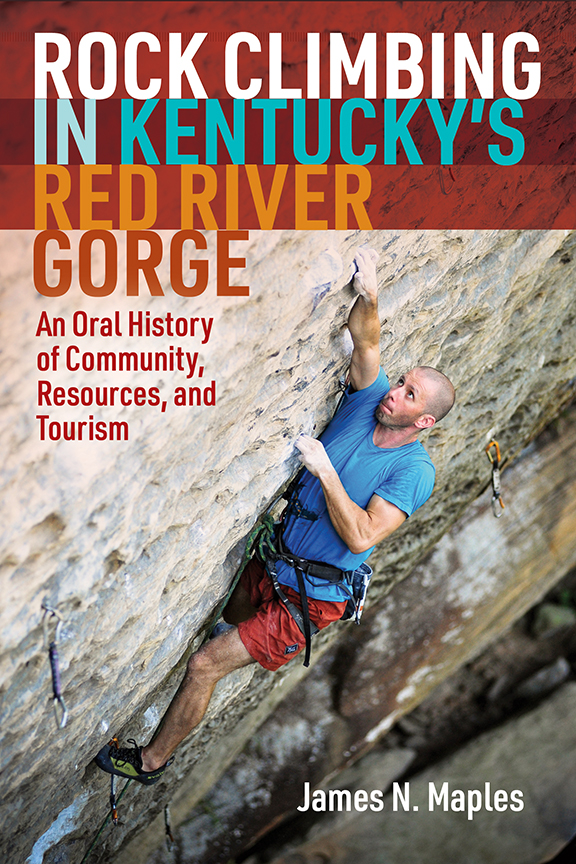
Rock Climbing in Kentucky’s Red River Gorge documents, for the first time, fifty years of oral history from this famous climbing community. Through extensive interviews, Maples reconstructs the growth of rock climbing in the region—including a twice-failed dam project, mysterious first routes, unauthorized sport-route growth on public lands, and a controversial archaeological dig. The book details five decades of collaborations to secure ongoing access to some of the world’s most beautiful and technically demanding routes and the challenges along the way.
More than a recounting of the past, however, Rock Climbing in Kentucky’s Red River Gorge uses the region’s extraordinary history to argue that climbing has the potential to be a valuable source of sustainable economic activity in rural areas throughout Appalachia today and in the years to come. The book concludes by offering policy recommendations and lessons learned about building beneficial partnerships among climbers, local communities, and public land managers to encourage community development and ecotourism alongside preservation.
Contents
Acknowledgments
Abbreviations
Introduction
1. A Brief Overview of the Red and the Surrounding Region
2. The Motherlode
3. The Red River Dam, 1962–1969
4. Cumberland Climbers, 1968–1975
5. Trad Climbing Growth and Climbing Guides, 1974–1986
6. Sport Climbing Begins in the Red, 1987–1995
7. Climbing Guides, Climbing Bans, and Climbers Organizing, 1993–1997
8. White-Haired Goldenrod and the Memorandum of Understanding, 1997–2000
9. The Military Wall Archaeological Dig, 2001–2002
10. Transitioning off Public Land and into a New Era at the Red, 2002–2004
11. The RocTrip, Growth, and Impact Issues, 2005–2010
12. Learning to Be a Red River Local, 2011–2019
13. What Comes Next? Climbing in the Red and Beyond, 2020–2050
Notes
Bibliography
Index
Author
James N. Maples is director of the Division for Regional Economic Assessment and Modeling and associate professor of sociology at Eastern Kentucky University. His work examines the economic and environmental impacts of outdoor recreation and sustainable tourism.
Reviews
“Well-written, accessible, and succinct. Historians, Kentuckians, scholars, and dirtbags alike will find this volume illuminating.”
Kristi McLeod Fondren, author of Walking on the Wild Side: Long-Distance Hiking on the Appalachian Trail
“In this book, Maples unfolds a rich tapestry of climbing history in the Red. The reader might expect this history to begin with the setting of the first routes, but they will be pleasantly surprised that, instead, these major moments of climbing history are situated within the region’s indigenous past, colonial movements, and the rise of Appalachian cultural heritage. Despite how isolated and insulated some of the crags and hollers of this region can seem, this book highlights the connections that weave through the Red as it has changed and will continue to change with time.”
Jillian Rickly, University of Nottingham
“Maples’s historical account of rock climbing in the Red River Gorge brings the people and places to life. From The Motherlode to current organizations working to preserve rock-climbing access, the compilation of history and memories offers a more nuanced understanding of rock climbing as an outdoor recreation endeavor for the region. Maples’s work will aid in understanding the past and present, and it will inform the future of outdoor recreation in the area.”
Michael J. Bradley, Arkansas Tech University
“One of the first attempts to provide a comprehensive chronology of the Red River Gorge and the impact climbing has played in its history, this book tells a story of a unique resource that many in eastern Kentucky have always felt rooted in but have had little opportunity to benefit from. In Rock Climbing in Kentucky’s Red River Gorge, we learn about the quirky history of this area, the tension between climbers and public land managers, and the ever-present battle between the recreational use of a natural resource and its conservation for future generations to experience and enjoy.”
Ryan L. Sharp, Kansas State University
“A climbing history of the Red—a global climbing mecca—is a major contribution. And like the climbers he studies, Maples pushes further, telling a larger story about the transformational power and possibility of climbing in Appalachia and beyond. Climbers, conservationists, public land advocates, and anyone with an interest in this region should read this book to understand how climbing is a complex force to be reckoned with and how climbers can be a force for good.”
Zachary Lesch-Huie, Access Fund
“Maples, through his genuine curiosity about the climbing community, his own deep love of place, and his thoughtful methodology, has woven together an enjoyable story that hopefully inspires continued conservation of this wonderful part of the world.”
Adam Cramer, Outdoor Alliance
A Union for Appalachian Healthcare Workers: The Radical Roots and Hard Fights of Local 1199

John Hennen
November 2021
288pp
PB 978-1-952271-24-3
$29.99
CL 978-1-952271-23-6
$99.99
eBook 978-1-952271-25-0
$29.99
West Virginia and Appalachia Series
A Union for Appalachian Healthcare Workers
The Radical Roots and Hard Fights of Local 1199
Summary
The union of hospital workers usually referred to as the 1199 sits at the intersection of three of the most important topics in US history: organized labor, health care, and civil rights. John Hennen’s book explores the union’s history in Appalachia, a region that is generally associated with extractive industries but has seen health care grow as a share of the overall economy.
With a multiracial, largely female, and notably militant membership, 1199 was at labor’s vanguard in the 1970s, and Hennen traces its efforts in hospitals, nursing homes, and healthcare centers in West Virginia, eastern Kentucky, and Appalachian Ohio. He places these stories of mainly low-wage women workers within the framework of shake-ups in the late industrial and early postindustrial United States, relying in part on the words of Local 1199 workers and organizers themselves. Both a sophisticated account of an overlooked aspect of Appalachia’s labor history and a key piece of context for Americans’ current concern with the status of “essential workers,” Hennen’s book is a timely contribution to the fields of history and Appalachian studies and to the study of social movements.
Contents
Acknowledgments
Abbreviations
Introduction
1. Radical Elders, or, a Multigenerational Red Thread
2. Busting Loose at Marshall
3. New Boundaries for Local 1199
4. “1199 Comes to Appalachia”
5. Law, Busting Unions, Building Unions
6. A Kentucky Saga and a Strike for Survival
8. Survival in the Time of Reagan
9. “Organize or Die:” An Ohio Odyssey and a Big Fight in Fairmont
10. “A Howling Voice in the Wilderness”: Separation and Merger
Epilogue
Bibliography
Index
Author
John Hennen taught history for over thirty years, including two decades at Morehead State University, where he is emeritus professor of history. He is the author of The Americanization of West Virginia: Creating a Modern Industrial State, 1916–1925.
Reviews
“An important contribution to the scholarship that examines the complexities of labor organizing.”
Journal of Southern History
“Hennen’s engagingly told and well-researched study is a valuable contribution to both American labor history and Appalachian studies.”
Gordon Simmons, president, West Virginia Labor History Association
“How did a union of healthcare workers founded in New York City by radical Russian immigrants and composed primarily of Black and Hispanic women gain a powerful foothold in Appalachia despite determined opposition from employers and national and state politicians, as well as the impact of the consolidation of the hospital industry? John Hennen tells this inspiring story in a way that speaks directly to our current moment, when a long era of declining union power may be coming to an end.”
Eric Foner, Columbia University