Seeds of Occupation, Seeds of Possibility: The Agrochemical-GMO Industry in Hawai‘i

author name and title in yellow and white text on green background; subtitle in light red text on bright red background; image of cultivated land between Hawaiian mountains and ocean; image of a Hawaiian man with a microphone addresses a protest rally with many people, many of them wearing red

Andrea Noelani Brower

December 2022
224 pp
PB 978-1-952271-69-4 $29.99
eBook 978-1-952271-70-0
$29.99

Radical Natures Series


Seeds of Occupation, Seeds of Possibility

The Agrochemical-GMO Industry in Hawaiʻi

Summary

Hawaiʻi is a primary site for development of herbicide-resistant corn seed and, until recently, was host to more experimental field trials of genetically engineered crops than anywhere else in the world. It is also a node of powerful resistance. While documentaries and popular news stories have profiled the biotech seed industry in Hawaiʻi, Seeds of Occupation, Seeds of Possibility is the first book to detail the social and historical conditions by which the chemical-seed oligopoly came to occupy the most geographically isolated islands in the world and made the soils of Hawaiʻi the epicenter of agrochemical and agricultural biotechnology testing.

Andrea Brower, an activist-scholar from Hawaiʻi, examines the consequences related to genetically engineered seed development for Hawaiʻi’s people and the social movement that has risen in response. With insights beyond the islands, Seeds of Occupation, Seeds of Possibility illuminates why visions for a radically better world must be expanded by intersectional and systemically oriented movements.

Contents

Acknowledgments

Introduction: Contested Futures

1. The Agrochemical-Seed-Biotech Oligopoly

2. Science and Regulation in Service of Capital

3. “GMO Ground Zero”

4. Imperialism and the Making of a Plantation Economy

5. From Sugar to Monsanto

6. The State’s Redistribution of Collective Wealth

7. Resistance Is Fertile

8. Battling Monsanto in an Era of Neoliberal Cynicism

9. Seeds of Possibility

Bibliography
Index

Author

Andrea Noelani Brower is an activist-scholar from Kaua‘i. Her scholarship is rooted in collective movements for justice, equality, liberation, and ecological regeneration. She teaches in sociology, environmental studies, and leadership studies at Gonzaga University.

Reviews

“Where this book differs from other academic studies about power in Hawaiʻi is in its steadfast commitment to demonstrating the power of intersectional resistance. Brower’s interest in capitalism and agrochemical agriculture’s colonization of food production is not only to expose the dangers to human and nonhuman life but also to demonstrate how a resistance that spans ethnicities, classes, genders, and other distinct interest groups derives power from coalition instead of division. This book is a timely examination of Hawaiʻi’s struggles over land and power.”
Kathryn Besio, University of Hawaiʻi at Hilo

“This book is a powerful intervention of truth and transparency into corporate darkness and influence. It explodes the myth of benevolence and the drive to feed the world in the agricultural biotechnology industry. What might seem like battles on the edge of the empire in places like Hawaiʻi can actually be seen as central sites of leadership, resistance, and innovation in grappling against global structures and power. Hawaiʻi’s place as the epicenter for a global battle over our future—the future of our food systems, the impacts of pesticides and herbicides on human health and environment, and the need for courageous actors—is made clear by this work. We need this book.”
Kamana Beamer, University of Hawaiʻi at Mānoa

EmailFacebookInstagramPinterestTwitter

Almanac for the Anthropocene: A Compendium of Solarpunk Futures

garden shed with trimmed branches and raised bed gardens in front with overlay of translucent yellow and white circles

Edited by Phoebe Wagner and Brontë Christopher Wieland

September 2022
208pp 
PB 978-1-952271-50-2
$26.99
eBook 978-1-952271-51-9
$26.99

Salvaging the Anthropocene Series

Almanac for the Anthropocene

A Compendium of Solarpunk Futures

Summary

Almanac for the Anthropocene collects original voices from across the solarpunk movement, which positions ingenuity, generativity, and community as beacons of resistance to the hopelessness often inspired by the climate crisis. To point toward practical implementation of the movement’s ideas, it gathers usable blueprints that bring together theory and practice. The result is a collection of interviews, recipes, exercises, DIY instructions, and more—all of it amounting to a call to create hope through action.

Inspired by a commitment to the idea that there can be no environmental justice without decolonial and racial justice, Almanac for the Anthropocene unites in a single volume both academic and practical responses to environmental crisis.

Contents

Introduction: The Situation So Far   
Phoebe Wagner and Brontë Christopher Wieland

Part 1: Generativity

Not Just Solar: Creating Our Own Powers, Stories, and Spaces
Brontë Christopher Wieland

1. Solarpunk Is a Verb for Rising
The Commando Jugendstil and Tales from the EV Studio

2. In Defense of Hope
Margaret Killjoy

3. Feeding Imagination
Giulia Lepori and Michał Krawczyk

4. A Collective Gardening Shed of Concepts for Planting Solarpunk Futures
Christoph D. D. Rupprecht

Part 2: Independence

Building toward Autonomy: Ways of Reclaiming the Present and the Future
Brontë Christopher Wieland

5. Your Mineral Footprint
Gabriel Aliaga

6. Solarpunk Design Guidelines
Navarre Bartz

7. How to Build a Solar-Powered Website
Kris De Decker

8. Solarpunks See the World: Traversing the World without Destroying It
Craig Stevenson

Part 3: Community

“All Organizing Is Science Fiction”: On Dreaming a Solarpunk Community
Phoebe Wagner

9. Science Fiction and Disability: Engage!
Petra Kuppers

10. The Urban Reef: Breaking Down Barriers between Green Spaces in Urban Environments
Octavia Cade

11. The Commensal Canine
Susan Haris

12. Solarpunk: The Fruitful Revolution
Connor D. Louiselle

Part 4: Ingenuity

Solarpunk Ingenuity and DIY Projects
Phoebe Wagner

13. Visible Mending: A Recipe for Beautiful and Sustainable Clothing
Sari Fordham

14. Appalachian Solarpunk: Growing Trees from Seed for the Plant Revolution
Vance Mullis and Joy Lew

15. Anthrocene Strategy: Foraging
Michael J. DeLuca

16. Multispecies Community Garden: A More-Than-Human Design Concept Proposal 
for Well-Being in Shrinking Cities
Christoph D. D. Rupprecht, Aoi Yoshida, and Lihua Cui

Conclusion: Looking Forward 
Phoebe Wagner and Brontë Christopher Wieland

Contributors

Editors

Phoebe Wagner is a writer, academic, and coeditor of Sunvault: Stories of Solarpunk and Eco-Speculation. She lives in Williamsport, Pennsylvania.

Brontë Christopher Wieland has an MFA in creative writing and environment and is coeditor of Sunvault: Stories of Solarpunk and Eco-Speculation. He lives in Reno, Nevada.

Reviews

"With their new anthology, Almanac for the Anthropocene, Wagner and Wieland continue to break new ground in the solarpunk genre. And like Sunvault, this new collection of work is sure to be a core component of solarpunk's standard reading curriculum." 
 Justine Norton-Kertson, Solarpunk Magazine

“I’m thankful for all that Wagner and Wieland have done to gather and champion those working in the solarpunk movement, and I believe this book will help bring new solarpunks into the fold, ready to join them in further thought and action.”
Matt Bell, author of Appleseed

“Wagner and Wieland demonstrate the breadth of the solarpunk movement through the collection’s ferocious expression of many possible futures, giving us tools and strategies for bringing those about, but reminding us that the conversation is not, and perhaps not ever, over.”
Sean Guynes, coeditor of Uneven Futures: Strategies for Community Survival from Speculative Fiction

EmailFacebookInstagramPinterestTwitter

Another Appalachia: Coming Up Queer and Indian in a Mountain Place
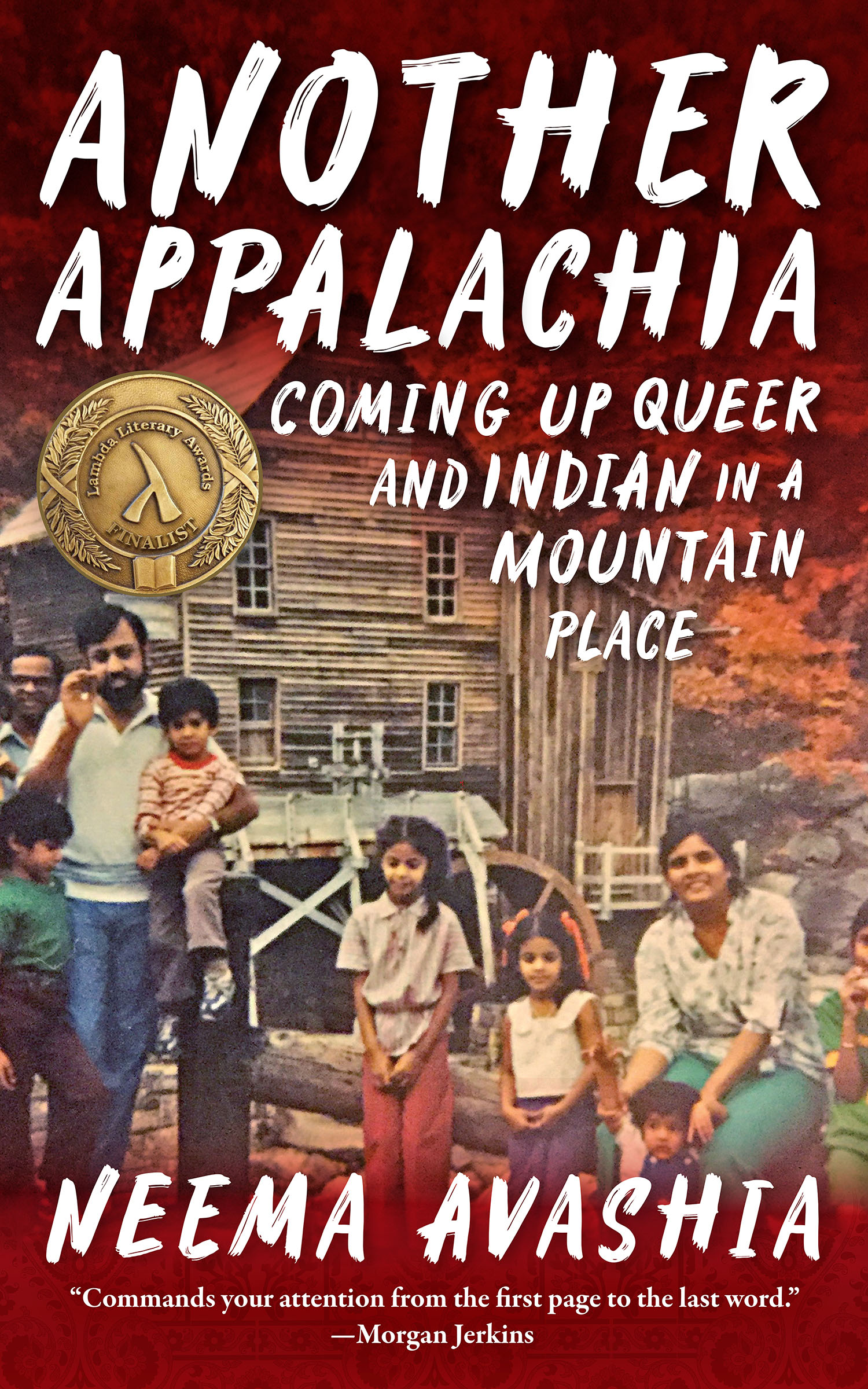

Another Appalachia cover: photo of an Indian-American family and the author as a young child in front of Glade Creek Grist Mill in Babcock State Park, West Virginia, in the late 1980s, in the fall

Neema Avashia

March 2022
168pp
PB 978-1-952271-42-7
$19.99
eBook 978-1-952271-43-4
$19.99


Another Appalachia

Coming Up Queer and Indian in a Mountain Place

Summary

2023 Lambda Literary Award Finalist, Lesbian Memoir/Biography
Named the BEST LGBTQ+ MEMOIR of 2022 by Book Riot

Named a New York Public Library Best Book of 2022
Weatherford Award finalist, nonfiction

When Neema Avashia tells people where she’s from, their response is nearly always a disbelieving “There are Indian people in West Virginia?” A queer Asian American teacher and writer, Avashia fits few Appalachian stereotypes. But the lessons she learned in childhood about race and class, gender and sexuality continue to inform the way she moves through the world today: how she loves, how she teaches, how she advocates, how she struggles.

Another Appalachia examines both the roots and the resonance of Avashia’s identity as a queer desi Appalachian woman, while encouraging readers to envision more complex versions of both Appalachia and the nation as a whole. With lyric and narrative explorations of foodways, religion, sports, standards of beauty, social media, gun culture, and more, Another Appalachia mixes nostalgia and humor, sadness and sweetness, personal reflection and universal questions.

Contents

Directions to a Vanishing Place
Chemical Bonds
Nine Forms of the Goddess
Be Like Wilt
The Blue-Red Divide
City Mouse/Country Mouse
Finding the Holy in an Unholy Coconut
Wine-Warmth
Magic Dust
A Hindu Hillbilly Elegy
Neighbors
The Hindu Hillbilly Spice Company
Shame-Shame
Our Armor
A History of Guns
Present-Life Hair
Only-Generation Appalachian
Thanks, Y’all

Author

Neema Avashia was born and raised in southern West Virginia to parents who immigrated to the United States. She has been a middle school teacher in the Boston Public Schools since 2003. Her essays have appeared in the Bitter Southerner, Catapult, Kenyon Review Online, and elsewhere.

Reviews

“This book lives beautifully in the gray area of trying to navigate a divisive environment while growing up queer and Asian American.”
Forbes

“I’m glad this memoir exists . . . and I’m especially glad it’s so good.”
Vauhini Vara, New York Magazine

“A graceful exploration of identity, community, and contradictions.”
Scalawag

“A timely collection that begins to fill the gap in literature focused mainly on the white male experience.”
Ms. Magazine

“Evocative and thought-provoking.”
Bitch Media

“Readers may be Indian, Appalachian, and queer or they may be some or none of these things. No matter—Avashia’s beautifully rendered prose contains insights to which everyone can relate.”
Still: The Journal

“Compelling and refreshing. . . . Appalachia needs more people like Neema Avashia.”
Daily Yonder

“This book gave me such tenderness toward a place that parsing my thoughts about it was like scooping up tadpoles with my bare hands.”
Pittsburgh Institute for Nonprofit Journalism

Another Appalachia is a breath of fresh air, a work that the public is in dire need of reading. Wide and expansive as the land the author calls home, this essay collection subverts the mainstream’s hyperfocus on white male-dominated narratives from rural America and commands your attention from the first page to the last word.”
Morgan Jerkins, author of This Will Be My Undoing: Living at the Intersection of Black, Female, and Feminist in (White) America and Caul Baby

“Neema Avashia, in this book, has named the unnamed, spoken the unspoken so that it does not become—to paraphrase Adrienne Rich—the unspeakable, and she has done so in language that is both lyrical and direct, both entertaining and edifying, both challenging and generous. I love this book and believe it introduces an important voice in America’s ongoing racial reckoning.”
Rahul Mehta, author of No Other World

“An essential text to add to the new canon of Appalachian writing—a compassionate and rigorous memoir of the author’s experience growing up as a queer Hindu child and teenager in a small community of West Virginian Indians. Another Appalachia is a bright and deeply empathetic portrait of a complicated place, a place that Neema Avashia allows to be multifaceted in the way it deserves.”
Anna Claire Weber, White Whale Bookstore
 

EmailFacebookInstagramPinterestTwitter

Lioness: A Novel

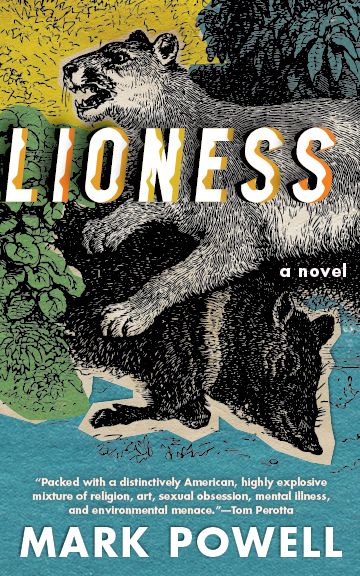
Lioness novel cover: a lioness attacking a boar behind white text

Mark Powell

April 2022
304pp
PB 978-1-952271-44-1
$21.99
eBook 978-1-952271-45-8
$21.99

Lioness

A Novel

Summary

In the fall of 2018, a bomb goes off at a water-bottling plant in the mountains of southwest Virginia, an incident the FBI declares an act of ecoterrorism. Arrested at the scene is Chris Bright, a mountain hermit with a long history of activism. Unaccounted for—and presumed dead—is Mara Wood, an installation artist who in the last two years has lost her son and left her husband.

But Mara’s estranged husband David cannot quite believe she is dead, and as he goes about reconstructing the story of what happened, he begins to imagine an alternate narrative—one in which their son doesn’t die and his wife doesn’t leave him, one in which his wife doesn’t carry on a secret relationship with Chris Bright, a man bent on fighting back against the environmental despoliation of his Appalachian home. Lioness is a page-turning, heart-wrenching examination of extremism: What pushes people to act violently, and is that violence ever justified?

Author

Mark Powell is the author of seven novels and has received fellowships from the National Endowment for the Arts, from the Bread Loaf and Sewanee Writers’ Conferences, and twice from the Fulbright Foundation, to Slovakia and Romania. He directs the creative writing program at Appalachian State University.

Reviews

“Emotionally wrenching. . . . Haunting (and haunted) in the best possible way.”
Kirkus Reviews (starred review)

“Powerful and layered, this is a tour de force . . . dark, moody, and mesmerizing.”
Foreword Reviews (starred review)

“He writes about difficult things in a beautiful way, reminiscent of Cormac McCarthy. . . . Powell’s love for his native turf comes through tangibly.”
Barbara Bennett, North Carolina Literary Review

Lioness is a darkly compelling portrait of an artist who evolves into a homegrown ecoterrorist. Mark Powell’s brooding, twisty novel is packed with a distinctively American, highly explosive mixture of religion, art, sexual obsession, mental illness, and environmental menace.”
Tom Perrotta, author of Tracy Flick Can’t Win and The Leftovers

“The best Appalachian novelist of his generation.” 
Ron Rash, author of Serena and In the Valley

“Mark Powell’s Lioness is a force of nature: moody, twisty, stormy, and supercharged with the fierce blue voltage of top-notch storytelling. It’s a riveting ecothriller that’s also a profound exploration of grief—grief for one another, and grief for the earth. What a powerful novel.”
Jonathan Miles, author of Anatomy of a Miracle

“A thriller with quickness and elegance, Lioness asks tough questions about our responsibilities to the natural world and to one another. In offering no easy answers, it achieves something beautiful and haunting. Mark Powell has written a gorgeous, enthralling, immensely readable novel that will hook you until the very last page.”
Kayla Rae Whitaker, author of The Animators

“Mark Powell’s Lioness is an immersive rendering of the human quest for love and healing amidst a world on fire—a fire we have set and cannot tame.”
Annette Saunooke Clapsaddle, author of Even as We Breathe

“In this haunting novel of passion and intrigue, Mark Powell takes on the environmental collapse coming at us and the people driven to action. Powell is a writer with mountains of talent, and here he creates complex and fascinating characters trying to figure a way out of grief and despair. Even love is sometimes violent.”
Janisse Ray, author of Wild Spectacle: Seeking Wonders in a World beyond Humans

Lioness takes the reader on a cross-country journey that is as much spiritual and psychological as it is physical. Mark Powell’s powerful descriptions capture the grief, love, and despair of his characters as they move through a land that’s been wrought by environmental degradation and an ever-changing climate.”
Jessica Cory, editor of Mountains Piled upon Mountains: Appalachian Nature Writing in the Anthropocene

EmailFacebookInstagramPinterestTwitter

Hungry Town: A Novel

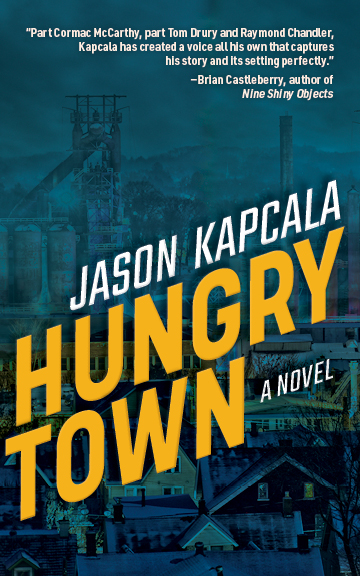
Hungry Town cover: title and author name in yellow and white letters with a blue tinted photograph of a factory town in the background

Jason Kapcala

March 2022
288pp
PB 978-1-952271-40-3
$19.99
eBook 978-1-952271-41-0
$19.99

Hungry Town

A Novel

Summary

2023 IPPY Award, Great Lakes - Best Regional Fiction, Silver

One October night in the depressed steel town of Lodi, Ohio, two police officers respond to a call about trespassers in the derelict Lodi Steel machine shop. A chase through the crumbling cathedral of steel columns launches a chain of events that will test the officers’ partnership and leave a boy to fend for himself in a decaying Rust Belt neighborhood choked by joblessness, boredom, and addiction.

On the opposite end of town, a young woman steps out of a rust-bucket Grand Marquis into an all-night diner. Instead of luggage, she carries mementos: an ankh tattoo she inked herself and a wallet-sized photograph of a boy who disappeared. She doesn’t realize her ex-boyfriend has hired two brothers to track her down and bring her back, by any means necessary.

The complex female leads of Hungry Town, with its sharp dialogue and poetic sensibility, turn classic noir and cop drama tropes on their heads. These morally complicated characters weave in and out of each other’s lives, sometimes violently, sometimes with surprising compassion.

Author

Jason Kapcala is the author of the short story collection North to Lakeville. His writing has been nominated for numerous prizes, including the Pushcart Prize. He grew up in northeastern Pennsylvania, near the ruins of the Bethlehem Steel Works, and now lives in northern West Virginia.

Reviews

“With the grit of a western and the crackle of a murder mystery, this finely wrought effort delivers the goods.”
Publishers Weekly

“A literary flair lifts this above the routine procedural.”
Kirkus Reviews

“These flawed people, dealt a losing hand, will not soon be forgotten.”
Akron Beacon Journal

“A literary page-turner that lends poetry to the forgotten town at the heart of this powerful novel, filled to its borders with complicated, honest characters who will linger in your imagination long after the last page. Part Cormac McCarthy, part Tom Drury and Raymond Chandler, Kapcala has created a voice all his own that captures his story and its setting perfectly.”
Brian Castleberry, author of Nine Shiny Objects

“A fun read, firmly fixed in the detective/crime novel genre but with a nice literary eye for details.”
Mesha Maren, author of Sugar Run

EmailFacebookInstagramPinterestTwitter

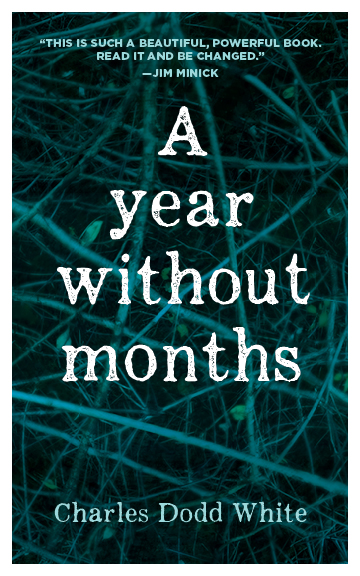
A Year without Months

Charles Dodd White

May 2022
176pp 
PB 978-1-952271-52-6
$19.99
eBook 978-1-952271-53-3
$19.99

In Place Series


A Year without Months


Summary

2023 Ippy Awards Silver Medal Winner

This collection of fourteen essays by Charles Dodd White—praised by Silas House as “one of the best prose stylists of Appalachian literature”—explores the boundaries of family, loss, masculinity, and place. Contemplating the suicides of his father, uncle, and son, White meditates on what it means to go on when seemingly everything worth living for is lost. What he discovers is an intimate connection to the natural world, a renewed impulse to understand his troubled family history, and a devotion to following the clues that point to the possibility of a whole life.

Avoiding easy sentiment and cliché, White’s transformative language drives toward renewal. A Year without Months introduces lively and memorable characters, as the author draws on a wide range of emotions to analyze everything, including himself.

Contents

Preface

Groupings
Coaster King
The Cabin
Bethlehem Bottoms
Southern Man
Apart
Why I Don’t Hunt Anymore
What We Gain in the Hurt
Human Animals
Self-Taught on the Tuck
Those Boys
Learning a Place by Its Waters
Under Weight
A Year without Months

Acknowledgments

Author

Charles Dodd White is the recipient of the Chaffin Award and the Appalachian Book of the Year Award for his fiction. He teaches English at Pellissippi State Community College in Knoxville, Tennessee.

Reviews

“White has had to redefine ‘southern man’ beyond guns and toughness in order to forge his own identity and in order, really, to survive. But this book is also deeply about loss, about coming to terms with our own failures, especially as parents. There’s a tremendous tenderness and grace here—for the imperfect dead who have gone on, for the flawed family that we still can love, and for the strong yet humble self, in all our many mistakes. This is such a beautiful, powerful book. Read it and be changed.”
Jim Minick, author of Fire Is Your Water

A Year without Months achieves a lyricism and poignancy reminiscent of Norman Maclean’s great family story A River Runs Through It, but Charles Dodd White’s voice and story are his own. Many books linger forever in our minds. Only a few also linger forever in our hearts, and this is one of them.”
Ron Rash, author of In the Valley

“This book is a reckoning. As a longtime fan of Charles Dodd White’s fiction, I’m captivated by the essays in A Year without Months. Here is a writer haunted by profound loss, by fatherhood and fatherlessness, and by the changing landscape of Appalachia. In beautiful, unsparing prose, White turns a novelist’s eye inward and interrogates his own southern manhood, offering nuanced, intimate portrayals of himself and his family. A candid and deeply necessary study of backwoods masculinity, with all its tenderness and toxicity laid bare.”
Leah Hampton, author of F*ckface

“Talk about a slim book with a powerful and emotional punch. White wrestles with unfathomable loss, difficult relationships, and the loss of Appalachia, yet somehow finds beauty and truth.”
Garden & Gun

“A work of harrowing candor, insightful compassion, and hard-won beauty.”
Chapter 16

“Necessary reading for anyone interested in the changing world of the modern mountain south.”
Still: The Journal

EmailFacebookInstagramPinterestTwitter

African American Workers and the Appalachian Coal Industry

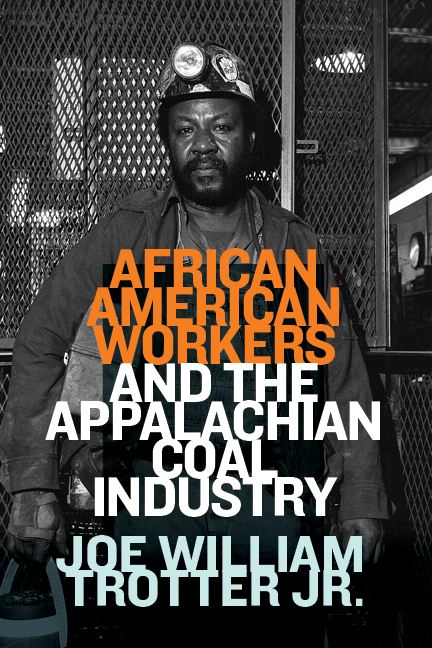
African American Workers and the Appalachian Coal Industry cover: black and white photo of an African American man wearing a miner's helmet with a light and miner clothing

Joe William Trotter Jr.

February 2022
176pp

PB 978-1-959000-12-9
$21.99

CL 978-1-952271-18-2
$34.99

eBook 978-1-952271-19-9
$21.99


African American Workers and the Appalachian Coal Industry

Summary

This collection brings together nearly three decades of research on the African American experience, class, and race relations in the Appalachian coal industry. It shows how, with deep roots in the antebellum era of chattel slavery, West Virginia’s Black working class gradually picked up steam during the emancipation years following the Civil War and dramatically expanded during the late nineteenth and early twentieth centuries.

From there, African American Workers and the Appalachian Coal Industry highlights the decline of the region’s Black industrial proletariat under the impact of rapid technological, social, and political changes following World War II. It underscores how all miners suffered unemployment and outmigration from the region as global transformations took their toll on the coal industry, but emphasizes the disproportionately painful impact of declining bituminous coal production on African American workers, their families, and their communities. Joe Trotter not only reiterates the contributions of proletarianization to our knowledge of US labor and working-class history but also draws attention to the gender limits of studies of Black life that focus on class formation, while calling for new transnational perspectives on the subject. Equally important, this volume illuminates the intellectual journey of a noted labor historian with deep family roots in the southern Appalachian coalfields.

Contents

Preface

Introduction: The Black Miner in U.S. Labor History
1. African Americans in West Virginia
2. Migration to Southern West Virginia
3. Inequality in the Workplace
4. Community Formation
5. Environmental Conditions
Epilogue: Comparative Race and Ethnic Relations

Acknowledgments
Appendix: Scholarship, Debates, and Sources
Notes
Bibliography
Sources and Permissions
Index

Author

Joe William Trotter Jr. is the Giant Eagle University Professor of History and Social Justice at Carnegie Mellon University, a member of the American Academy of Arts and Sciences, and author of Workers on Arrival: Black Labor in the Making of America and Pittsburgh and the Urban League Movement: A Century of Social Service and Activism.

Reviews

“Joe William Trotter Jr.’s African American Workers and the Appalachian Coal Industry is more than a topical collection of essays by a pioneering scholar summarizing the history and historiography of Black coal miners. At a time when race, class, labor, and structural violence are coming back into sharp thematic focus due to the disproportionate effects of a major global pandemic on many communities of color, Trotter’s work is also a prescient—and deeply personal—exploration of the formation and growth of Black working-class communities, institutions, social and cultural networks, and political movements for reform and liberatory change over time.”
Clarence Lang, Susan Welch Dean of the College of the Liberal Arts and professor of African American studies, Penn State University

“Joe Trotter has had a profound impact on the way I approach African American history both as a scholar and as a teacher. A collection of his groundbreaking work is long overdue.”
Robert H. Woodrum, author of Everybody Was Black Down There: Race and Industrial Change in the Alabama Coalfields

EmailFacebookInstagramPinterestTwitter

Teaching Matters: A Guide for Graduate Students

Teaching Matters book cover: pink, blue, orange, and yellow geometric shapes

Aeron Haynie and
Stephanie Spong

June 2022
240pp
PB 978-1-952271-55-7
$24.99
CL 978-1-952271-54-0
$99.99
eBook 978-1-952271-56-4
$24.99

Teaching and Learning in Higher Education Series

Teaching Matters

A Guide for Graduate Students

Summary

In a book written directly for graduate students that includes graduate student voices and experiences, Aeron Haynie and Stephanie Spong establish why good teaching matters and offer a guide to helping instructors-in-training create inclusive and welcoming classrooms.

Teaching Matters is informed by recent research while being grounded in the personal perspectives of current and past graduate students in many disciplines. Graduate students can use this book independently to prepare to teach their courses, or it can be used as a guide for a teaching practicum. With a just-in-time checklist for graduate students who are assigned to teach courses right before the semester starts, step-by-step directions for writing a compelling teaching philosophy, and an emphasis on teaching well regardless of modality, Teaching Matters will remain relevant for graduate students throughout their careers.


Receive a 30% discount on orders of 10 or more copies of this title with code HIGHEREDBULK30 at checkout.

Contents

Acknowledgments

1. Why Teaching Matters
2. How Do You Design a Course?
3. How Can You Create a Welcoming Classroom Community?
4. How Do You Develop a Classroom Practice?
5. Navigating Classroom Challenges
6. Creating Assignments and Responding to Student Work
7. What Are Other Graduate Students Experiencing?
8. Cultivating Well-Being

Appendix 1: Help! What If My Course Starts Next Week?
Appendix 2: How Can My Teaching Experience Help Me Get a Job?
Appendix 3: Resources

Notes
References
Index

Authors

Aeron Haynie is executive director of the Center for Teaching and Learning and associate professor of English at the University of New Mexico. She is coeditor of Exploring Signature Pedagogies and Exploring More Signature Pedagogies.

Stephanie Spong is an associate director for the Center for Teaching and Learning and affiliated faculty with the department of organization, information, and learning sciences at the University of New Mexico.

Reviews

“Empowering graduate students to savor teaching when higher education emphasizes research is no mean feat. I mentor graduate students from multiple disciplines, and this book, from its title to its student-focused chapters, resonates closely with my rallying call. Yes, indeed, teaching matters, and Haynie and Spong nicely address graduate student needs head on, warmly inviting the educators of the future to join the teaching commons and let the passion for teaching develop and shine unbridled.”
Regan A. R. Gurung, coauthor of Thriving in Academia: Building a Career at a Teaching-Focused Institution

“Indispensable.”
John Warner, Inside Higher Ed

EmailFacebookInstagramPinterestTwitter

Remembering and Forgetting in the Age of Technology: Teaching, Learning, and the Science of Memory in a Wired World

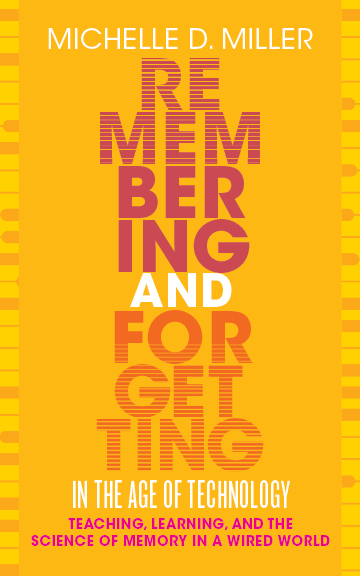
Remembering and Forgetting in the Age of Technology book cover: Book title and subtitle in red, white, orange, and pink against an orange background

Michelle D. Miller

April 2022
288pp
PB 978-1-952271-47-2
$24.99
eBook 978-1-952271-48-9
$24.99

Teaching and Learning in Higher Education Series

Remembering and Forgetting in the Age of Technology

Teaching, Learning, and the Science of Memory in a Wired World

Summary

Human minds are made of memories, and today those memories have competition. Biological memory capacities are being supplanted, or at least supplemented, by digital ones, as we rely on recording—phone cameras, digital video, speech-to-text—to capture information we’ll need in the future and then rely on those stored recordings to know what happened in the past. Search engines have taken over not only traditional reference materials but also the knowledge base that used to be encoded in our own brains. Google remembers, so we don’t have to. And when we don’t have to, we no longer can. Or can we?

Remembering and Forgetting in the Age of Technology offers concise, nontechnical explanations of major principles of memory and attention—concepts that all teachers should know and that can inform how technology is used in their classes. Teachers will come away with a new appreciation of the importance of memory for learning, useful ideas for handling and discussing technology with their students, and an understanding of how memory is changing in our technology-saturated world.


Receive a 30% discount on orders of 10 or more copies of this title with code HIGHEREDBULK30 at checkout.

Contents

Introduction: Machines, Memory, and Learning
1. What Technology Does to Us (and for Us): Taking a Critical Look at Common Narrative  
2. Why We Remember, Why We Forget
3. Enhancing Memory and Why It Matters (Even though Google Exists)
4. Memory Requires Attention
5. The Devices We Can’t Put Down: Smartphones, Laptops, Memory, and Learning
Conclusion: How Memory Can Thrive in a Technology-Saturated Future

Notes
Acknowledgments
Index    

Author

Michelle D. Miller is a professor of psychological sciences and President’s Distinguished Teaching Fellow at Northern Arizona University. She is the author of Minds Online: Teaching Effectively with Technology.

Reviews

“This is the book we need: a clear, lively, and authoritative examination of technology, memory, and learning—perhaps the most critical subjects in all of higher education right now.”
Kevin Gannon, author of Radical Hope: A Teaching Manifesto

EmailFacebookInstagramPinterestTwitter

Rogues in the Postcolony: Narrating Extraction and Itinerancy in India

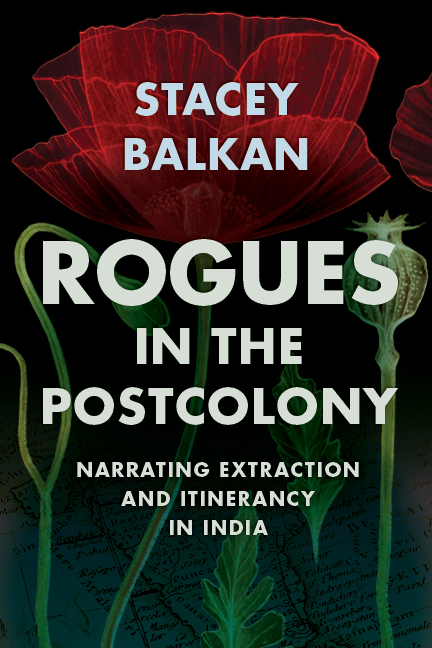
Rogues in the Postcolony cover, large transparent red poppy flower with green leaves on a black background

Stacey Balkan

February 2022
216pp
PB 978-1-952271-36-6
$29.99
CL 978-1-952271-35-9
$99.99
eBook 978-1-952271-37-3
$29.99

Histories of Capitalism and the Environment Series


Rogues in the Postcolony

Narrating Extraction and Itinerancy in India
 

Summary

Rogues in the Postcolony is a study of Anglophone Indian picaresque novels that dramatize the impacts of extractive capitalism and colonial occupation on local communities in several Indian states. In this materialist history of development on the subcontinent, Stacey Balkan considers works by Amitav Ghosh, Indra Sinha, and Aravind Adiga that critique violent campaigns of enclosure and dispossession at the hands of corporate entities like the English East India Company and its many legatees. By foregrounding the intersections among landscape ideology, agricultural improvement, extractive capitalism, and aesthetic expression, Rogues in the Postcolony also attends to the complicity of popular aesthetic forms with political and economic policy, as well as the colonial and extractivist logics that often frame discussions around the so-called Anthropocene epoch.

Bringing together questions about settler-colonial practices and environmental injustice, Rogues in the Postcolony concludes with an investigation of new extractivist frontiers, including solar capitalism, and considers the possibility of imagining life after extraction on the Indian subcontinent and beyond.

Contents

Acknowledgments
Abbreviations

Introduction: Why Can’t a Rogue Be a Hero?
1. Revisiting the Environmental Picaresque: Plantationocene Aesthetics and the Origins of Cheap Nature in Amitav Ghosh’s Ibis Trilogy
2. A Memento Mori Tale: Indra Sinha
s Animals People and the Politics of Global Toxicity
3. Slum Ecologies: Figuring (Energy) Waste in Aravind Adiga’s The White Tiger
Conclusion: Beyond Extraction: Imagining Solarity in India's Mineral Belt

Notes
Bibliography
Index 

Author

Stacey Balkan is assistant professor of English and environmental humanities at Florida Atlantic University. She is coeditor of Oil Fictions: World Literature and Our Contemporary Petrosphere.

Reviews

Rogues in the Postcolony is a marvelous study of how picaresque novels refract the violent dispossessions and rogue freedoms of extractive capitalism in India and beyond. In dialogue with cutting-edge conversations in environmental and energy humanities, Balkan argues convincingly that extraction is a pervasive dynamic within post/colonial modernity.”
Dominic Boyer, author of Energopolitics: Wind and Power in the Anthropocene

EmailFacebookInstagramPinterestTwitter