Slime Line: A Novel

illustration of a leaping coho salmon against a stylized background of a salmon-colored sky and dark blue ocean, with the text Slime Line in a bold handwriting font in a blue-green color with a white stroke around the letters

Jake Maynard

June 2024
344pp
PB 978-1-959000-19-8
$21.99
eBook 978-1-959000-20-4
$21.99

Slime Line

A Novel

Summary

A trippy and darkly funny portrait of the commercial fishing industry, Slime Line is the tragicomic yarn of one troubled college dropout’s desperate attempts to remake himself into a hard-nosed working man.

In the wake of his father’s death, Garrett Deaver washes up at a salmon processing plant in his dad’s old stomping grounds of Alaska. There, he renames himself Beaver—because just like a beaver, he’s “an industrious motherfucker”— and vows to become a supervisor at Klak Fancy Salmon, LLC. But moving up within the industry’s seasonal underclass is anything but simple, and soon he finds himself with real, and imagined, enemies at the plant. As amphetamines scramble his sense of reality, and secrets about his father’s life are revealed, the job he’d hoped would bring him salvation threatens to leave him broke, alone, and—maybe even literally—underwater.

Author

Jake Maynard is a fiction writer and essayist from Pennsylvania. He has held a few different jobs in the Alaskan commercial fishing industry. His writing appears in Southern Review, Guernica, Gulf Coast, Alaska Quarterly Review, the New Republic, the Baffler, the New York Times, and others. Slime Line is his first novel.

Reviews

"Maynard is a bold new American voice in fiction, and he's arrived with a fillet knife. Christ I loved this book."
— Taylor Brown, author of Rednecks and Gods of Howl Mountain

“A cult classic is born. Jake Maynard’s inspiring Slime Line is a backward glance at what the American novel could achieve before it got highjacked by English departments. Stumbling through the stinking grist of the salmon processing slums, written with fish-gut fingers, and fueled by an impetuous, chemical verve of prose a la Thom Jones, Slime Line exposes Alaska’s wage-slave work camps via the addled observations of its indefatigable narrator, one Garrett Deaver, a kid wielding a filet knife manically passionate about a job that will leave him beaten, abandoned, and hiding from the police inside a floating trailer park while still attempting to solve the mystery of his father’s death. Sinclair and Steinbeck would applaud this novel’s eye, but it’s Maynard’s outrageous characters loosed upon the Alaskan seacoast that propel Slime Line into page-turning madness. Maynard gets
every word right.”
— Lee Durkee, author of The Last Taxi Driver and Stalking Shakespeare

“Maynard’s Slime Line is an arresting read that sinks its claws deep into your gut and dares you to blink. It’s a story of hard work, loss, exploitation, and family set against a backdrop of blood, ice, and heavy machinery at an Alaskan fish processing plant peopled by misfits, scoundrels, and ghosts. You’ll never look at a salmon filet the same way again.”
— Kim Kelly, author of Fight Like Hell: The Untold Story of American Labor

“A bold and forceful and glorious book, like a beer bottle smashed to bits over your head, leaving you sticky with glass shards. Jake Maynard’s Slime Line depicts the world how it really is, or one hard slice of it anyway: the puke-inducing Alaskan commercial fishing sector. You’ll learn how to gut a salmon in one chapter, then how to lose a family in the next. In both cases, it’s not pretty. (“Everything,” as Maynard tells it, “comes out clean except for the heart.”) This is an eviscerating read, at once improbably raw and real.”
— Ben Purkert, author of The Men Can’t be Saved

Slime Line is a deeply compelling novel. Maynard’s energetic prose is as gritty and raw as Alaska itself.”
—Callan Wink, author of August

“There aren’t enough gross books about work. This is a story that hasn’t yet been told, and thank goodness Maynard was in right place to bear witness and tell it. Slime Line is a wild romp, both compelling and educational. It will change how people approach fish processing—and work, even—in Alaska.”
—Brendan Jones, author of The Alaskan Laundry

"Slime Line is a stone-cold winner: a book about the dirty work of capitalism, searching for a missing father, and reckoning with your legacy. It’s full of fish guts and lousy shifts, but it’s also driven by a big, beating heart. I found it impossible to put down. As in all great books, the big catch here is the truth, and Jake Maynard hauls it in, one gorgeous sentence after another. Tender, musical, sad, funny as hell. Read it.”
—Steve Almond, author of All the Secrets of the World and Truth Is the Arrow, Mercy Is the Bow

EmailFacebookInstagramPinterestTwitter

Utter, Earth: Advice on Living in a More-than-Human World

Text at top reads Utter, Earth: Advice on Living in a More-than-Human World, Isaac Yuen. Beneath the text are four illustrations: a moth silhouette, in white, against a red background, a catfish silhouette, in white, against a mint green background, a silhouette of wheat, in white, against a blue background, and a rhino silhouette, in white against a mushroom background

Isaac Yuen

April 2024
240pp
PB 978-1-959000-15-0
$21.99
eBook 978-1-959000-16-7
$21.99


Utter, Earth

Advice on Living in a More-than-Human World

Summary

A light, literary take on an animal book for grown-ups, a tongue-in-cheek self-help column with lessons drawn from nature, a sort of hitchhiker’s guide to the more-than-human world—Isaac Yuen’s Utter, Earth is a celebration, through wordplay and earthplay, of our planet’s riotous wonders.

In a time of dirges and elegies for the natural world, Utter, Earth features odes to sloths, tributes to trilobites, and ringing endorsements for lichen. For animal lovers and readers of Brian Doyle, Aimee Nezhukumatathil, and Amy Leach, each essay of this one-of-a-kind collection combines joyous language, whimsical tangents, and scientific findings to remind us of and reconnect us with those to whom we are inextricably bound. Highlighting life that once was, still is, and all that we stand to lose, this living and lively mini encyclopedia (complete with glossary) shines the spotlight on the motley, fantastical, and astonishing denizens with whom we share this planet.

Receive a 30% discount on orders of 10 or more copies of this title with code BULK30 at checkout.

Contents

1. Din
Yes, You Can Leave the Hospital Without Naming Your Baby
Second Best Is Best

2. Spectacle
On Sights Unseen
102 Briefly Mentioned, Mostly Living Things
The Perfect Party Guest

3. Contact
A School Is a Type of Shoal
A Hearth Is a Kind of Home

4. Exchange
A Breath in Four Parts
How to Make Friends and Keep Them Lifelong
Life Lessons from the Odd and Ancient

5. Duress
How to Debate as a Fish
Giving Up on Your Dreams
Going Down to Ground

6. Rebound
Creature Career Counseling
Reinvention Is a Matter of Necessity

7. Sustain
Pick-A-Mix, Build-A-Beast
So You Want to Write an Animal Essay

Brief Thoughts on Almost Every Mentioned, Mostly Living Thing (in Alphabetical Order)
Acknowledgments

Author

Isaac Yuen is a first-generation Hong Kong Canadian author. His work has appeared in AGNI, Gulf Coast, Orion, Shenandoah, Tin House, and numerous other publications. He has held residencies and fellowships at the Jan Michalski Foundation for Literature in Switzerland and the Hanse-Wissenschaftskolleg Institute of Advanced Studies in Germany. Utter, Earth is his first solo book.

Reviews

To shoal is to be social, to sense together, we learn in one of Yuen’s more-than-human essays. But to school is to sweep together in unison, to dazzle with coherence. It’s this spirit of schooling that animates Utter, Earth, essays that—in their curiosity, play, and care—aim to weave us back into a world of which we are but one small part. How would our language change if we invited nonhuman others alongside us again in fellowship, if our lives not only allowed for but celebrated everything swimming just beyond the limits of what we know? It’s not time for school, it’s time to school, to school with the creatures of Utter, Earth, the lemurs, leopards, and leafcutter ants, the wombats, waterbuck, and wildebeest, to school with others to find ourselves again.”
—David Naimon, host of Between the Covers

Utter, Earth leaps, ranges, delves—or should I say rabbits, antelopes, and elephant seals? Isaac Yuen’s playful, precise book will delight biologist and linguaphile alike. With persnickety glee and accuracy, he holds obscure facts of the more-than-human world up to the light in a style that’s a mashup of Rachel Carson, Gary Larson, Ross Gay, David Sedaris, and David Attenborough. The enthusiasm and delight of Utter, Earth is infectious, and that’s just the point. Yuen wants us to fall in love with the beings we share this amazing planet with, to realize the human way of living, breathing, birthing, eating, working, and caring is not the acme but just one option among many wonderful, amazing ways of being—and we could perhaps learn a thing or two from dung beetles and hagfish if we allowed ourselves to be curious. I laughed aloud while reading Utter, Earth, and the naturalist in me bows to the huge body of knowledge and research that permits Yuen’s accuracy to sing with such a light touch. Do yourself a favor and read every page, including the ‘Brief Thoughts on Almost Every Mentioned, Mostly Living Thing’ that serves as a quasi-appendix. You’ll leave your chair ready to appreciate the world around you anew.”
—Elizabeth Bradfield, naturalist, author of Toward Antarctica, and coeditor of Cascadia Field Guide: Art, Ecology, Poetry

EmailFacebookInstagramPinterestTwitter

Roxy and Coco: A Novel
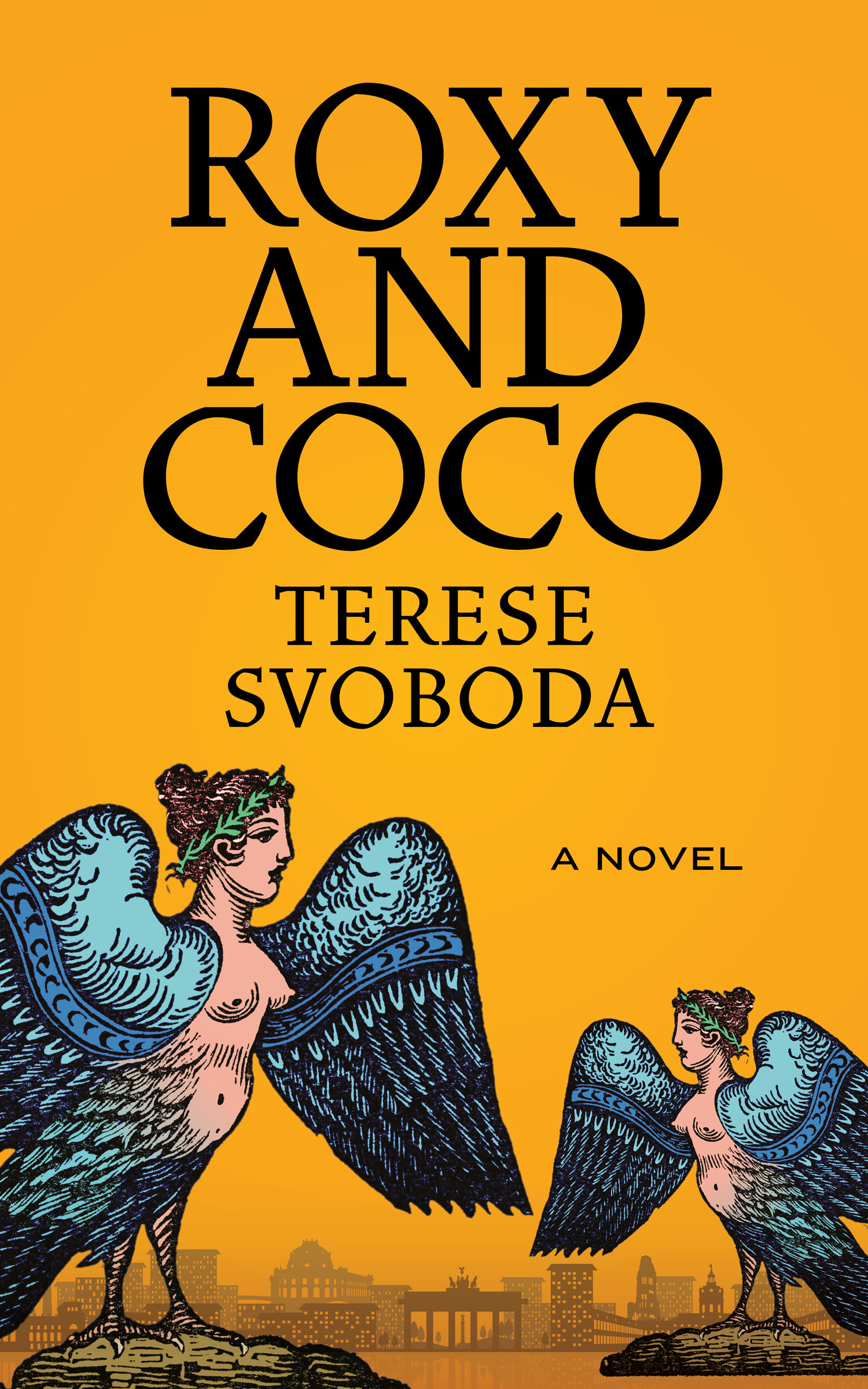

two illustrated harpies with blue wings set against an orange background with a city skyline in the distant background; text reads Roxy and Coco: A Novel, Terese Svoboda

Terese Svoboda

February 2024
286pp
PB 978-1-959000-06-8
$21.99
eBook 978-1-959000-07-5
$21.99

Roxy and Coco

A Novel

Summary

Sisters Roxy and Coco are two glamorous harpies—mythical bird women—attempting to outrun extinction and fix the planet by preventing child abuse, one child at a time.

When Roxy is suddenly attracted to her human supervisor at a social work agency a hundred years too early, Coco is very suspicious. Luring Roxy with his scent, Tim is also on the payroll of a fake conservationist intent on her less-than-legal collection. Coco swoops in to vet Tim, but Interpol is hot on her trail for a series of curious homicides. (Surveillance has a very hard time convincing his boss of what he’s monitoring.) When the sisters find themselves trapped, Chris, a bipolar skateboarding truant, tries his best to rescue them but it’s Stewie, Coco’s colleague, who turns the story inside out. Roxy and Coco climaxes at a gala of egg fanciers who scramble to escape the harpies’ talons.

Action figure–worthy, for readers of Neil Gaiman and Karen Russell, this modern take on these fabled women touches on mental illness, racism, animal rights, and the rights of children.

Author

Author of more than twenty books of poetry, fiction, memoir, biography, and translations from the Nuer, Terese Svoboda has received the Guggenheim, Bobst Prize in fiction, Iowa Poetry Prize, National Endowment for the Humanities translation grant, Graywolf Nonfiction Prize, Jerome Foundation and National Endowment for the Arts media grants, O. Henry Award, Pushcart Prize for the essay, and three New York Foundation for the Arts fellowships.

Reviews

“[A] wry and rambunctious fable . . . . The book offers brief and staggered visions of family, in all its complex permutations. Here, flocks settle into wonderfully unlikely formations. It’s possible that the most dangerous thing for anyone, harpy or human, is the decision to fly alone.”
— Hilary Leichter, New York Times Book Review

“Existing at the sweet spot between Rachel Ingalls’s Mrs. Caliban, Donald Barthelme’s Snow White, and James Purdy’s I Am Elijah Thrush, Roxy and Coco plucks a creature out of myth to bring it into our present—and does so in a way that keeps a steady eye on the flaws of our own weird moment. Rarely has fantastic fiction managed to say so much so deftly about the real while still offering a terrific, strange, and highly original read.”
—Brian Evenson, author of Song for the Unraveling of the World

“There are many mythic reimaginings out there, but I can guarantee you that Roxy and Coco is unlike anything you’ve read—Terese Svoboda’s harpies are winged avengers, a celestial task force who save kids who have been abused by their terrestrial protectors. Who but Svoboda with her talons descending from the clouds could wrest so much humor, poetry, and beauty from the abyss?”
—Karen Russell, author of Orange World and Swamplandia!
EmailFacebookInstagramPinterestTwitter

Hell’s Not Far Off: Bruce Crawford and the Appalachian Left

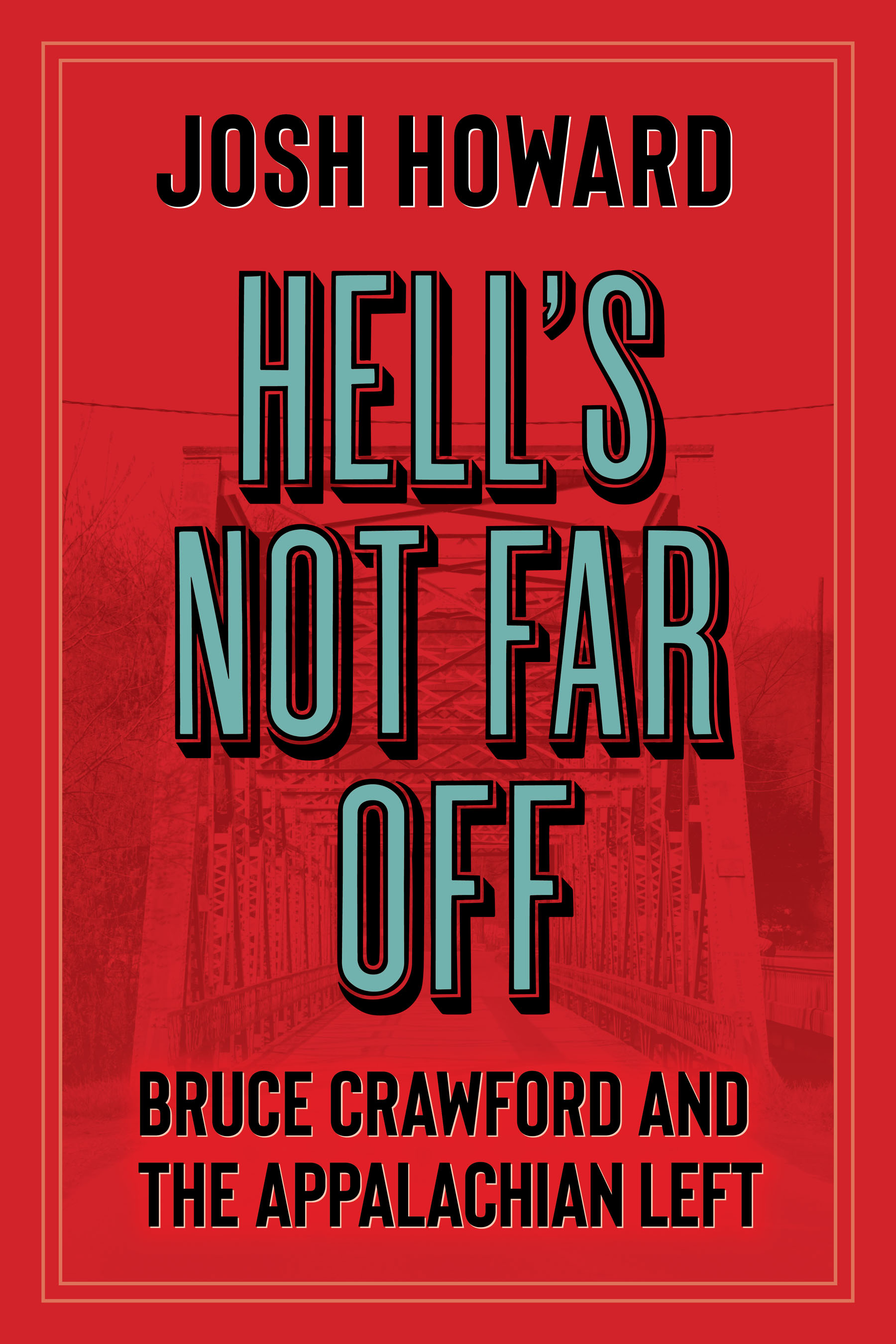
A bright red background superimposed over an image of a bridge; text readers Hell's Not Far Off: Bruce Crawford and the Appalachian Left by Josh Howard

Josh Howard

March 2024
208pp
PB 978-1-959000-10-5
$26.99
eBook 978-1-959000-11-2
$26.99

Hell's Not Far Off

Bruce Crawford and the Appalachian Left

Summary

Hell’s Not Far Off is a grounded, politically engaged study of the Appalachian journalist and political critic Bruce Crawford, a scourge of coal and railway interests. Crawford fought injustices wherever he saw them at major risk to his own life and became an early interpreter of Appalachian labor history.

His writings and actions from the 1920s to the 1960s helped shape southwest Virginia and West Virginia. Through Crawford’s Weekly, a newspaper active from 1920 to 1935, Crawford challenged the Ku Klux Klan, lynch mobs, and the private police forces of coal barons. The wounds received for these efforts were the closing of his paper and a bullet to his leg during a Harlan County strike in the 1930s. In his work after journalism, he led the West Virginia branch of the Federal Writers’ Project during the political standoff over the contents of the state’s official guidebook.

In Hell’s Not Far Off, Josh Howard resurrects strands of a radical tradition centered especially on matters of labor, environment, and race, drawing attention to that tradition’s ongoing salience: “Present-day Appalachia’s fights were [Crawford’s], and his fights are still ours.”

Contents

Acknowledgments

Introduction

1. A Young Newspaper Editor

2. Getting Shot in Harlan County

3. A Critic Fails at Politics

4. The Editor as Public Historian

5. An Inability to Adapt

Notes

Bibliography

Index

Author

Josh Howard is the cofounder of Passel Applied History Consulting, where he works as an applied historian. He lives in Virginia with his partner and cat and writes about Appalachia, legal history, sports, and the National Park Service.

Reviews

“Howard’s meticulous research and artful telling of Bruce Crawford’s story offers a fascinating glimpse into the life of a radical newspaper publisher whose social and political impact extended well beyond the rural Appalachian community in which he published.”
—Michael Clay Carey, author of The News Untold: Community Journalism and the Failure to Confront Poverty in Appalachia

“Appalachian mountain journalist and businessman Bruce Crawford was variously an outspoken critic of the 1920s Klan, a self-described leftist radical fighter for Appalachian coal mining families in the 1930s, a dedicated New Dealer who earned the wrath of an anti-union Democratic West Virginia governor, and a reactionary critic of Civil Rights and New Left activists. Despite his unpredictable political journey, Crawford’s reputation for personal bravery and integrity was never in question. Josh Howard’s work will rescue this brilliant, mercurial figure from undeserved obscurity and fascinate readers interested in Appalachian history and American politics.”
—John Hennen, author of A Union for Appalachian Healthcare Workers: The Radical Roots and Hard Fights of Local 1199

EmailFacebookInstagramPinterestTwitter

Gendered Infrastructures: Space, Scale, and Identity

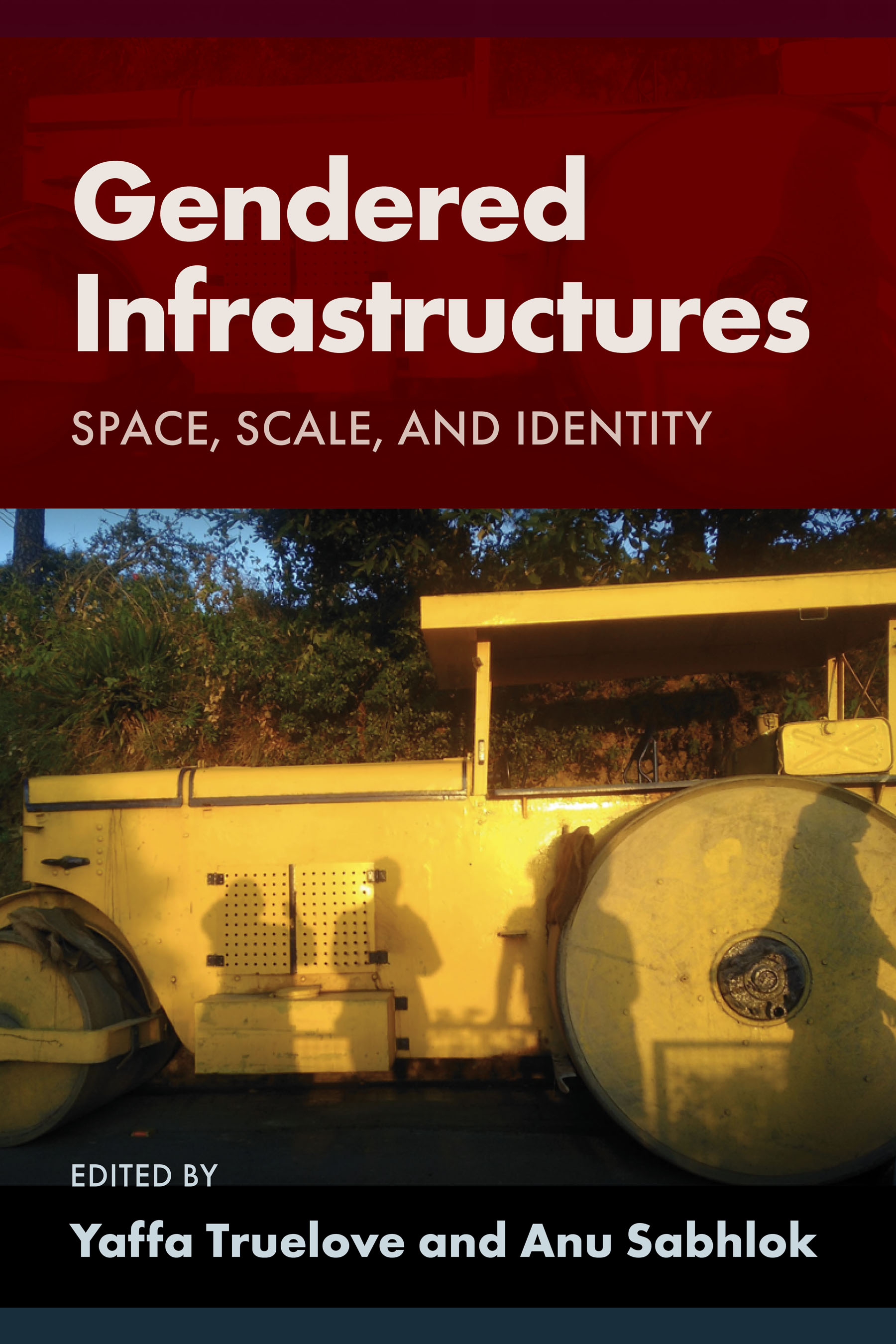
photograph of a yellow tractor with four women's shadows silhouetted against it; text reads Gendered Infrastructures: Space, Scale, and Identity, edited by Yaffa Truelove and Anu Sabhlok

Edited by Yaffa Truelove and Anu Sabhlok

March 2024
264pp
PB 978-1-959000-08-2
$29.99s
eBook 978-1-959000-09-9
$29.99

Gender, Feminism, and Geography Series

Gendered Infrastructures

Space, Scale, and Identity

Summary

The first book to take a feminist geographical approach to infrastructure, Gendered Infrastructures delves into the complex relationships between identity, social relations, and infrastructure. By drawing on feminist scholarship to enable new frameworks for critical study, this edited volume explores the gendered nature of infrastructures as diverse as Senegal’s waste disposal, Vietnam’s cement industry, and Lilongwe’s water kiosks. The chapters consider how infrastructural assemblages rework and shape gendered relations, identities, and meanings across space, while tracing the intersectionality of relations and uneven geographies that surround infrastructure. Ultimately, the contributors show how gender is always present in the quotidian building blocks that organize the socio-material world and daily life.

Edited by Yaffa Truelove and Anu Sabhlok, and the third book in Amy Trauger and Jennifer Fluri’s Gender, Feminism, and Geography series, the original essays in Gendered Infrastructures respond to and build upon a “new infrastructural turn in critical scholarship”—one that has helped enliven studies of identity across scale. The volume is relevant to geographers, anthropologists, architects, sociologists, urban researchers, and other interdisciplinary scholars interested in the gendered and social dimensions of infrastructure.

Contents

Acknowledgments

Introduction
Yaffa Truelove and Anu Sabhlok

1. Concretizing Modernity: The Gendered Labor of Cement Infrastructures in Vietnam
Christina Schwenkel

2. Gender Relations and Infrastructural Labors at the Water Kiosks in Lilongwe, Malawi
Cecilia Alda-Vidal, Alison L. Browne, and Maria Rusca

3. Gendered Infrastructures of Discard in Dakar, Senegal
Rosalind Fredericks

4. Placing Oppression (with)in Public Infrastructures: Tracing an Intersectional Relationship between Gender, Violence, and Technology
Anshika Suri

5. Severing the Spatial Leash: Promoting Women’s Right of Mobility through Digital Disruption and a Feminist Ethics of Care
Linda Carroli and Deanna Grant-Smith

6. Trains, Trees, and Terraces: Infrastructures of Settler Colonialism and Resistance in the Refaim Valley, Israel-Palestine
Gabi Kirk

7. Informal Transport Infrastructures: Gendered Experiences of Moving around the Peripheries of Quito, Ecuador
Cristen Dávalos and Julie Gamble

8. “Dirty Phone”: Infrastructures of Violence against Women in Urban Kerala
Nabeela Ahmed and Ayona Datta

9. Infrastructure of Recyclable Waste as Assemblages: From Scavengers on the Ground to Recycling Workers in Collectives
Margarida Queirós, Antonio Cezar Leal, Fernanda Regina Fuzzi, and Mário Vale

10. Conceptualizing Bodies as Urban Infrastructure: Gender, Intimate Infrastructures, and Slow Infrastructural Violence in Urban Nepal and India
Yaffa Truelove and Hanna A. Ruszczyk

11. Looking into Wells: Picturing the Gendered Relations of Water Infrastructure in Southwest Cameroon
Jennifer A. Thompson

Afterword
Anu Sabhlok and Yaffa Truelove

Contributors

Index

Author

Yaffa Truelove is an assistant professor in the Department of Geography and the Program in International Affairs at the University of Colorado Boulder. Her research focuses on urban and feminist political ecologies of water, urban infrastructure, and the governance of Indian cities.

Anu Sabhlok is a professor in the Department of Humanities and Social Sciences at the Indian Institute of Science Education and Research Mohali. Her work lies at the intersection of feminist geography, architecture, labor studies, and critical infrastructure studies.

Reviews

“This collection offers insights into the ways in which infrastructural challenges, restrictions, breakdowns, and opportunities intersect with gendered labor, mobility, and the ability to effectively access spaces and live in specific places. It will undoubtedly make important and lasting contributions to the extant literature in feminist geography and geographies of development.”
Jennifer L. Fluri, coauthor of Engendering Development: Capitalism and Inequality in the Global Economy
 

EmailFacebookInstagramPinterestTwitter

Give to West Virginia University Press

Give to West Virginia University Press

Dark-blue button with gold text reading Give to WVU Press

Why Give?

West Virginia University Press—as the only university press, and the largest publisher of any kind, in the state of West Virginia—strives to publish the very best work in our areas of specialization. As a nonprofit publisher, we publish books because of their significance and impact rather than their commercial viability. While sales cover a significant portion of our costs, donations help us carry out our mission to publish high-quality books for readers in the state, around the country, and around the world.

Many of our most distinguished and attractive books are made possible by support from generous individuals and institutions. Your gift allows the Press to:

  • Publish scholarly and regional works that may not always recover their costs through sales
  • Produce beautifully illustrated books about West Virginia and the region
  • Develop ambitious long-term projects showcasing areas in which West Virginia, West Virginia University, and the Press are recognized as established or emerging leaders

How to Give

We welcome contributions of any amount. To make a gift, please visit our page at Give WVU (https://give.wvu.edu/wvupress).

Donations are tax deductible.

To discuss funding opportunities at the Press, including sponsorship of individual books and series, please contact Than Saffel, interim director, at press_director@mail.wvu.edu.

Thank you for your support!

Victorian Poetry: Volume 60, Issues 1-4

Image

Victorian Poetry: Volume 60, Issues 1–4
Editor: John B. Lamb, West Virginia University
E-ISSN: 1530-7190
Print ISSN: 0042-5206

Click on listed price to corresponding product to order:
Institution (US): $140.00
Individual (US): $65.00
Institution (Outside US, including Canada): $165.00
Individual (Outside US, including Canada): $90.00


Mama Said: Stories

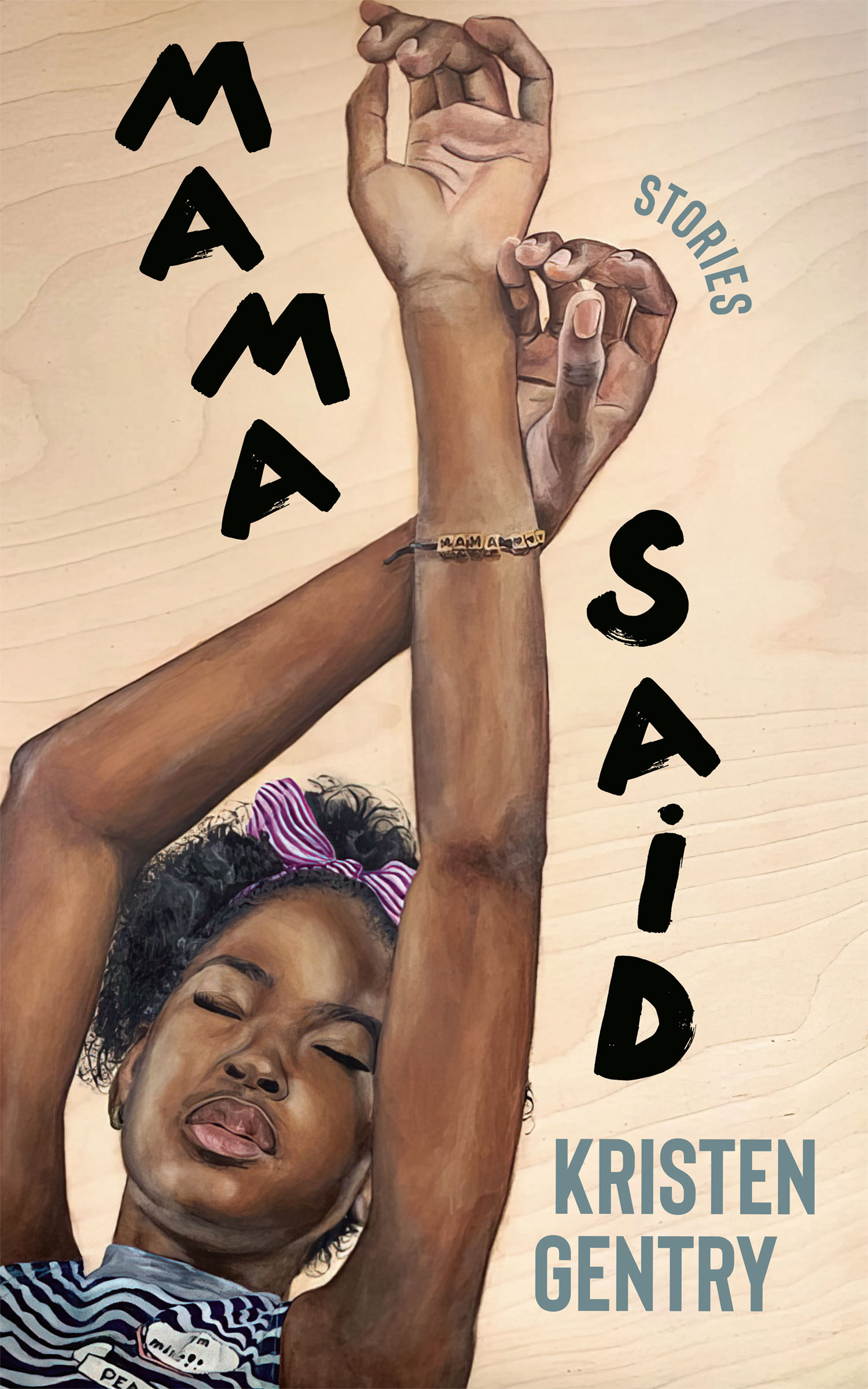
painting of a black girl laying on a light wood-grain floor with her arms overhead; text reads Mama Said: Stories by Kristen Gentry

Kristen Gentry

October 2023
288pp
PB 978-1-952271-98-4
$19.99
eBook 978-1-952271-99-1
$19.99

Mama Said

Stories

Summary

The linked stories in Mama Said are set in Louisville, Kentucky, a city with a rich history steeped in tobacco, bourbon, and gambling, indulgences that can quickly become gripping and destructive vices. Set amid the tail end of the crack epidemic and the rise of the opioid crisis, Mama Said evokes Black family life in all its complexity, following JayLynn, along with her cousins Zaria and Angel, as they come of age struggling against their mothers’ drug addictions.

JayLynn heads to college intent on gaining distance from her depressed mother, only to learn that her mother’s illness has reached a terrifying peak. She fears the chaos and instability of her extended family will prove too much for her boyfriend, whose idyllic family feels worlds, not miles, apart from her own. When bats invade Zaria’s new home, she is forced to determine how much she is willing to sacrifice to be a good mother. Angel rebels on Derby night, risking her safety to connect with her absent mother and the wild ways that consumed her.

Mama Said separates from stereotypes of Black families, presenting instead the joy, humor, and love that coexist with the trauma of drug abuse within communities. Kristen Gentry’s stories showcase the wide-reaching repercussions of addiction and the ties that forever bind daughters to their mothers, flaws and all.

Contents

Mama Said
A New World
A Satisfying Meal
A Sort of Winning
Origin Story
A Good Education
Grown Folks’ Business
Introduction
To Have and to Hold
Animal Kingdom
In Her Image
Everything You Could Ever Want

Acknowledgments

Author

Kristen Gentry received her MFA from Indiana University. Her award-winning fiction has been nominated for a Pushcart Prize and has appeared in Crab Orchard Review, Jabberwock Review, and other journals. She is a VONA and Bread Loaf Writers’ Conference alumna, as well as a member of the inaugural Poets & Writers publicity incubator cohort for debut authors. Her passion is helping Black women and girls share their stories—the ones they’ve lived and the ones they create. She lives and writes in Louisville, Kentucky. Learn more at kristengentry.com.

Reviews

“A celebration of Black family life that will make you laugh and cry in equal measure.”
Kirkus Reviews (starred review)

“The collection will reshape what you think about the region and the people that inhabit it.”
Debutiful

“Surprising and revelatory. Mama Said is funny and smart, with many wonderful images, arresting descriptions, and well-developed characters with rich interior lives. I love this book.”
—Stephanie Powell Watts, author of No One Is Coming to Save Us

“This book has staying power. Mama Said is a collection of brilliant stories that are of Kentucky, of Louisville, of Black communities throughout the United States. They are rooted in geographic specificity yet expand to far-reaching bounds of culture, family, and belonging. The characters and their struggles and triumphs will vibrate within your heart and mind long after the last pages are turned.”
—Crystal Wilkinson, former poet laureate of Kentucky and author of Praisesong for the Kitchen Ghosts

Mama Said is a tough yet tender glimpse into a complex community in a city full of strife and love. The characters contain a depth not often seen in a collection of stories, and readers are sure to be thinking about their lives and relationships long after finishing the last (tear-jerking!) page.”
—Maggie Henriksen, Carmichael’s Bookstore

EmailFacebookInstagramPinterestTwitter

Shattered: Fragments of a Black Life

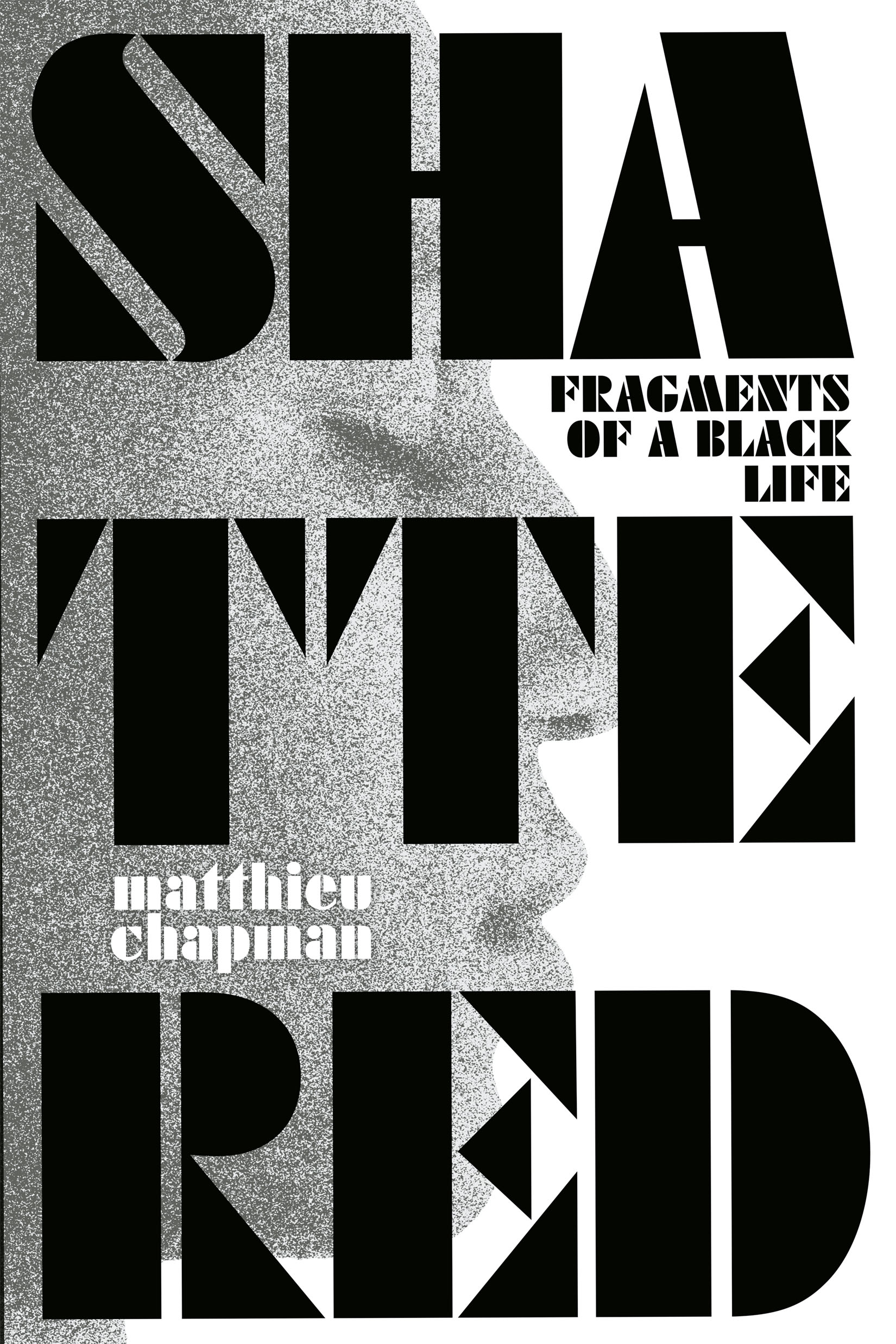
white background with black lettering overtop the side profile of a young black man in pixelated black and white; text reads Shattered: Fragments of a Black Life by Matthieu Chapman

Matthieu Chapman

August 2023
456pp
PB 978-1-952271-92-2
$27.99
eBook 978-1-952271-93-9
$27.99


Shattered

Fragments of a Black Life

Summary

From a distance, Matthieu Chapman’s life and accomplishments serve as an example of racial progress in America: the first in his family to go to college, he earns two master’s degrees and a doctorate and then becomes a professor of theater. Despite his personal and academic success, however, the specter of antiblackness continues to haunt his every moment and interaction.

Told through fragments, facets, shards, slivers, splinters, and absences, Shattered places Chapman’s own story in dialogue with US history and structural analysis of race to relay the experience of being very alive in a demonstrably antiblack society—laying bare the impact of the American way on black bodies, black psyches, and black lives. From the Church of Jesus Christ of Latter-day Saints to the offices of higher education, from a Loyal White Knights flyer on his windshield to a play with black students written by a black playwright, Chapman’s life story embodies the resistance that occurs, the shattering, collapsing, and reconfiguring of being that happens in the collisions between conceptions of blackness. Shattered is a heartrending and thought-provoking challenge to narratives of racial progress and postracial America—an important reminder that systemic antiblack racism affects every black person regardless of what they achieve in spite of it.

Author

Matthieu Chapman is assistant professor of theater and head of theater studies at SUNY New Paltz. His writing has been published in Huffington Post and Pithead Chapel, among others. He holds degrees in theater and performance theory from San Diego State University, Mary Baldwin University, and University of California San Diego.

Reviews

“Every so often, a book comes along that changes the way we see, speak, and think about the world. Shattered is one of those books. Chapman’s relentless prose interweaves compelling narrative with groundbreaking critical race theory in an unflinching analysis of the day-to-day violence inflicted on black beings in an antiblack world. A must-read for anyone seeking a deeper understanding of race relations in America and answers to why black liberation remains deferred.”
Frank B. Wilderson III, author of Afropessimism and Incognegro

“I’m writing this while I’m back home in West Virginia visiting my mama, and I wish my pre-writer/professor black ass coulda read Matthieu Chapman’s Shattered as a teen because it woulda helped me navigate this complicated mess of growing up black in WV. Now, it’ll help me navigate this complicated mess of growing up black in this world. This important book is for everyone, and I hope all the young folks and old heads in any geography get a chance to read it. Thanks, homie.”  
Steven Dunn, author of Potted Meat

Excerpt

Author’s Note

Afropessimism.

Many find the name off-putting, depressing, defeatist—all reactions I had initially. But once I began to interrogate my own aversion to the label and began to truly engage with the nuances and diversity of thought within the field, I found things I had never experienced before.

Radical hope.
Radical creativity.
Radical self-determination.

Afropessimism is a field of theory that distinguishes antiblack racism from other forms of racism. As such, the problem of race for black people is not white supremacy—in which all nonwhite races suffer equally compared to whiteness—but rather the problem is antiblackness—in which all nonblacks maintain a structural position of human from which blacks are excluded. In other words, black people are nonhuman, and everyone else is human. The distinction is that under white supremacy, all nonwhite beings are positioned as subhuman—less than the full white subject—and therefore the suffering of nonwhite beings can be analogized. For example, with white supremacy, we can compare the suffering of the colonized Indian to the suffering of the immigrant Mexican. In Afropessimism, blackness is incompatible with the construction of the human, therefore blacks do not exist on the scale that would allow us to compare black suffering to human suffering. Afropessimism is not a critique of black people. Rather it is a critique of a world that needs black suffering and black death to maintain its own mental health.

Throughout this book, I use “black” in the lowercase. And only in the lowercase—even when starting a sentence. I used to oscillate between various constructions of “black” and “Black” to distinguish between a color and a Concept. “black”—black as night, black tar, coal-black. “Black”—Black people, Black being, Black death. But “Black” is not proper in this context because the concept of black in this book is not proper. This book is not about blackness that is sanitized and proper and resilient and hopeful. This book is about the blackness that survives despite its death, despite a world that continually kills us. This book is about blackness that, as La Marr Jurelle Bruce says, is “a critique of the proper . . . a blackness that is neither capitalized nor propertized via the protocols of Western grammar; a blackness that centers those who are typically regarded as lesser and lower cases.”1 It is a blackness that escapes what the world thinks of it and transcends any definitions I could give. I love the capital B, and I love those who use the capital B. But this book escapes designations of proper and improper. This book works beyond and between the anger and the rage and the joy and the love and the hope for a future and the hopelessness in the now. Nothing about this book is “proper,” most of all its exploration and expression of blackness.

This is not a book about black life or about living life as a black man. This is neither a book about being black nor about black being. This book is about the resistance that occurs, the shattering, collapsing, and reconfiguring of being that happens in the collisions between competing conceptions of blackness. This book is about the struggle between a free, unbridled, uncontainable blackness and the cage that the antiblack world has built for it.

This book is about living in a world of the dying.
This book is about being dead in the land of the living.
This book is about the tension between wholes and pieces in a world whose whole is built on my pieces.

As such, the story is in the whole, but the story is also in the pieces: fragments, facets, shards, slivers, splinters, absences.

  • Fragments: Think of these as broader chapters that cover chunks of time.
  • Facets: Each fragment contains multiple facets—the large pieces of a primarily linear narrative of my trials and tribulations in navigating the world of difference between my blackness and how the world perceives, engages, and violates my blackness. Each facet is required to see the whole. The facets in the narrative, while numbered beginning with one in each fragment, do not necessarily come in chronological order—the pieces never fall organized or neatly.
  • Shards: Alongside the facets are various shards of story that have broken through time, space, and narrative to provide other experiences in my life that inform and enliven the facets.
  • Slivers: Adjacent to the facets and shards are the smaller slivers of being that provide light, brief bits of history, and contexts through which to view the other pieces.
  • Absences: But shattered objects are not defined solely by the pieces that scatter. The breaking produces negative spaces that define the separate parts of the former whole. These absences appear on the page as the unseeable that haunt and scandalize the whole.
  • Splinter: And just when I thought I had collected all the pieces, I found that splinters remain missing. Tiny, nearly imperceptible spears of emotion and imagery that cannot be put into tidy paragraphs.


Absence
Status: The story you are reading is true.

This story is not about resistance and resilience in the face of white supremacy.
This story is not about overcoming obstacles and dismantling systemic racism.
The story is asking why black resistance and overcoming always seem to fall short of creating lasting change.
This story is asking how, despite the many political and social progresses of black people, we are still no closer to the mountaintop.
This story is questioning if we’ve been having the wrong conversations about how to change the world.
This story is about a world that needs antiblackness to function.
This story is about wandering the world of the living as a dead man.
This story is about surviving in death.
This story isn’t about changing that world.
This story is about destroying it.


Fragment 1

Facet: 1
Age: 11
Place: Uniontown, PA
Status: Dying

I had never actually heard the word in person. Sure, I had heard the word’s distant cousin, whose razor blade edges had been dulled by the softening of the hard r sound into “nigga,” on albums from the Wu-Tang Clan and Dr. Dre. But even in those cases, the force of the word was always mediated through layers of hi-fi and audiotape.

But here, in the flesh, the word was too real. The word became tangible. The hard r re-sharpened the blade. The blade grew wings, eyes, a mouth—the razors becoming talons on a monster that cut through the room toward me with velocity and violence. It caught my chest and ripped through my flesh, leaving a wound in my soul that would never and could never heal. A taste overcame my mouth: a blend of sour rancidness and ferric metal—a mix of bile and blood that rose from deep in the pit of my stomach.

It was the taste of hate.

Up until that moment, I didn’t know that hate had a taste.

EmailFacebookInstagramPinterestTwitter