
Ecologies of a Storied Planet in the Anthropocene


Serpil Oppermann
March 2023
240pp
PB 978-1-952271-62-5
$29.99
eBook 978-1-952271-73-1
$29.99
Salvaging the Anthropocene Series

Serpil Oppermann
March 2023
240pp
PB 978-1-952271-62-5
$29.99
eBook 978-1-952271-73-1
$29.99
Salvaging the Anthropocene Series
Ecologies of a Storied Planet in the Anthropocene is a tour de force. With transdisciplinarity and theoretical lucidity, it rethinks the Anthropocene from a material ecocritical perspective, envisioning innovative modes of knowledge for deeper understandings of Anthropocene ecologies. Focusing on nonhuman agencies, Serpil Oppermann shows in fascinating detail how to better imagine an ecological future on our storied planet that has suffered enormously from an anthropocentric mindset.
Introduction
1. The Storied Planet in the Anthropocene
2. The Scale of the Anthropocene and New Anthroposcenarios
3. Migrant Ecologies of the Anthropocene
4. Postnatural Ecologies of the Anthropocene
5. The Ecology of Colors in the Anthropocene
Coda
Acknowledgments
Notes
References
Index
Serpil Oppermann is professor of environmental humanities and director of the Environmental Humanities Center at Cappadocia University. She is the coeditor of many books, including International Perspectives in Feminist Ecocriticism, Material Ecocriticism, and Environmental Humanities: Voices from the Anthropocene.
“Simply dazzling. . . . The book is shockingly revealing, honest, and persuasive. It shines.”
Ecocene
“Genuinely interdisciplinary, clear, and readable. This should be read across the academy—from geography to literary studies.”
Claire Colebrook, Penn State University
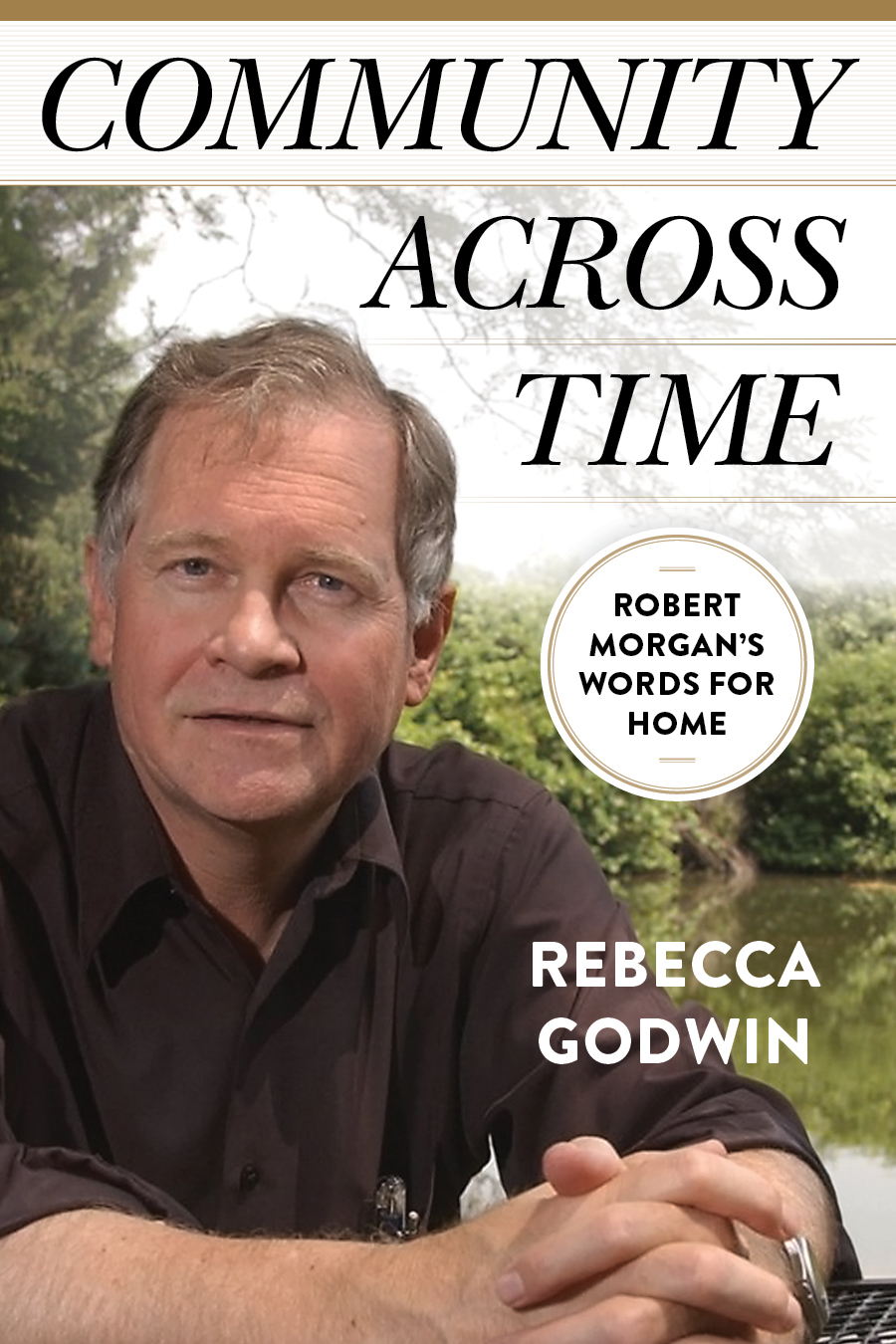
Rebecca Godwin
May 2023
208pp
PB 978-1-952271-82-3
$26.99
eBook 978-1-952271-83-0
$26.99
Robert Morgan’s Words for Home
One of the first book-length studies of Robert Morgan, Community across Time considers the Appalachian writer’s explorations of memory, family history, and landscape. It provides a study of all of Morgan’s fiction to date, as well as a chapter on his poetry and some reference, where appropriate, to his nonfiction. Rebecca Godwin examines the family history that informs much of this body of work, offering an extended biographical essay that ties characters and plot details to Morgan’s ancestors’ lives and to his own experiences growing up in the Blue Ridge Mountains.
Religious rifts, economic hardships, class conflicts, the place of women and Indigenous peoples, and the failure of humans to recognize the divinity of the natural world are among the motifs centering Morgan’s writing. Community across Time explores those themes as it looks to Morgan’s relationship to the Appalachian South.
Preface
1. Influences and Context: Robert Morgan in Literary Community
2. Roots of a Writing Life: His Appalachian Homes, South and North
3. Sixteenth- through Nineteenth-Century History: Fictionalizing Pioneers and Conflicts
4. The Family Novels: Two Generations of Paternal and Maternal Ancestors
5. More Short Fiction: Classism, War, Machine-Age Destruction
6. Poetry’s Place: Memory, Nature, Science, Resurrection
7. Final Words: The Morgenland Elohist
Notes
Bibliography
Index
Rebecca Godwin is professor of English and Elizabeth H. Jordan Chair of Southern Literature at Barton College in Wilson, North Carolina. She is author of a book on Lee Smith as well as forty essays and book reviews in critical anthologies or scholarly journals, all focused on southern or Appalachian writers.
“Robert Morgan has established himself as a major American writer and one of the most important voices to have emerged from Appalachia in the past half century. Remarkably, no scholarly monograph has yet been published on his writing. Rebecca Godwin’s excellent treatment is poised to satisfy a demand that is keenly and widely felt.”
George Hovis, author of Vale of Humility: Plain Folk in Contemporary North Carolina Fiction

Kristine Langley Mahler
October 2022
192pp
PB 978-1-952271-65-6
$21.99
eBook 978-1-952271-66-3
$21.99
In Place Series
Artifacts
After spending four years of adolescence in suburban North Carolina, Kristine Langley Mahler, even as an adult, is still buffeted by the cultural differences between her pioneer-like upbringing in Oregon and the settled southern traditions into which she could never assimilate. Collecting evidence of displacement—a graveyard in a mall parking lot, a suburban neighborhood of white kids bused to desegregate public schools in the 1990s, and the death of her best friend—Curing Season is an attempt to understand her failed grasp at belonging.
Mahler’s yearning for acceptance remains buried like a splinter, which she carefully tweezes out in the form of artifacts from her youth. But it isn’t until she encounters a book of local family histories that she takes inhabitation and truth apart, grafting and twisting and imprinting her history on theirs, until even she can no longer tell the difference between their truth and her own. Using inventive essay forms, Mahler pries apart the cracks of exclusion and experiments with the nature of belonging, memory, and place. Curing Season is a coming-of-age memoir for anyone who grew up anywhere but home.
Surface Tension
Club Pines
Shadowbox
A Fixed Plot
Mädchenfänger
She’ll Only Come Out at Night
Creepsake
Not Something That’s Gone
Out Line
In the Burn Pile Behind the Old Nobles House
A Pit Is Removed, a Hollow Remains
Alignment
Pull Me Through the Doorway
Acknowledgments
Notes
Kristine Langley Mahler is a memoirist experimenting with the truth who lives near Omaha, Nebraska. Her work has been supported by the Nebraska Arts Council and is published in DIAGRAM, Ninth Letter, Brevity, Speculative Nonfiction, the Rumpus, and elsewhere. She is the director of Split/Lip Press.
“An exquisite, aching memoir of adolescent girlhood. . . . Treasures await.”
Minneapolis Star Tribune
“These experimental essays about place, home, and the failed effort to belong are closely tied to Eastern North Carolina, but will resonate everywhere.”
Shelf Awareness
“Through careful excavation . . . Mahler manages to create a time machine harking back to the simplicity and complexity of adolescence in 1990s America.”
Booklist
“A fun, strange play on nostalgia and belonging that embodies something so middle school that it aches. . . . It’s a lovely and clever book of essays that add up to an intricate depiction of what must surely be everyone’s oddest time.”
The Rumpus
“Kristine Langley Mahler’s Curing Season is a lovely and rapturous excavation and examination of the past, a lesson in writing oneself into history when it doesn’t offer you a space. Displaced, coming of age, estranged from tradition, feeling out of place, this is a voice that teaches us how to live in the aftermath: you may not recognize life as you are living it, mementos may not reveal themselves until after the fact, what we miss and mourn may be what harmed us in the past. In imaginative forms and gripping prose, Mahler leads us to the entombed interiors of loss and shows us how to rewrite our stories so that we truly fit in.”
Jenny Boully, author of Betwixt-and-Between: Essays on the Writing Life
“An exquisite excavation of childhood and adolescence, Curing Season recounts Kristine Langley Mahler’s long-ago attempts at fitting in after moving to her new town: from wanting to carry the right shopping bag in the mall to forming an alliance with one girl against others to mailing ‘histrionic letters of homesickness’ to friends at her old school. In wise, lyrical, and formally inventive essays, Mahler vividly illustrates the heartaches of trying to belong in a place—even after leaving it.”
Jeannie Vanasco, author of Things We Didn’t Talk about When I Was a Girl
“An exceptional example of both place-based and experimental writing. My own adolescence and all the times I felt like an outsider sprang to life reading these pages.”
Erica Trabold, author of Five Plots
Rachel King
November 2022
152pp
PB 978-1-952271-49-6
$19.99
eBook 978-1-952271-57-1
$19.99
Stories
2023 Colorado Book Award Winner, Literary Fiction
It’s almost a decade after the Great Recession, and in Colorado, St. Anthony Sausage has not recovered. Neither have its employees: a laid-off railway engineer, an exiled computer whiz, a young woman estranged from her infant daughter, an older man with cancer who lacks health care. As these low-wage workers interact under the supervision of the factory’s owner and his quietly rebellious daughter, they come to understand that in America’s postindustrial landscape, although they may help or comfort each other, they also have to do what’s best for themselves.
Over the course of these twelve interrelated stories, Rachel King gives life to diverse, complex, and authentic characters who are linked through the sausage factory and through their daily lives in a vividly rendered small town in Boulder County. The internal and external struggles of Bratwurst Haven’s population are immediately and intimately relatable and resonant: these people seek answers within the world they inhabit while questioning what it means to want more from their lives.
Railing
Visitation Day
A Friendship
A Deal
Poker Night
Childrearing
Murals
At the Lake
Strangers
Middle Age
Pavel
Bratwurst Haven
Rachel King is the author of the novel People along the Sand. Her short stories have appeared in One Story, North American Review, Green Mountains Review, Northwest Review, and elsewhere. A graduate of the University of Oregon and West Virginia University, she lives in her hometown of Portland, Oregon.
“An excellent collection that’s likely to appeal to fans of Alice Munro and Tobias Wolff—or to anybody with a taste for emotionally resonant short fiction.”
Kirkus Reviews
“Often hovering on the cusp of some potential change, the characters in Bratwurst Haven’s beautifully written stories share a yearning for more—a better relationship or job or simply a chance to feel content. These all-too-relatable struggles make the stories not only engrossing but also an intriguing and tenderly rendered study of this flawed world we call home.”
Rajia Hassib, author of A Pure Heart
“In these twelve linked short stories, Rachel King captures the magic of the American mountain west and the people who call it home. Her characters take work in a sausage factory, pull shifts at a bar to fund their art, struggle with booze and pills, or end up with a haircut after losing at poker. They also care for one another, offering kindnesses both large and small. In Bratwurst Haven, King uncovers the complicated ways humans connect, and she gives it to us in prose that is as crystal clear as a bright Colorado day. It is a collection that builds with each story revealing more and more of the friendships and family that bind us all together—and that we cannot escape from, even when we try.”
Wendy J. Fox, author of What If We Were Somewhere Else and If the Ice Had Held
“Bratwurst Haven is an endearing composite portrait of a working class community in transition.”
Foreword Reviews

Tom Bredehoft
August 2022
248pp
PB 978-1-952271-60-1
$19.99
eBook 978-1-952271-61-8
$19.99
A Mystery Novel
In the space of one weekend in Morgantown, West Virginia, private investigator Big Jim Foote finds himself at the center of two murder investigations. Suspected of one killing at a local festival, he locates the body of a missing person immediately after. The cops are watching him, and Big Jim has a secret he dares not reveal: he is a bigfoot living in plain sight, charged with keeping his people in the surrounding hills from being discovered. To protect the bigfoot secret, he must solve both murders—and convince himself it wasn’t a bigfoot who pulled the trigger.
Through the course of his investigations, Big Jim is helped by unique and well-rendered characters and friends in both his bigfoot and human communities. Readers are introduced to Appalachian mountain folk and traditional culture in new ways, even while Big Jim experiences the impact of the opioid epidemic on his own bigfoot kin. By centering a mythical creature as the unlikely protagonist in this enchanting literary murder mystery, Foote offers a winsome redefinition of a cryptid “monster” and breathes new life into the PI genre.
Tom Bredehoft lives in Morgantown, West Virginia. In an earlier life, he was an English professor specializing in medieval literature.
“A tale about humanity wrapped in the garment of an excellent hard-boiled thriller. Part mystery, part fable but all original, Jim Foote is sure to be one of your favorite literary detectives—cryptid or otherwise.”
Jordan Farmer, author of The Poison Flood and The Pallbearer
“The first thing to say about Foote is that it is a strange and seemingly untenable hybrid of bigfoot fantasy and detective novel noir; the second is that its matter-of-fact voice and deeply authentic setting in the hollows of West Virginia render every part of the story perfectly real and entirely (marvelously) ordinary. This is a novel that uses moonshine heritage to delve into the modern opioid epidemic, and a novel that asks about the meaning of ‘otherness’ while reminding us what it means to be human. I fell into this book and loved it from the first page.”
Molly Gloss, author of Wild Life and The Heart of Horses
“Family, folklore, and mountain folk culture all play starring roles in this cryptozoological conundrum that delights and entertains at every twist of the trail.”
Southern Review of Books
“A pleasure to read. . . . The West Virginia otherworld Bredehoft patiently builds in this compact, 224-page whodunit is a delightfully odd noir mélange.”
West Virginia Humanities Council Broad Side
Kelly A. Hogan and
Viji Sathy
August 2022
272pp
PB 978-1-952271-63-2
$24.99
eBook 978-1-952271-64-9
$24.99
Teaching and Learning in Higher Education Series
Strategies for Promoting Equity in the College Classroom
In a book written by and for college teachers, Kelly Hogan and Viji Sathy provide tips and advice on how to make all students feel welcome and included. They begin with a framework describing why explicit attention to structure enhances inclusiveness in both course design and interactions with and between students. Inclusive Teaching then provides practical ways to include more voices in a series of contexts: when giving instructions for group work and class activities, holding office hours, communicating with students, and more. The authors finish with an opportunity for the reader to reflect on what evidence to include in a teaching dossier that demonstrates inclusive practices.
The work of two highly regarded specialists who have delivered over a hundred workshops on inclusive pedagogy and who contribute frequently to public conversations on the topic, Inclusive Teaching distills state-of-the-art guidance on addressing privilege and implicit bias in the college classroom. It seeks to provide a framework for individuals and communities to ask, Who is being left behind and what can teachers do to add more structure?
Receive a 30% discount on orders of 10 or more copies of this title with code HIGHEREDBULK30 at checkout.
Preface
Chapter 1: Inclusive Teaching as a Mindset
Chapter 2: The Value of Structure
Chapter 3: Designing Your Course and Syllabus with an Inclusive Mindset
Chapter 4: Launching Your Course
Chapter 5: Classroom Environment and Interactions
Chapter 6: Inclusive Practices Outside the Classroom
Chapter 7: Reflecting and Documenting
Acknowledgements
Bibliography
Index
Kelly A. Hogan and Viji Sathy are award-winning instructors at the University of North Carolina at Chapel Hill with a passion for student success, equity, and inclusion in the classroom. Both are leading the campus in curriculum reforms, bringing inclusive course design and pedagogy to all disciplines.
“An important and necessary contribution to the conversation about teaching that is happening now, both postpandemic and in the wake of ongoing protests about racism in our society. The overall tone is one of compassion and deep understanding of what teaching entails and how to make it better for both instructor and student.”
Cyndi Kernahan, author of Teaching about Race and Racism in the College Classroom
“Compelling and critical. Given the urgent need to promote justice, equity, diversity, and inclusion in our communities, the book is a must-read for all who are in a position to better support inclusive teaching inside and outside the classroom.”
Science
“Powerful and welcome. . . . There are a lot of pragmatic strategies to implement—something for faculty at every level of teaching expertise.”
Regan A. R. Gurung, coauthor of Thriving in Academia: Building a Career at a Teaching-Focused Institution
Edited by Jessamyn Neuhaus
November 2022
296pp
PB 978-1-952271-67-0
$24.99
eBook 978-1-952271-68-7
$24.99
Teaching and Learning in Higher Education Series
Interrupting Biases about Faculty and Increasing Student Learning
Picture a Professor is a collection of evidence-based insights and intersectional teaching strategies crafted by and for college instructors. It aims to inspire transformative student learning while challenging stereotypes about what a professor looks like.
Representing a variety of scholarly disciplines, the volume’s contributing authors offer practical advice for effectively navigating student preconceptions about embodied identity and academic expertise. Each contributor recognizes the pervasiveness of racialized, gendered, and other biases about professors and recommends specific ways to respond to and interrupt such preconceptions—helping students, teachers, and others reenvision what we think of when we picture a professor.
Educators at every stage of their career will find affirming acknowledgment of the ways systemic inequities affect college teaching conditions, as well as actionable advice about facilitating student learning with innovative course design, classroom activities, assessment techniques, and more.
Receive a 30% discount on orders of 10 or more copies of this title with code HIGHEREDBULK30 at checkout.
Introduction: Embodied Identity, Empowering Pedagogy, and Transformative Learning
Jessamyn Neuhaus
Part One
The First Day: Strategies for Starting Strong
1. How Blind Professors Win the First Day: Setting Ourselves Up for Success
Sheri Wells-Jensen, Emily K. Michael, and Mona Minkara
2. Critical Reflexivity as a Tool for Students Learning to Recognize Biases: A First Day of Class Conversation on What a Professor Looks Like
Jesica Siham Fernández
3. Commonalities and Research: A One-Two Punch to Combat STEM Fears and Biases on the First Day of Class
Kelly E. Theisen
4. Where’s the Professor? First-Day Active Learning for Navigating Students’ Perceptions of Young Professors
Reba Wissner
Part Two
Making Connections: Strategies for Building Trust and Rapport with Students
5. Using Experiential Learning to Humanize Course Content and Connect with Students
Breanna Boppre
6. Collaborative Rubric Creation as a Queer, Transgender Professor’s Tactic for Building Trust in the Classroom
Fen Kennedy
7. Reflect to Deflect: Using Metacognitive Activities to Address Student Perceptions of Instructor Competence and Caring
Melissa Eblen-Zayas
8. From Absentminded Professor to Epistemic Collaborator: Reframing Academic Expertise through Vulnerability and Metacognition
Rebecca Scott
9. Black Man in a Strange Land: Using Principles of Psychology and Behavior Science to Thrive in the Classroom
Erik Simmons
Part Three
Anti-Racist Pedagogies: Strategies for Increasing Equity
10. Beyond Making Statements: The Reflective Practice of Becoming an Anti-Racist Educator
M. Gabriela Torres
11. Rippling the Patterns of Power: Enacting Anti-Racist Pedagogy with Students as Co-teachers
Chanelle Wilson and Alison Cook-Sather
12. Beyond “Good Writing”: Enacting Anti-Racist Policies in Academic Writing
Jacinta Yanders and Ashley JoEtta
Part Four
Teaching with Our Whole Selves: Strategies for Instructional Authenticity and Pedagogical/Professional Success
13. The Superpowers of Visual Ambiguity: Transfiguring My Experience of Colorism and Multiheritage Identity for Educational Good
Donna Mejia
14. Sharing Our Stories to Build Community, Highlight Bias, and Address Challenges to Authority
Sarah Mayes-Tang
15. Teaching Up: Bringing My Blackness into the Classroom
Celeste Atkins
16. Empowered Strategies for Women Faculty of Color Navigating Teaching Inequities in Higher Ed
Chavella T. Pittman
Index
Jessamyn Neuhaus is a professor of history and Center for Teaching Excellence director at SUNY Plattsburgh. Recipient of the SUNY Chancellor’s Award for Teaching Excellence, she is the author of two historical monographs, numerous articles, and Geeky Pedagogy: A Guide for Intellectuals, Introverts, and Nerds Who Want to Be Effective Teachers.
“Does a service to all who would prefer a different path, offering realistic strategies to engage students in undermining scholarly stereotypes.”
Science
“Raising awareness of challenges diverse instructors can face when teaching in higher ed classrooms and sharing empowering and tested solutions are both much needed. Picture a Professor does both and more. Grounded in the experiences of scholars teaching in the classroom, the book is a valuable resource for instructors, administrators, those responsible for promotion and tenure decisions, and educational developers partnering with a diverse faculty. Much praise to Jessamyn Neuhaus and chapter authors for addressing the often undiscussed truth that not all instructors who teach are afforded the same privileges.”
Tracie Marcella Addy, coauthor of What Inclusive Instructors Do: Principles and Practices for Excellence in College Teaching
“In this collection, the authors weave scholarship, personal narratives, and practical teaching ideas into an intersectional call to action that, when reflectively implemented, will positively transform our college classrooms for years to come.”
Travis Thurston, coeditor of Resilient Pedagogy: Practical Teaching Strategies to Overcome Distance, Disruption, and Distraction

Scott A. MacKenzie
January 2023
256pp
PB 978-1-952271-71-7
$29.99
eBook 978-1-952271-72-4
$29.99
West Virginia and Appalachia Series
Slavery, Emancipation, and the Formation of West Virginia, 1829–1872
Every history of West Virginia’s creation in 1863 explains the event in similar ways: at the start of the Civil War, political, social, cultural, and economic differences with eastern Virginia motivated the northwestern counties to resist secession from the Union and seek their independence from the rest of the state. In The Fifth Border State, Scott A. MacKenzie offers the first new interpretation of the topic in over a century—one that corrects earlier histories’ tendency to minimize support for slavery in the state’s founding.
Employing previously unused sources and reexamining existing ones, MacKenzie argues that West Virginia experienced the Civil War in the same ways as the border states of Missouri, Kentucky, Maryland, and Delaware. Like these northernmost slave states, northwestern Virginia supported the institution of slavery out of proportion to the actual presence of enslavement there. The people who became West Virginians built a new state first to protect slavery, but radical Unionists and escaping slaves forced emancipation on the statehood movement. MacKenzie shows how conservatives and radicals clashed over Black freedom, correcting many myths about West Virginia’s origins and making The Fifth Border State an important addition to the literature in Appalachian and Civil War history.
List of Illustrations
List of Tables
Acknowledgments
Introduction
1. Northwestern Virginia’s Path towards Reconciliation, 1829–1851
2. Northwestern Virginia on the Defensive, 1851–1860
3. Northwestern Virginia in the Secession Crisis, January to July 1861
4. The Conservative Phase of the West Virginia Statehood Movement, August 1861 to February 1862
5. The Radical Phase of the West Virginia Statehood Movement, March 1862 to June 1863
6. West Virginia under Radical Rule, June 1863 to December 1869
Epilogue: West Virginia Redeemed, 1870–1872
Appendix A: An Appeal of the People of West Virginia to Congress, Suggesting for the Consideration of Members Material Facts
Appendix B: Report of the Minority to Lincoln’s Border State Emancipation Plan, July 15, 1862
Notes
Scott A. MacKenzie received his education at the University of Manitoba, Queens College of the City University of New York, the University of Calgary, and Auburn University. He lives in Winnipeg, Manitoba.
"Thoughtfully researched and lucidly argued."
Civil War Monitor
“A refreshing new look at how West Virginia became a state. I can see The Fifth Border State appealing widely to scholars of the Civil War era.”
William Hal Gorby, West Virginia University
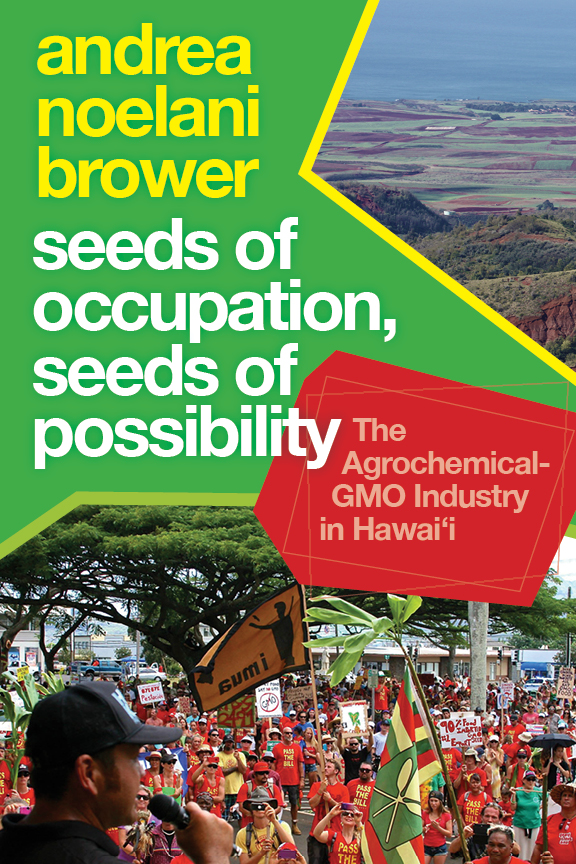
Andrea Noelani Brower
December 2022
224 pp
PB 978-1-952271-69-4 $29.99
eBook 978-1-952271-70-0
$29.99
Radical Natures Series
The Agrochemical-GMO Industry in Hawaiʻi
Hawaiʻi is a primary site for development of herbicide-resistant corn seed and, until recently, was host to more experimental field trials of genetically engineered crops than anywhere else in the world. It is also a node of powerful resistance. While documentaries and popular news stories have profiled the biotech seed industry in Hawaiʻi, Seeds of Occupation, Seeds of Possibility is the first book to detail the social and historical conditions by which the chemical-seed oligopoly came to occupy the most geographically isolated islands in the world and made the soils of Hawaiʻi the epicenter of agrochemical and agricultural biotechnology testing.
Andrea Brower, an activist-scholar from Hawaiʻi, examines the consequences related to genetically engineered seed development for Hawaiʻi’s people and the social movement that has risen in response. With insights beyond the islands, Seeds of Occupation, Seeds of Possibility illuminates why visions for a radically better world must be expanded by intersectional and systemically oriented movements.
Acknowledgments
Introduction: Contested Futures
1. The Agrochemical-Seed-Biotech Oligopoly
2. Science and Regulation in Service of Capital
3. “GMO Ground Zero”
4. Imperialism and the Making of a Plantation Economy
5. From Sugar to Monsanto
6. The State’s Redistribution of Collective Wealth
7. Resistance Is Fertile
8. Battling Monsanto in an Era of Neoliberal Cynicism
9. Seeds of Possibility
Bibliography
Index
Andrea Noelani Brower is an activist-scholar from Kaua‘i. Her scholarship is rooted in collective movements for justice, equality, liberation, and ecological regeneration. She teaches in sociology, environmental studies, and leadership studies at Gonzaga University.
“Where this book differs from other academic studies about power in Hawaiʻi is in its steadfast commitment to demonstrating the power of intersectional resistance. Brower’s interest in capitalism and agrochemical agriculture’s colonization of food production is not only to expose the dangers to human and nonhuman life but also to demonstrate how a resistance that spans ethnicities, classes, genders, and other distinct interest groups derives power from coalition instead of division. This book is a timely examination of Hawaiʻi’s struggles over land and power.”
Kathryn Besio, University of Hawaiʻi at Hilo
“This book is a powerful intervention of truth and transparency into corporate darkness and influence. It explodes the myth of benevolence and the drive to feed the world in the agricultural biotechnology industry. What might seem like battles on the edge of the empire in places like Hawaiʻi can actually be seen as central sites of leadership, resistance, and innovation in grappling against global structures and power. Hawaiʻi’s place as the epicenter for a global battle over our future—the future of our food systems, the impacts of pesticides and herbicides on human health and environment, and the need for courageous actors—is made clear by this work. We need this book.”
Kamana Beamer, University of Hawaiʻi at Mānoa
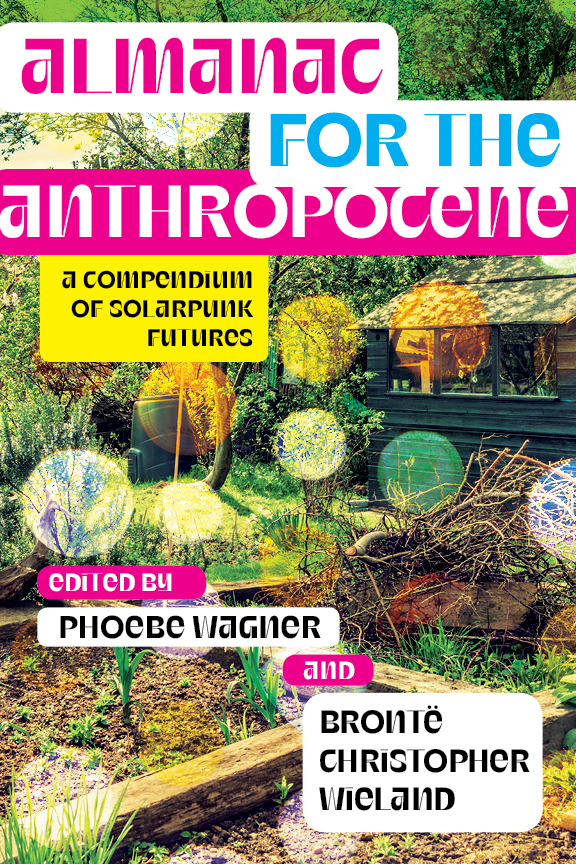
Edited by Phoebe Wagner and Brontë Christopher Wieland
September 2022
208pp
PB 978-1-952271-50-2
$26.99
eBook 978-1-952271-51-9
$26.99
Salvaging the Anthropocene Series
A Compendium of Solarpunk Futures
Almanac for the Anthropocene collects original voices from across the solarpunk movement, which positions ingenuity, generativity, and community as beacons of resistance to the hopelessness often inspired by the climate crisis. To point toward practical implementation of the movement’s ideas, it gathers usable blueprints that bring together theory and practice. The result is a collection of interviews, recipes, exercises, DIY instructions, and more—all of it amounting to a call to create hope through action.
Inspired by a commitment to the idea that there can be no environmental justice without decolonial and racial justice, Almanac for the Anthropocene unites in a single volume both academic and practical responses to environmental crisis.
Introduction: The Situation So Far
Phoebe Wagner and Brontë Christopher Wieland
Part 1: Generativity
Not Just Solar: Creating Our Own Powers, Stories, and Spaces
Brontë Christopher Wieland
1. Solarpunk Is a Verb for Rising
The Commando Jugendstil and Tales from the EV Studio
2. In Defense of Hope
Margaret Killjoy
3. Feeding Imagination
Giulia Lepori and Michał Krawczyk
4. A Collective Gardening Shed of Concepts for Planting Solarpunk Futures
Christoph D. D. Rupprecht
Part 2: Independence
Building toward Autonomy: Ways of Reclaiming the Present and the Future
Brontë Christopher Wieland
5. Your Mineral Footprint
Gabriel Aliaga
6. Solarpunk Design Guidelines
Navarre Bartz
7. How to Build a Solar-Powered Website
Kris De Decker
8. Solarpunks See the World: Traversing the World without Destroying It
Craig Stevenson
Part 3: Community
“All Organizing Is Science Fiction”: On Dreaming a Solarpunk Community
Phoebe Wagner
9. Science Fiction and Disability: Engage!
Petra Kuppers
10. The Urban Reef: Breaking Down Barriers between Green Spaces in Urban Environments
Octavia Cade
11. The Commensal Canine
Susan Haris
12. Solarpunk: The Fruitful Revolution
Connor D. Louiselle
Part 4: Ingenuity
Solarpunk Ingenuity and DIY Projects
Phoebe Wagner
13. Visible Mending: A Recipe for Beautiful and Sustainable Clothing
Sari Fordham
14. Appalachian Solarpunk: Growing Trees from Seed for the Plant Revolution
Vance Mullis and Joy Lew
15. Anthrocene Strategy: Foraging
Michael J. DeLuca
16. Multispecies Community Garden: A More-Than-Human Design Concept Proposal
for Well-Being in Shrinking Cities
Christoph D. D. Rupprecht, Aoi Yoshida, and Lihua Cui
Conclusion: Looking Forward
Phoebe Wagner and Brontë Christopher Wieland
Contributors
Phoebe Wagner is a writer, academic, and coeditor of Sunvault: Stories of Solarpunk and Eco-Speculation. She lives in Williamsport, Pennsylvania.
Brontë Christopher Wieland has an MFA in creative writing and environment and is coeditor of Sunvault: Stories of Solarpunk and Eco-Speculation. He lives in Reno, Nevada.
"With their new anthology, Almanac for the Anthropocene, Wagner and Wieland continue to break new ground in the solarpunk genre. And like Sunvault, this new collection of work is sure to be a core component of solarpunk's standard reading curriculum."
Justine Norton-Kertson, Solarpunk Magazine
“I’m thankful for all that Wagner and Wieland have done to gather and champion those working in the solarpunk movement, and I believe this book will help bring new solarpunks into the fold, ready to join them in further thought and action.”
Matt Bell, author of Appleseed
“Wagner and Wieland demonstrate the breadth of the solarpunk movement through the collection’s ferocious expression of many possible futures, giving us tools and strategies for bringing those about, but reminding us that the conversation is not, and perhaps not ever, over.”
Sean Guynes, coeditor of Uneven Futures: Strategies for Community Survival from Speculative Fiction
You are being redirected to The Chicago Distribution Center.
West Virginia University Press is not responsible for content on external sites.