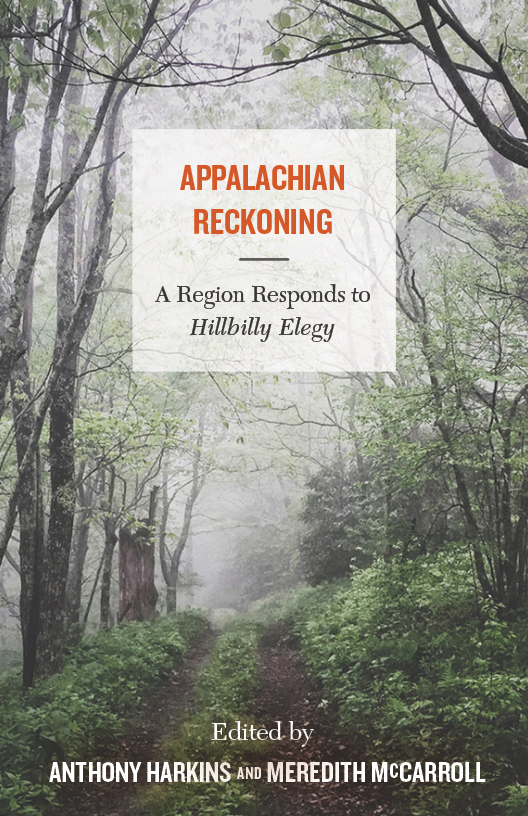

Appalachian Reckoning: A Region Responds to Hillbilly Elegy


Edited by Anthony Harkins and Meredith McCarroll

432pp
PB 978-1-946684-79-0
$28.99
eBook 978-1-946684-80-6
$28.99

Appalachian Reckoning

A Region Responds to Hillbilly Elegy

Summary

2020 American Book Award Winner: Walter & Lillian Lowenfels Criticism Award
2019 Weatherford Award Winner, Nonfiction

With hundreds of thousands of copies sold, a Ron Howard movie in the works, and the rise of its author as a media personality, J. D. Vance’s Hillbilly Elegy: A Memoir of a Family and Culture in Crisis has defined Appalachia for much of the nation. What about Hillbilly Elegy accounts for this explosion of interest during this period of political turmoil? Why have its ideas raised so much controversy? And how can debates about the book catalyze new, more inclusive political agendas for the region’s future?

Appalachian Reckoning is a retort, at turns rigorous, critical, angry, and hopeful, to the long shadow Hillbilly Elegy has cast over the region and its imagining. But it also moves beyond Hillbilly Elegy to allow Appalachians from varied backgrounds to tell their own diverse and complex stories through an imaginative blend of scholarship, prose, poetry, and photography. The essays and creative work collected in Appalachian Reckoning provide a deeply personal portrait of a place that is at once culturally rich and economically distressed, unique and typically American. Complicating simplistic visions that associate the region almost exclusively with death and decay, Appalachian Reckoning makes clear Appalachia’s intellectual vitality, spiritual richness, and progressive possibilities.

Contents

Acknowledgments

Part I. Considering Hillbilly Elegy

Interrogating

Hillbilly Elitism
T. R. C. Hutton;

Social Capital
Jeff Mannp

Once Upon a Time in “Trumpalachia”: Hillbilly Elegy, Personal Choice, and the Blame Game
Dwight B. Billings

Stereotypes on the Syllabus: Exploring Hillbilly Elegy’s Use as an Instructional Text at Colleges and Universities
Elizabeth Catte

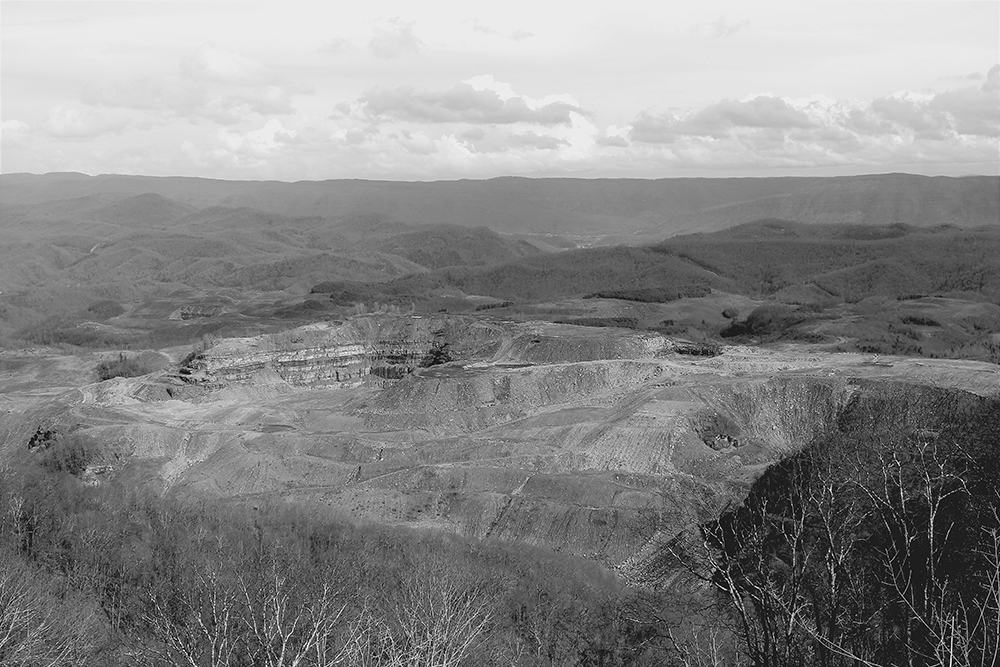
Benham, Kentucky, Coalminer / Wise County, Virginia, Landscape
Theresa Burriss

Panning for Gold: A Reflection of Life from Appalachia
Ricardo Nazario y Colón

Will the Real Hillbilly Please Stand Up? Urban Appalachian Migration and Culture Seen through the Lens of Hillbilly Elegy
Roger Guy

What Hillbilly Elegy Reveals about Race in Twenty-First-Century America
Lisa R. Pruitt

Prisons Are Not Innovation
Lou Murrey

Down and Out in Middletown and Jackson: Drugs, Dependency, and Decline in J. D. Vance’s Capitalist Realism
Travis Linnemann and Corina Medley

Responding

Keep Your “Elegy”: The Appalachia I Know Is Very Much Alive
Ivy Brashear

HE Said/SHE Said
Crystal Good

The Hillbilly Miracle and the Fall
Michael E. Maloney

Elegies
Dana Wildsmith

In Defense of J. D. Vance
Kelli Hansel Haywood

It’s Crazy Around Here, I Don’t Know What to Do about It, and I’m Just a Kid
Allen Johnson

“Falling in Love,” Balsam Bald, the Blue Ridge Parkway, 1982
Danielle Dulken

Black Hillbillies Have No Time for Elegies
William H. Turner

Part II. Beyond Hillbilly Elegy

Nothing Familiar
Jesse Graves

History
Jesse Graves

Tether and Plow
Jesse Graves

On and On: Appalachian Accent and Academic Power
Meredith McCarroll

Olivia’s Ninth Birthday Party
Rebecca Kiger

Kentucky, Coming and Going
Kirstin L. Squint

Resistance, or Our Most Worthy Habits
Richard Hague

Notes on a Mountain Man
Jeremy B. Jones

These Stories Sustain Me: The Wyrd-ness of My Appalachia
Edward Karshner

Watch Children
Luke Travis

The Mower—1933
Robert Morgan

Consolidate and Salvage
Chelsea Jack

How Appalachian I Am
Robert Gipe

Aunt Rita along the King Coal Highway, Mingo County, West Virginia
Roger May

Holler
Keith S. Wilson

Loving to Fool with Things
Rachel Wise

Antebellum Cookbook
Kelly Norman Ellis

How to Make Cornbread, or Thoughts on Being an Appalachian from Pennsylvania Who Calls Virginia Home but Now Lives in Georgia
Jim Minick

Tonglen for My Mother
Linda Parsons

Olivia at the Intersection
Meg Wilson

Appalachian Apophenia, or The Psychogeography of Home
Jodie Childers

Canary Dirge
Dale Marie Prenatt

Poet, Priest, and “Poor White Trash”
Elizabeth Hadaway

List of Contributors
Sources and Permissions
Index

Editors

Anthony Harkins is a professor of history at Western Kentucky University in Bowling Green, Kentucky, where he teaches courses in popular culture and twentieth-century United States history and American studies. He is the author of Hillbilly: A Cultural History of an American Icon.

Meredith McCarroll is the director of writing and rhetoric at Bowdoin College, where she teaches courses in writing, American literature, and film. She is the author of Unwhite: Appalachia, Race, and Film.

Reviews

“The most sustained pushback to Vance’s book . . . thus far. It’s a volley of intellectual buckshot from high up alongside the hollow.”
New York Times

“In this illuminating and wide-ranging collection, the authors do more than just debunk the simplistic portrayal of white poverty found in Hillbilly Elegy. They profoundly engage with the class, racial, and political reasons behind a Silicon Valley millionaire’s sudden triumph as the most popular spokesman for what one contributor cleverly calls ‘Trumpalachia.’ This book is a powerful corrective to the imperfect stories told of the white working class, rural life, mountain folk, and the elusive American Dream.”
Nancy Isenberg, author of White Trash: The 400-Year Untold History of Class in America

“So often the song of this place has been reduced to a single off-key voice out of tune and out of touch.Appalachian Reckoningis the sound of the choir, pitch perfect in its capturing of these mountains and theirpeople. This book is not only beautiful, but needed.”
David Joy, author of The Line That Held Us

“A welcome and valuable resource for anyone studying or writing about this much-maligned region.”
Kirkus (starred review)

“Stunning in its intellectual and creative riches.”
Foreword Reviews (starred review)

"While Vance offers one bleak 'window' into the extensive multistate region, this valuable collection shows resilience, hope, and belonging are in Appalachia, too.”
Publishers Weekly

"A book of over 40 essays and poems that bring the real Appalachia to life."
The Bitter Southerner

“A vibrant collection of essays . . . many by women, people of colour and queer people, largely written out of Hillbilly Elegy.”
Times Literary Supplement

“This edited volume continues the rich Appalachian studies tradition of pushing back against one-sided caricatures of Appalachian people. The essays, poems, and photo-essays in this book demonstrate the diversity of Appalachian perspectives on the serious problems facing our nation as well as the role that myths about Appalachia continue to play in US policy debates. This is a must-read for everyone who read (or refused to read) J. D. Vance’s deeply flawed, best-selling memoir, Hillbilly Elegy.
Shaunna Scott, University of Kentucky

Introduction

Why This Book?

Anthony Harkins and Meredith McCarroll

This is a book born out of frustration. This is a book born out of hope. It attempts to speak for no one and to give voice to many. This is a book that could have emerged without Hillbilly Elegy, but it was also created in the explicit context of a postelection, post–Hillbilly Elegy moment. It therefore attempts to respond to those who have felt they understand Appalachia “now that they have read Hillbilly Elegy” and to push back against and complicate those understandings. It is meant to open a conversation about why that book struck such a deep nerve with many in the region, but it is not meant to demonize J. D. Vance. Instead, the contributors to this book prioritize focusing on the region, reclaiming some of the talk about Appalachia, and offering ideas through the voices of many who have deep, if varied, lived experiences in and of Appalachia.

Either explicitly or implicitly, begrudgingly acknowledged, directly repudiated, or partially welcomed, the shadow of Hillbilly Elegy hangs over this book. Not since Harry Caudill’s Night Comes to the Cumberlands (1963) has a nonfiction book on Appalachia attracted such widespread national acclaim and success as J. D. Vance’s 2016 account, controversially subtitled A Memoir of a Family and Culture in Crisis. As of February 2018, the book had been on the New York Times best-seller list for a remarkable seventy-three weeks in a row and has sold in all formats combined well over a million copies. It ranked first in the combined E-book and nonfiction list for six weeks in 2017 and was the top selling nonfiction ibook of the year.1 It has also received broad critical attention, and has been reviewed across a wide swath of the national media landscape from the National Review and the Wall Street Journal to All Things Considered, Fresh Air, and Slate. In book reviews and on-air interview programs, it has been routinely described as “riveting” and “starkly honest.” “The most important book about America” pronounced the Economist. David Brooks called it “essential reading.” Although such rave reviews have since somewhat abated, Vance himself continues in early 2018 to be a common presence on television and radio interview shows and as a guest speaker, and he was even for a time courted as a potential Republican Senate candidate in Ohio.2

Clearly Vance’s account of growing up in Middletown, Ohio, and visiting eastern Kentucky as a member of a multigenerational family scarred by drug abuse and alcoholism has resonated with many readers, including some Appalachians. Yet, just as obviously, Hillbilly Elegy and Vance have been criticized by many within the Appalachian region and beyond as anti-intellectual, overly anecdotal, and attempting to revitalize widely discredited “culture of poverty” explanations for persistent inequities in the region. Regardless of their particular perspective on Vance, though, all the voices in this book stress that Appalachia is a far more diverse and complex place and identity than Hillbilly Elegy and the media’s interpretation of it imply or that the president tweets about. The people and region belie simplistic definitions or characterizations of a monolithic and predeterminative “hillbilly culture,” as Vance labels it. All of its inhabitants and experiences are not simply an extension of Vance’s individual family and life story, nor should the notion of a “memoir of a culture” (as Vance’s subtitle constructs it) go unchallenged. There is not a single “truth” about Appalachia and its people, and the essays, narratives, and artistic expressions in this book, integrated in the best tradition of Appalachian studies, collectively break up this too solid image of the place simply by speaking multiple truths about multiple experiences. In so doing, they challenge the idea that any single book, including this one, can sum up the entirety of Appalachia and what it means to be Appalachian.

This book provides a platform for reactions to and insights about Vance’s book and its reception but also to writings that reach well beyond Hillbilly Elegy to consider the many ways that Appalachians experience their Appalachianness. As citizens and scholars, Appalachians have been fighting against gross simplifications and stereotypes since at least the early nineteenth century, and this work should be considered only the latest effort to challenge such views.3 Some contributors emphasize the need to challenge distorting and debilitating stereotypes; some stress the need to face the region’s problems forthrightly and squarely. Some are quiet and contemplative; others are angry. Yet despite what the majority of our contributors find to be Hillbilly Elegy’s flaws and even damages, they share the sense that the broader public “rediscovery” of the region that Hillbilly Elegy and the conceptual construction of “Trumpalachia” (in the neologism of contributor Dwight Billings) have engendered should also be seen as an opportunity—a chance to reclaim Appalachia and to help those unfamiliar with the region to recognize its complexities and its diversities.

In this spirit, the contributors address from a range of perspectives an array of pressing questions the Hillbilly Elegy phenomenon raises: What about Vance and his book accounts for the explosion of interest in Appalachia and its people in this historical moment of national political turmoil? Why have the ideas in Hillbilly Elegy caused such a firestorm in the region? What can we learn about both actual Appalachia and the way it is perceived from these reactions and debates? What does it mean in the twenty-first century to be Appalachian? Perhaps most significantly, as poet Jeff Mann explicitly asks here in his poem “Social Capital,” what other Appalachian voices have been drowned out in the flood of attention that Vance and his book have garnered? And how can these voices be heard?

To bring some conceptual structure to this wide range of topics, Appalachian Reckoning is organized broadly into two parts. Part I, “Considering Hillbilly Elegy,” features texts directly assessing or commenting on the words and impact of Vance’s influential work. It is further divided into two sections: a collection of primarily scholarly essays (although also shaped by the authors’ mountain backgrounds and experiences) that carefully consider Hillbilly Elegy through various social and political prisms and a section of personal and autobiographical reflections on the book (although also informed by scholarly analysis). Interspersed throughout part I are poems and photographs that provide artistic responses to Vance’s book.

Part II, “Beyond Hillbilly Elegy,” features narratives and images that together provide a snapshot of a place that is at once progressive, haunted, depressed, beautiful, and culturally and spiritually rich. These stories are difficult to categorize because of their range in voice, focus, perspective, and plot. They are at turns heartbreaking, humorous, contemplative, and defiant. In their broad outlines, they are stories that anyone could tell. But they are stories told by Appalachians, grounded in the specific. The sound of a vowel, the feel of a tool, the recipe for corn pone, the name of a school. There is no singular focal point to part II other than the shared idea that there is no consensus about Appalachia.

* * *

Let us further elaborate on each part of the book, starting with some general thoughts on Hillbilly Elegy and the public persona of J. D. Vance. It is important to recognize the often-stated point that Hillbilly Elegy’s surprising and sustained success is largely a product of the presidential campaign and election of Donald Trump. As others have noted, Vance’s sensational book would most likely have found an audience anyway, since Appalachia is “(re)discovered” cyclically. This political earthquake was the latest shock again bringing Appalachia and some of its people and issues to the forefront of media attention and through that attention to the broader public across the country (and indeed the world).4 The Trump campaign and postelection media coverage have framed one version of Appalachia defined almost exclusively through the prism of the white male coal miner, depressed towns, and rampant opioid addiction. This has served as the perfect signifier of white working-class “forgotten Americans.” In turn, it has led to a partial reconceptualization of the region less as an exotic exception to the rest of America (the “strange land and peculiar people” mindset that has so characterized views of the region since at least the nineteenth century) and instead more as an intensified signifier of the hazily defined conceptual category of “the white working class”—regardless of both the concept’s and the region’s actual geographic, demographic, and cultural diversity.5

There is also appeal for many in Vance’s ability to transcend his early childhood traumas and in his simple and personalized account of that transcendence. Vance’s story, largely devoid of analyses of broader socioeconomic and historical dynamics, is compelling—the quintessential “up from your bootstraps” “American Dream,” as he often notes. He describes growing up in an unstable, nontraditional, lower middle-class household and experiencing harrowing moments navigating childhood and early adulthood with a drug-dependent, dysfunctional mother. Overcoming a long string of ineffectual and uncommitted stepfathers and his mom’s boyfriends, and an extended family prone to violence, he is cared for by his strong and loving, if “crazy hillbilly,” maternal grandmother and generally hardworking maternal grandfather. Vance barely avoids becoming a high school dropout, joins the Marines upon graduation to get his life in order, and graduates early and summa cum laude from Ohio State University. A degree from Yale Law School and marriage to a classmate complete his transformation into the upper class. Vance’s story of transformation may not be over, since Hillbilly Elegy’s phenomenal success has launched him into the role of pundit and potential national politician. As some of our contributors stress, this end result is crucial to both the book’s appeal and his claims to hillbilly authenticity. Despite his hardscrabble beginnings, only his later success in the world of law and politics and the valuable personal connections he has made (with the likes of billionaire businessman and investor Peter Thiel and Yale University “tiger mom” Amy Chua) make him seem a legitimate “spokesperson for the white working class.” In other words, only in distancing himself from Appalachia and what he dubs “greater Appalachia” has Vance come to be seen as the “authentic” and “credible” voice of the region and the white working class.

This is not meant to blithely dismiss the obvious appeal of the book for so many as simply a form of “false consciousness.” Nor is it meant to discount the legitimacy of the issues his book and life story bring to the foreground, including the devastating impact of drug abuse and addiction, particularly in rural America and Appalachia; the economic and social debilitation brought on by the collapse of the old industrial economy and the jobs so many relied upon; the sustaining power of intergenerational bonds and the importance of positive role models and social stabilizers; and the deep sense of cynicism, pessimism, and resignation felt by many, especially older white men in non-coastal America. But it is important to also consider what it is about the story he tells that makes it such an appealing vision to many Americans of a variety of political stripes who so desperately want to believe that the “American Dream” (a term that Vance repeatedly uses but never really defines) is still possible—especially because they also fully recognize how the country is characterized by deep economic and political inequities and injustices.

The ideas and contradictions introduced above are explored and elaborated on in part I of the book. The essays in the first section, “Interrogating,” assess the accuracy of Vance’s so-called memoir of a culture and seek to illuminate the ways Hillbilly Elegy and its social impact are tied to powerful political ideologies and institutions active in America today. Historian T. R. C. Hutton begins by critiquing the book as an unrealistic modern-day Horatio Alger tale of advancement over economic and familial obstacles through “luck and pluck” that rejuvenates long-discredited “culture of poverty” arguments to explain the hardships the region faces. He argues this approach erases larger socioeconomic factors, relies falsely on ethnic determinism, and essentializes working-class society. Sociologist Dwight Billings reflects critically on the way the book has been embraced, in the wake of the election of 2016 and the Trump presidency, by neoliberals in both major political parties and contributed to the idea of a mythical realm he dubs “Trumpalachia.” However, Billings argues that the region, rather than being inherently “the reddest of red state America,” is potentially far more politically progressive than the media and both political parties have acknowledged or Vance’s book implies. Next, public historian and writer Elizabeth Catte considers the causes and implications of the book being featured as the selection of a campus or community-wide “one read” book program by many colleges and universities. She concludes that one effect is to too narrowly define who and what Appalachia is and, more problematically, is not. Urban migration scholar Roger Guy then considers the accuracy of the book’s portrayal of the urban Appalachian migrant experience, comparing Vance’s account and experience with those of twentieth-century Appalachian migrants to Chicago and other Midwestern cities. He explores multigenerational patterns of work and life for Appalachian out-migrant and shuttle-migrant communities, concluding that Vance’s story of familial violence and degradation contrasts with the experiences of most first- and second-generation migrants.

The remaining essays under “Interrogating” consider the messages of the book through the prisms of race and racial ideology and drug addiction and criminality. Although she empathizes with Vance’s emotional journey and appreciates his attention to place, class, and culture, legal scholar Lisa Pruitt ultimately sees the book as more of a distortion than an illumination of white socioeconomic disadvantage. She argues that by understating the positive role of the state in his own life trajectory (especially the military and public higher education), erasing the concept of white privilege, and presenting the idea of “hillbilly” as strictly a cultural and not a racial identity and construction, Vance promotes the myth of a society based on true meritocracy so dear to white elites largely ignorant of the reality of systemic working-class inequity. Travis Linnemann and Corina Medley, analysts of media representations of justice, focus instead on the portrayal of the drug abuse and addiction that is so central to Hillbilly Elegy as well as to the ways Appalachia has come to be perceived as ground zero of this nationwide epidemic. While in no way discounting the seriousness of this crisis, these authors argue that by erasing broader social and historical forces and explanations, Hillbilly Elegy offers a form of victim blaming in which drug abuse becomes nearly the sole explanation for familial and social ill fortunes rather than a symptom of larger debilitating forces of neoliberal capitalism.

“Responding,” the second section of part I, offers the individual reactions of five very different Appalachians who see the book as resonating with, or more often diverging from, their own personal and familial experiences. Ivy Brashear, Michael Maloney, Kelli Haywood, Allen Johnson, and William Turner offer eloquent and heartfelt responses to Vance’s portrayal of growing up in Appalachia and southern Ohio. Community activist Brashear forcefully condemns the book for distorting the complexity of the region, erasing the history of “oppressive systems of extraction,” and leaving the impression that all Appalachian families share the same dysfunction as Vance’s own. She reveals this destructive history through sharing her own family’s generations-long experiences of resisting exploitation and supporting one another emotionally. Brashear further challenges Vance’s narrative by telling her own story of a typical American childhood in Perry County, Kentucky, building forts, playing Nintendo, and going to prom. Michael Maloney’s narrative is grounded in his own geographically similar history to that of Vance, having grown up just outside of Jasper, Kentucky (where Vance spent many of his summers with his grandparents), and later in the southern Ohio towns around Cincinnati near Middletown where Vance was raised. Maloney also draws on his decades of work assisting urban migrant communities to explore the ways Appalachian migrants have dealt with the hardships of economic relocation and eventual deindustrialization. Although he acknowledges the problems with Vance’s understating of systemic causes, he also sees much truth and value in Vance’s story and ends with a call to embrace Vance as a means to achieve better public policy in Appalachia and Appalachian migrant communities in the wake of deindustrialization, globalization, and automation.

Kelli Haywood largely defends the book as a powerful and honest personal account of the harsh realities of the lives of many living in the mountains. She argues that though Vance’s portrait is at times simplistic, it nonetheless brings uncomfortable truths to the foreground and highlights a litany of negative statistics—a reality that must be faced squarely if the region as a whole is to advance. Allen Johnson offers yet a different take from his perspective as a rural West Virginian with decades of experience in social services, ministry, environmental stewardship, and raising a family. Although he does not personally share Vance’s rough origin story, Johnson praises the book as a window into and model of the central role of what he calls “transcenders”—individuals who are able to overcome adverse childhood experiences to become successful and fulfilled adults. Finally, sociologist and researcher William Turner offers his unique perspective as both an African American who grew up in the coalfields of southeastern Kentucky and a leading scholar of the history of blacks in Appalachia and out-migration communities. Drawing on his own remarkable achievements and those of so many of his classmates from Lynch (Kentucky) Colored School and others in the self-named “Eastern Kentucky Social Club,” Turner stresses the total absence of African Americans from Vance’s book and from national views of the hardships of the people of the region. These conceptions exist, he argues, despite the fact that blue-collar black migrants collectively both have disproportionately suffered more than blue-collar whites from deindustrialization and have proven more resilient in the face of these difficulties.

Scholarly essays and personal narratives are not the only ways Appalachians have grappled with Hillbilly Elegy and its regional and national reception. Part I therefore also includes a selection of poems and photographs that reveal other ways of envisioning what Vance gets right and wrong about the region. Jeff Mann’s poem “Social Capital” captures the ways Vance simultaneously illuminates and erases this elusive if powerful idea, whereas Ricardo Nazario y Colón’s “Panning for Gold” frames the book as the latest contribution to the “politics of poverty” show. Crystal Good’s “HE Said/SHE Said” rejects Vance as representative of her Appalachian experience; Dana Wildsmith’s “Elegies” sympathetically ties Vance to an earlier Appalachian voice of cultural celebration and lamentation. The photographs and explanatory notes of Theresa Burriss, Lou Murrey, and Danielle Dulken offer yet other ways to consider a region shaped by the dignity of hard work and devastating environmental degradation, diversity and activism, and countless stories of the joys and sorrows of everyday people.

* * *

When the War on Poverty came to Appalachia in the early 1960s, many felt that the region’s story was being told by the wrong voices. Or at least too few voices. After President Johnson traveled to Appalachia in 1964 to bring media attention to its needs as part of his launch of this massive economic support program, many filmmakers and documentary crews followed those well-rutted dirt roads into the same hollows. Charles Kuralt’s Christmas in Appalachia (CBS, 1965) had the broadest reach, but other filmmakers swept in to capture familiar images and tell familiar stories about a complex place.6 One response to this wave of cinematic depictions of Appalachia was the desire to empower residents of those places to tell their own stories and make their own films. The result was Appalshop, a nonprofit cultural arts organization that opened its doors in 1969, funded by the Office of Economic Opportunity along with the American Film Institute. The War on Poverty that paved the path for simplistic representations of Appalachia, therefore, also helped launch an organization dedicated to countering and complicating those narratives and to giving voice to more people living in the region—to allow them to tell their own stories.7

In the same way, the collection of personal narratives that make up part II of this book, “Beyond Hillbilly Elegy,” was imagined partly in response to the noise surrounding Vance’s book and took as its inspiration other recent collections of astute and powerful Appalachian writers.8 A good way to quiet one voice is to add other voices to it. Simply put, that is the aim of this collection of stories and reflections on Appalachia. Casting a wide net, the narratives collected here give voice to a broad range of Appalachian writers who, just by sharing their stories, complicate the narrow story often told about this place. These stories defy the limited Appalachia that Vance sells in his book. They hail from different parts of the region; they boast different racial identities and sexual orientations and represent diverse life stories. Young as well as seasoned, they are educators, activists, poets, photographers, mothers, fathers, brothers, and sisters. And they come from a long Appalachian tradition of speaking up and talking back.9 These personal narratives range in content and context widely but are all grounded in specific Appalachian experiences. Many focus on capturing movement into and out of Appalachia from a new generation’s perspective. Some writers grapple with what it means to be Appalachian as they leave the region and understand how others have framed it for them. When a place is defined for them, they ask, how much power do they have to define it themselves? Other writers and poets ask similar questions but from within the region. Seeing a changing landscape and culture, they work to maintain connections to traditions of their elders, and to pass those along to a new generation. Some strive to escape parts of their inheritances while celebrating others. Part II deals with the way others have seen us (as snake handlers, as mountain men, as Deliverance extras) and the more complex ways that we try to see ourselves. And like people from anywhere, no one marker of identity suffices. But unlike people from some places, all these Appalachians feel a strong need to define themselves in opposition to the (mis)defining that others are doing on our behalf. The contributors are all reclaiming Appalachia in their way.

Part II begins with three poems from Jesse Graves, each an expression of a bodily connection to place—generations deep, yet never stagnant. Meredith McCarroll laments the ways that she shifted her accent as she spent more time in academia, and celebrates the opportunity to reclaim and integrate layers of identity. A photograph from Rebecca Kiger, the first of four featured here from Looking at Appalachia, the crowd-sourced photography project launched by Roger May, challenges negative perceptions of downtrodden Appalachians and shows them instead as strong, vital, and joyous. In “Kentucky, Coming and Going,” Kirstin Squint wrestles with family legacies and lore, asking what it means to be from a place, to leave a place, and to claim a place as your own. Poet Richard Hague defiantly celebrates Appalachia in his poem “Resistance, or Our Most Worthy Habits.” Jeremy B. Jones recalls being called a mountain man and reflects on the multiplicity of being a ninth-generation mountaineer, but he also thinks about Ernest T. Bass and The Andy Griffith Show and the legacy of labels we inherit without claim. Edward Karshner, too, remembers the sting of being characterized as a “hillbilly,” and later comes to revel in the stories that he passes down to his own children—complicated by his rich knowledge of language and its implications in Appalachia and what he calls the “Off.” Luke Travis’s photograph, set in Pittsburgh, reminds him that the small-town values he knew from childhood make their way into the city. In “The Mower—1933,” Robert Morgan crafts a tangible description of work as he both conquers and communes with the land that he knows so well. Chelsea Jack’s story of leaving and finding home is tied to her mother’s labor, her family’s mobility, and her ability to bring with her that which was left behind.

Robert Gipe traces his own path through Appalachia, enabled by his mother’s humor and sense of voice, which allows him to work, through storytelling, with his community in Harlan County. Roger May’s photograph “Aunt Rita along the King Coal Highway, Mingo County, West Virginia” defies elegy and celebrates home. Poet Keith S. Wilson’s series “Holler” explores travel and migration, belonging and not belonging—both inside and outside of Appalachia. Through close readings and reflections empowered both by theory and experiences of class migration, Chelsea Jack writes about the tension of finding one’s place in the out-of-place. Inspired by antebellum texts and imaginings of new freedom, Kelly Norman Ellis contributes two poems that situate the black female body squarely in the mountains of the American South. In the form of a recipe, Jim Minick reflects on homesteading, cornbread, migration, and home. In “Tonglen for My Mother,” Linda Parsons reflects on suffering, compassion, and peace. Meg Wilson’s photograph “Olivia at the Intersection” captures a small moment on a Friday night when community fills the streets in its own Appalachian celebration. Jodie Childers’s vivid recollection of caretaking winds us through her own comings and goings in and out of Appalachia, in and out of her familial role. In “Canary Dirge,” Dale Marie Prenatt directly and bitterly calls on America to see itself in Appalachia. Finally, Elizabeth Hadaway writes about her experiences being stereotyped, both in academia and in the ministry—where she learned, at last, how to handle the snakes that surrounded her.

Collectively, the scholarship, personal reflections, poetry, and photography in this book offer a rejoinder to the national reportage on Appalachia that is rooted in the Hillbilly Elegy phenomenon and that defines the region monochromatically and almost completely in terms of backwardness, ignorance, isolation, violence, dependency, and passivity, ultimately as a place of social, economic, and cultural death. This book instead presents a very different Appalachia and Appalachians—a place and people with undeniable problems but also intellectual vitality, diversity (in terms of ideology, gender and sexuality, race and ethnicity), and a powerful resilience. It is these characteristics that are lost in imagining Hillbilly Elegy as the sole window into the Appalachian experience.

* * *

On the closing day of the 2018 Appalachian Studies Association conference in Cincinnati, J. D. Vance was an invited panelist alongside ethnographer and journalist Wendy Welch on the topic of poverty and the opioid epidemic. The presence of Vance was deeply upsetting and disruptive to many engaged in the work around Appalachia. In response, Y’ALL (Young Appalachian Leaders and Learners) organized a protest of Vance, turning their chairs and bodies to the back of the room when he spoke, periodically booing and talking back to him, and singing “Which Side Are You On?,” a protest song written in 1931 by Florence Reece during the Harlan County Mine Wars. Many supported this demonstration of anger and frustration, but others tried to quiet the protesters. The aftermath of Vance’s presence at ASA has exposed a problematic generational divide within the organization as well as a call by Y’ALL for reforms to the process of organizing and convening panels at the national conference.

Painful as this experience has been for many, we also see it as offering opportunities for greater understanding and dialogue that we hope this book can help fulfill. At a time in which policy making too often takes the form of 140-character tweets, Russian bots decipher our online profiles in order to influence the way that we vote by creating extreme division, and differences among us seem to create insurmountable chasms, we desperately need a space to open up, listen, make room, and disagree with respectful candor. This does not mean treating all sides and all forces as equally valid. When Florence Reece wrote and performed “Which Side Are You On?,” it functioned as a moral rallying cry to wake people in and beyond the region and to align them with the workers around them rather than the company that exploited them. We do not need to smooth out our differences or silence protestors or shout down those with whom we disagree, or shame someone who has a story to tell. Rather, we need to magnify the ways we are unique, give voice to all who want to contribute a verse, and acknowledge the full range of experiences that constitute Appalachia.

Postelection America has made it strange to be from Appalachia. Many of us have not liked the way that Hillbilly Elegy has been used as a shorthand way to explain the Trump phenomenon. While it is frustrating to have one person speak for a place, it is worse to have so many people listen to that one person and assume that he’s right and representative of all of Appalachia. Contributor Elizabeth Catte recently recalled in her blog the way she addressed the question of audience at a talk at West Virginia University, writing, “I think self-definition is power and if I tell you what or who you are I have taken some power from you and I do not want to do that.”10 So when coworkers in Maine or in-laws in Florida or even college friends in western Kentucky say that they now understand Appalachia because they have read Hillbilly Elegy, it strikes a nerve. We’ve been defined by so many journalists and filmmakers over the years who’ve briefly dropped in only to confirm what they already suspected, and we’re sick of it.

So we’re passing the microphone. We’re making room for scholars who have spent careers thinking about poverty and family and race and labor and addiction to share what they know about some of the topics that Vance touches on in Hillbilly Elegy. We are carving out space for more people to tell their family stories, their Appalachian memories, their lived experiences, and their views of future Appalachias. Inspired by Looking at Appalachia, we are featuring powerful and poignant images that resonate with the writings and offer a perhaps unexpected window into what it means to be Appalachian.11 May this collection of scholarship, poetry, photography, and personal narrative remind us all that there is and always has been space to differ, to disagree, to protest, to rage, to reimagine, to commemorate, and to learn. There is space for all of us to reclaim Appalachia as it is for us. And there is a desperate need for the fierce hope embedded in these grounded critiques, humorous anecdotes, and captured moments. Let this book inspire a fierce hope for Appalachia.

Notes

  1. “Combined Print and E-Book Nonfiction,” New York Times, February 11, 2018, https://nyti.ms/2BjQKkv; Jim Milliot, “Print Units through September Up 2%: Sales of Popular Backlist Books Offset the Lack of New Blockbuster,” Publishers Weekly, October 6, 2017, https://www.publishersweekly.com/pw/by-topic/industry-news/bookselling/….
  2. For a sampling of such reactions, see https://www.harpercollins.com/9780062300546/hillbilly-elegy. On Vance’s Senate decision, see Kevin Robillard, “J. D. Vance Passes on Senate Run in Ohio,” Politico, January 19, 2018, https://www.politico.com/story/2018/01/19/jd-vance-no-senate-run-ohio-3….
  3. For an overview of some of these important efforts, see Stephen L. Fisher, Fighting Back in Appalachia: Traditions of Resistance and Change (Philadelphia: Temple University Press, 1993); Dwight Billings, Gurney Norman, and Katherine Ledford, eds., Back Talk from Appalachia: Confronting Stereotypes (Lexington: University Press of Kentucky, 1999); Stephen L. Fisher and Barbara Ellen Smith, eds., Transforming Places: Lessons from Appalachia (Champaign: University of Illinois Press, 2012); and, most recently, Elizabeth Catte, What You Are Getting Wrong about Appalachia (Cleveland: Belt, 2017).
  4. The idea that the book would have found an audience is from Joshua Rothman, “The Lives of Poor White People,” New Yorker, September 12, 2016, https://www.newyorker.com/culture/cultural-comment/the-lives-of-poor-wh…. On the continual “rediscovery” of Appalachia, see Catte, What You Are Getting Wrong, especially pt. II; Allen W. Batteau, The Invention of Appalachia (Tucson: University of Arizona Press, 1990); Henry D. Shapiro, Appalachia on Our Mind: The Southern Mountains and Mountaineers in the American Consciousness, 1870–1920 (Chapel Hill: University of North Carolina Press, 1978); Emily Satterwhite, Dear Appalachia: Readers, Identity, and Popular Fiction since 1878 (Lexington: University Press of Kentucky, 2011); and Billings, Norman, and Ledford, Back Talk from Appalachia.
  5. The phrase “Strange Land and a Peculiar People” comes from an 1873 article by Will Wallace Harney. On this tradition, see Anthony Harkins, Hillbilly: A Culture History of an American Icon (New York: Oxford University Press, 2003), 29–45.
  6. See Harkins, Hillbilly, 184–86; Batteau, Invention of Appalachia, chaps. 8–9; Ron Eller, Uneven Ground: Appalachia since 1945 (Lexington: University Press of Kentucky, 2013), 80–82, 102–3; Meredith McCarroll, Unwhite: Appalachia, Race, and Film (Athens: University of Georgia Press, 2018), chap. 4.
  7. Appalshop, https://www.appalshop.org/about-us/our-story/; Stephen P. Hanna, “Appalshop,” in Encyclopedia of Appalachia (Knoxville: University of Tennessee Press, 2006), 1693–94, and “Three Decades of Appalshop Films: Representations, Strategies, and Regional Politics,” Appalachian Journal 25, no. 4 (Summer 1998).
  8. Adrian Blevins and Karen Salyer McElmurray, eds., Walk Till the Dogs Get Mean: Meditations on the Forbidden from Contemporary Appalachia (Athens: Ohio University Press, 2015); Charles Dodd White and Larry Smith, eds., Appalachia Now: Short Stories of Contemporary Appalachia (Huron, OH: Bottom Dog Press, 2015).
  9. Thanks to Theresa Burriss for helping us appreciate this spectrum and put it into words.
  10. Elizabeth Catte, “A Message to the Future of Appalachia,” https://elizabethcatte.com/2018/04/16/future/.
  11.  Looking at Appalachia, http://lookingatappalachia.org/.

Excerpt

Read Robert Gipe's "How Appalachian I Am"on Humanities Tennessee's Chapter 16.

© Theresa Burriss

© Luke Travis

© Rebecca Kiger

© Chelsea Jack

© Meg Wilson

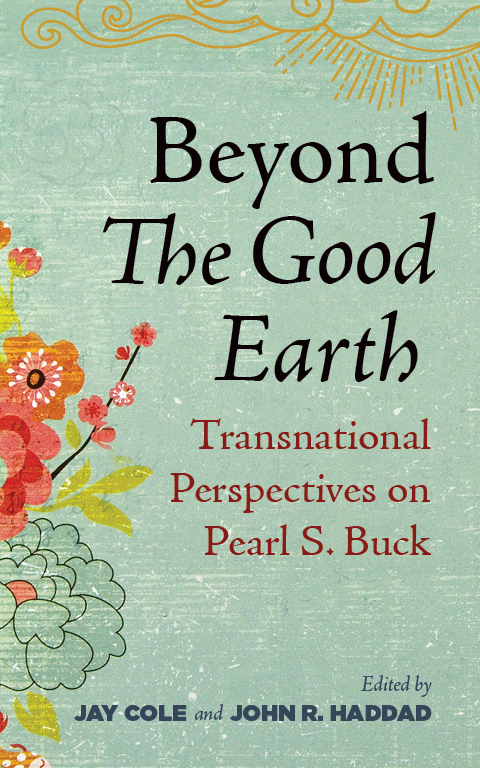
Beyond The Good Earth: Transnational Perspectives on Pearl S. Buck

Edited by Jay Cole and John R. Haddad

204pp 
PB 978-1-946684-75-2
$24.99
eBook 978-1-946684-76-9
$24.99


Summary

How well do we really know Pearl S. Buck? Many think of Buck solely as the Nobel laureate and Pulitzer Prize–winning author of The Good Earth, the novel that explained China to Americans in the 1930s. But Buck was more than a novelist and interpreter of China. As the essays in Beyond The Good Earth show, she possessed other passions and projects, some of which are just now coming into focus.

Who knew, for example, that Buck imagined and helped define multiculturalism long before it became a widely known concept? Or that she founded an adoption agency to locate homes for biracial children from Asia? Indeed, few are aware that she advocated successfully for a genocide convention after World War II and was ahead of her time in envisioning a place for human rights in American foreign policy. Buck’s literary works, often dismissed as simple portrayals of Chinese life, carried a surprising degree of innovation as she experimented with the styles and strategies of modernist artists.

In Beyond The Good Earth, scholars and writers from the United States and China explore these and other often overlooked topics from the life of Pearl S. Buck, positioning her career in the context of recent scholarship on transnational humanitarian activism, women’s rights activism, and civil rights activism.

Contents

Introduction    
Jay Cole and John Rogers Haddad
1. Pearl Buck, Raphael Lemkin, and the Struggle for the Genocide Convention      
David M. Crowe
2. Pearl Buck and the Evolution of American Foreign Policy: Reflections and Speculations of Her Film Biographer        
Donn Rogosin
3. Pearl Buck’s Strategic Vision: Decolonization, Desegregation, and Second World War Imperatives      
Charles Kupfer
4. Chinese Culture “Going Global”: Pearl S. Buck’s Methodological Inspiration    
Junwei Yao
5. Pearl S. Buck’s Promising Legacy in South Korea: The Pearl S. Buck Foundation and the Rise of Korean Multiculturalism    
T.J. Park
6. “Always in Love with Great Ends”: Pearl S. Buck on Sun Yatsen and His Nationalist Revolution         
David Gordon
7. China’s Recent Realization: The Real Peasant Life Portrayed by Pearl S. Buck  
Kang Liao
8. Gateways into The Good Earth: Myth, Archetype and Symbol in Pearl S. Buck’s Classic Novel           
Carol Breslin
9. “Not Having to Be Alone Is Happiness”: The Cal Price Writing Workshops at the Pearl Buck Birthplace as Catalysts for a Glocal Writing Community     
Rob Merritt
Contributors    
Index   

Author

Jay Cole serves as senior advisor to the president of West Virginia University. He teaches courses about Pearl S. Buck as part of the WVU Osher Lifelong Learning Institute, and he is a member of the Pearl S. Buck Birthplace Foundation board of directors.

John R. Haddad chairs the American studies program at Penn State Harrisburg. He is the author of The Romance of China: Excursions to China in U.S. Culture, 1776–1876 and America’s First Adventure in China: Trade, Treaties, Opium, and Salvation.

Reviews

“The strength of this collection lies in the breadth and variety of the subjects discussed, from US foreign policy to literary and political controversies in China to Pearl Buck’s accomplishments and influence as a writer and as a social and political activist. Taken collectively, these essays provide a rewarding survey.”
Peter Conn, author of Pearl S. Buck: A Cultural Biography

On Petrocultures: Globalization, Culture, and Energy

Imre Szeman

May 2019
288pp 
PB 978-1-946684-88-2
$26.99
CL 978-1-946684-87-5
$99.99
eBook 978-1-946684-89-9
$26.99

Summary

On Petrocultures brings together key essays by Imre Szeman, a leading scholar in the field of energy humanities and a critical voice in debates about globalization and neoliberalism. Szeman’s most important and influential essays, in dialogue with exciting new pieces written for the book, investigate ever-evolving circuits of power in the contemporary world, as manifested in struggles over space and belonging, redefinitions of work and individual autonomy, and the deep links between energy use and climate change.

These essays explore life lived in the twenty-first century by examining critically the vocabulary through which capitalism makes sense of itself, focusing on concepts like the nation, globalization, neoliberalism, creativity, and entrepreneurship. At the heart of the volume is the concept of “petrocultures,” which demands that we understand a fundamental fact of modern life: we are shaped by and through fossil fuels. Szeman argues that we cannot take steps to address global warming without fundamentally changing the social, cultural, and political norms and expectations developed in conjunction with the energy riches of the past century. On Petrocultures maps the significant challenge of our dependence on fossil fuels and probes ways we might begin to leave petrocultures behind.

Author

Imre Szeman is University Research Chair of Communication Arts at the University of Waterloo. His recent books include After Oil (West Virginia University Press, 2016), Energy Humanities: An Anthology (Johns Hopkins University Press, co-ed, 2017) and Fueling Culture: 101 Words on Energy and Environment (Fordham University Press, co-ed, 2017). 

Reviews

“Every essay in On Petrocultures is a gem. Szeman is making real arguments about policy’s relationship to culture around energy and environment, and in that sense he is modeling a collaborative public humanities practice. This is what the field of environmental humanities will and should be doing in the coming decades, and Szeman is doing it now." 
Stephanie Foote, editor of Histories of the Dustheap: Waste, Material Cultures, Social Justice

"The 'crisis in the humanities' has become a refrain in the media and in academia, but Imre Szeman is more concerned in his work with what the humanities can do to address a much larger crisis: nothing less than the future of the planet. The essays in On Petrocultures represent the remarkable range of an innovative scholar whose insights into how we live in the world are fueled at once by a sense of urgency and deep compassion. This work illustrates what the humanities can contribute to a cross-disciplinary conversation that is long overdue."
Priscilla Wald, Duke University

“Excellent and provocative.”
ariel: A Review of International English Literature


Just Three Minutes, Please: Thinking Out Loud on Public Radio

Michael Blumenthal

March 2014
120pp
PB  978-1-938228-77-3
$16.99
ePub 978-1-938228-78-0
$16.99
 

Summary

What's wrong with the contemporary American medical system? What does it mean when a state’s democratic presidential primary casts 40% of its votes for a felon incarcerated in another state? What’s so bad about teaching by PowerPoint? What is truly the dirtiest word in America?

These are just a few of the engaging and controversial issues that Michael Blumenthal, poet, novelist, essayist, and law professor, tackles in this collection of poignant essays commissioned by West Virginia Public Radio. 

In these brief essays, Blumenthal provides unconventional insights into our contemporary political, educational, and social systems, challenging us to look beyond the headlines to the psychological and sociological realities that underlie our conventional thinking. 

As a widely published poet and novelist, Blumenthal brings along a lawyer’s analytical ability with his literary sensibility, effortlessly facilitating a distinction between the clichés of today’s pallid political discourse and the deeper realities that lie beneath. This collection will captivate and provoke those with an interest in literature, politics, law, and the unwritten rules of our social and political engagements.

Contents

Introduction

I. ACHES AND PAINS

The Unkindest Cut of All

The Quality of Our Mercy

Sum of Its Parts

Vote With Your Feet! 

The Lame of the Earth

II. ALMOST HEAVEN

The Wild, Not-So-Wonderful Whites of West Virginia 

Tale of Two Countries

Voting, In Black and White

Foul Play!

III. COUNTRY OF THE SECOND CHANCE

Unwired

Country of the Second Chance

Immigration Nation

Some Truly Affirmative Action: A Farmer on the Supreme Court  

The Business of America

BP And Our Human Shadow

Change We Don’t Believe In

Taking Back the Saddle

Right to Bear Harms

The Dirtiest Word in America

Gay Marriage and the Pursuit of Happiness

The Sweetest Dream That Labor Knows

Heroes with a Thousand Faces

A Modest Proposal

Encore!

Lynched

IV. OF MINDS AND MINDFULNESS

A Mind of Winter

College Days, Danger Days

On-Line & On Point, But Way Off Course

None of Your Business

In Praise of Doing Nothing

Author

Michael Blumenthal is a Visiting Professor of Law and Co-Director of the Immigration Clinic at West Virginia University College of Law. A former Director of Creative Writing at Harvard University, he is the author of eight books of poetry, as well as All My Mothers and Fathers, a memoir; Weinstock Among The Dying, a novel; When History Enters the House, a collection of essays; and “Because They Needed Me”: The Incredible Struggle of Rita Miljo To Save The Baboons of South Africa, a book-length account of his work with orphaned infant chacma baboons in South Africa. His first collection of short stories, The Greatest Jewish-American Lover in Hungarian History, is forthcoming.

Reviews

 “The intellect of a scholar, the sensitivity of a poet, the objectivity of a professor of law: it hardly seems possible that so many virtues can be embodied in one book of short talks.”
C.K. Williams, American poet, critic and translator, and recipient of the Pulitzer Prize for poetry.

“Engaging, astute, and eloquent.”
Meenakshi Gigi Durham, author of The Lolita Effect and Professor and Collegiate Scholar at University of Iowa

 "David Sedaris and Ira Glass have a brother from another mother, and his name is Michael Blumenthal. His soulful NPR essays are profound thought-clouds from one of America's finest poets."
Dalton Delan is an Executive Producer of In Performance at the White House for PBS

“Michael  Blumenthal has had many professions—lawyer, psychotherapist, poet, professor, travel writer, novelist—and somehow these different  professional  perspectives blend together perfectly in his latest incarnation as a commentator for NPR. He writes with prickly piquancy and gleeful eclecticism  over a broad range of topics—but is always, in the tradition of our  best essayists, speaking from the  baseline of his own humanity.“
Ross McElwee, Professor of Visual and Environmental Studies at Harvard University

“An enjoyable and liberating read.”
Craig Manning, Independent Publisher

Their Houses

Meredith Sue Willis

252pp 
PB 978-1-946684-34-9
$19.99
eBook 978-1-946684-35-6
$19.99

Summary

As children, two sisters make homes for their toys out of matchboxes and shoeboxes, trying to create safe places after the loss of their mother to psychosis.

Grace, now a schoolteacher married to a doctor, appears to have a conventional life but has a breakdown during an undesired move from her beloved cottage to another house. Dinah has married a self-ordained preacher with a troubled past and tries to keep her children safely separate from the world. Meanwhile, a childhood friend is linked to a militia’s abortive attempt to blow up the FBI’s fingerprint records facility in West Virginia, and later builds an isolated survivalist compound in the mountains.

These three adults, closely bonded in childhood, are reunited on this acreage once owned by a white supremacist group, where they discover in various ways that there is no final protection, no matter how hard they strive to find it or make it.

Author

Meredith Sue Willis teaches novel writing at New York University’s School of Professional Studies. She is the author of twenty-two books, including A Space Apart, Love Palace, Out of the Mountains: Appalachian Stories, and Oradell at Sea (West Virginia University Press). She has received literary fellowships from the National Endowment for the Arts and the New Jersey State Council on the Arts and has won awards such as the PEN Syndicated Fiction Award, the West Virginia Library Association Literary Merit Award, and the Appalachian Heritage Denny C. Plattner Prize for both fiction and nonfiction.

Reviews

“Full of surprising twists and turns, this sharp, tough-minded, compelling novel takes us deeply into its high-low milieus and conflicted characters. A cross between noir and redemption, it’s a terrific read.”
Phillip Lopate, author of Portrait Inside My Head

 “A timely story.”
Kirkus Reviews

 “A surprisingly tender portrait of the bonds that keep friends and families afloat.”
Foreword Reviews

"Their Houses gives its readers many of the best elements one could want from a novel: flawed characters portrayed generously, well-balanced plots, and a clear, conversational narrative voice that guides the reader along. With an entertaining blend of high-action farce and moving interpersonal drama, Their Houses both entertains in the moment and lingers after the last page."
American Book Review

"A timely, relatable read."
Appalachian Heritage

“Every move in this jolt-filled tale—told in the sweet, slyly humorous cadences of West Virginia—is perfect. Willis has the stuff from beginning to end.”
Diane Simmons, author of The Courtship of Eva Eldridge

“With deep sympathy for her characters, Willis writes in lucid and compelling prose about one of the dark undersides of American life. Their Houses reads fast, as a compelling series of mysteries, and reminds us of how much legacy we all carry, not only in our bodies and our genes but in our stories.”
Jane Lazarre, author of The Communist and the Communist’s Daughter  and Beyond the Whiteness of Whiteness: Memoir of a White Mother of Black Sons

Meaningful Grading: A Guide for Faculty in the Arts

Natasha Haugnes, Hoag Holmgren, and Martin Springborg

August 2018
240pp
PB 978-1-946684-49-3
$26.99
CL 978-1-946684-48-6
$99.99
eBook 978-1-946684-50-9
$26.99


Summary

College and university faculty in the arts (visual, studio, language, music, design, and others) regularly grade and assess undergraduate student work but often with little guidance or support. As a result, many arts faculty, especially new faculty, adjunct faculty, and graduate student instructors, feel bewildered and must “reinvent the wheel” when grappling with the challenges and responsibilities of grading and assessing student work.

Meaningful Grading: A Guide for Faculty in the Arts enables faculty to create and implement effective assessment methodologies—research based and field tested—in traditional and online classrooms. In doing so, the book reveals how the daunting challenges of grading in the arts can be turned into opportunities for deeper student learning, increased student engagement, and an enlivened pedagogy.

Contents

Introduction

Part I: Course Design and Preparation

Examining Your Own Beliefs and Biases

1.         Quantifying the Qualitative       

2.         Examining Aesthetic Sensibility 

3.         The Apprenticeship of Observation      

Knowing Your Context

4.         Novices and Experts     

5.         Getting Involved          

6.         Implications of Grades  

Defining Success in Your Course

7.         Course Design: An Overview    

8.         Course Design: Defining Goals  

9.         Course Design: Teaching and Learning Activities           

10.       Course Design: Assessment Criteria       

11.       Your Grading System: Math Matters      

12.       Ungraded Assignments 

13.       Scaffolding Learning Tasks       

14.       Soliciting Feedback      

Part I Supplementary Resources 

Part II: During the Semester

Communicating Goals

15.       Making Grading Expectations Clear      

16.       A Mutual Understanding of Progress     

17.       Clarifying Teaching Methods    

18.       Choice of Graded Projects         

19.       Office Hours    

Emphasizing Process over Results

20.       Making Creative Process Explicit          

21.       Redefining Effort         

22.       Problem Finding           

23.       Generating Ideas and Brainstorming      

24.       Aha! Moments 

25.       Grading and Mistakes   

26.       Contemplative Practice 

27.       Famous Artists’ Early Work      

28.       The Artist-Apprentice Dynamic 

29.       Grading Participation    

30.       Grading Discussions     

31.       Self-Assessment and Creative Process    

Teaching Content and Skills

32.       The Language of the Discipline 

33.       Assessing Research      

34.       Skills-Based Assignments          

Rubrics

35.       Creating Rubrics           

36.       Using Rubrics   

37.       When to Introduce a Rubric      

38.       Student-Generated Rubrics       

39.       Rubrics for Peer and Self-Assessment    

40.       Common Rubric Pitfalls 

The Critique

41.       Structuring the Critique 

42.       Critiquing in the Online Environment    

43.       Peer Critique    

44.       Art Directing vs. Critiquing       

45.       Critique Journals          

Part II Supplementary Resources           

Part III: Post-semester

46.       Requesting Feedback on Your Grading  

47.       Post-semester Community: Moving Beyond Assessment 

48.       Reflecting and Planning for Next Semester        

49.       End-of-Semester Evaluations    

50.       Norming Your Grades  

Part III Supplementary Resources         

Notes   

Author

Natasha Haugnes, currently at the Academy of Art University and California College of the Arts, has worked in art and design university settings for twenty-three years and has authored two ESL textbooks.

Hoag Holmgren has worked in the field of faculty and educational development for over twenty years. A former creative writing instructor, he is the author of the poetry collection p a l e o s  and No Better Place: A New Zen Primer, both published in 2018.

Martin Springborg is a faculty member in the Minnesota State system of colleges and universities, where he teaches photography and art history.

Reviews

"A rich resource for educational developers.”
 International Journal for Academic Development 

“Fills a significant gap in the teaching and learning literature. I am particularly impressed with the ability of the volume to serve simultaneously as text, guide, and reference, and suspect that artist-teachers will find the same utility.”
David Chase, coauthor of Assessment in Creative Disciplines: Quantifying and Qualifying the Aesthetic

How Humans Learn: The Science and Stories behind Effective College Teaching

Joshua R. Eyler

December 2018
312pp
PB 978-1-946684-64-6
$24.99
CL 978-1-946684-65-3
Out of print
eBook 978-1-946684-66-0
$24.99

Teaching and Learning in Higher Education

Summary

Even on good days, teaching is a challenging profession. One way to make the job of college instructors easier, however, is to know more about the ways students learn. How Humans Learn aims to do just that by peering behind the curtain and surveying research in fields as diverse as developmental psychology, anthropology, and cognitive neuroscience for insight into the science behind learning.

The result is a story that ranges from investigations of the evolutionary record to studies of infants discovering the world for the first time, and from a look into how our brains respond to fear to a reckoning with the importance of gestures and language. Joshua R. Eyler identifies five broad themes running through recent scientific inquiry—curiosity, sociality, emotion, authenticity, and failure—devoting a chapter to each and providing practical takeaways for busy teachers. He also interviews and observes college instructors across the country, placing theoretical insight in dialogue with classroom experience.


Receive a 30% discount on orders of 10 or more copies of this title with code HIGHEREDBULK30 at checkout.

Contents

Acknowledgments      

Introduction     

1. Curiosity     

2. Sociality     

3. Emotion      

4. Authenticity                        

5. Failure         

Epilogue         

Notes   

Bibliography   

Index   

Author

Joshua R. Eyler is the director of the Center for Teaching Excellence and adjunct associate professor of humanities at Rice University. He has a PhD in medieval studies from the University of Connecticut and has published on a range of topics, including evidence-based pedagogy, technology in the classroom, and disability studies.

Reviews

"A wonderful tool for reflection on one's own teaching practice, a way to catalog one's own values and how we put them into practice in the classroom and out."
Inside Higher Ed

"Joshua R. Eyler, who directs the Rice University Center for Teaching Excellence, has done all teachers—and all people curious about learning—a major service with this book."
Chicago Tribune

"A splendid repository of ways to rethink how we teach college."
Los Angeles Review of Books

“Unique and compelling. Eyler brings lyrical prose and a truly fresh perspective to problems that have stubbornly persisted.”
Michelle D. Miller, author of Minds Online: Teaching Effectively with Technology

"A warm, humane little book—a scientifically informed reminder that even in college, students and teachers are really driven by emotion, anxiety, curiosity, and care." 
Daniel F. Chambliss, coauthor of How College Works

Reach Everyone, Teach Everyone: Universal Design for Learning in Higher Education

Thomas J. Tobin and
Kirsten T. Behling

November 2018
312pp
PB 978-1-946684-60-8
$26.99
CL 978-1-946684-59-2
Out of print
eBook 978-1-946684-61-5
$26.99

Teaching and Learning in Higher Education


Summary

Advocates for the rights of people with disabilities have worked hard to make universal design in the built environment “just part of what we do.” We no longer see curb cuts, for instance, as accommodations for people with disabilities, but perceive their usefulness every time we ride our bikes or push our strollers through crosswalks.

This is also a perfect model for Universal Design for Learning (UDL), a framework grounded in the neuroscience of why, what, and how people learn. Tobin and Behling show that, although it is often associated with students with disabilities, UDL can be profitably broadened toward a larger ease-of-use and general diversity framework. Captioned instructional videos, for example, benefit learners with hearing impairments but also the student who worries about waking her young children at night or those studying on a noisy team bus.

Reach Everyone, Teach Everyone is aimed at faculty members, faculty-service staff, disability support providers, student-service staff, campus leaders, and graduate students who want to strengthen the engagement, interaction, and performance of all college students. It includes resources for readers who want to become UDL experts and advocates: real-world case studies, active-learning techniques, UDL coaching skills, micro- and macro-level UDL-adoption guidance, and use-them-now resources.


Receive a 30% discount on orders of 10 or more copies of this title with code HIGHEREDBULK30 at checkout.

Contents

Acknowledgments

Introduction

Part 1   Where We Are Now

1. How Universal Design for Learning Got to Higher Education      

2. It’s the Law . . . Except When It Isn’t        

Part 2   Reframing UDL

3. Meet the Mobile Learners   

4. Engage Digital Learners     

5. Adopt the Plus-One Approach        

6. Coach the Coaches and the Players           

Part 3   Adopt UDL on Your Campus    

7. Expand One Assignment    

8. Enhance One Program: UDL across the Curriculum         

9. Extend to One Modality: The Online Environment            

10. Embrace One Mind-Set: Campuswide UDL        

11. Engage! The UDL Life Cycle      

Coda    

References       

Index   

About the Authors      

Author

Thomas J. Tobin is the conference programming chair at the University of Wisconsin–Madison and the author of Evaluating Online Teaching and Copyright Ninja #1: Rise of the Ninja.

Kirsten T. Behling is the director of student accessibility services at Tufts University and an adjunct professor at Suffolk University, where she cofounded and teaches in the graduate certificate program on disability services in higher education.

Reviews

“Engaging, well researched, and accessible. The ‘UDL in 20 minutes, 20 days, and 20 months’ exercises are an especially interesting framework for the planning and implementation of UDL on campus.”
Joseph W. Madaus, University of Connecticut

“Practical and rich with strategies, this book will leave educators understanding why UDL is important for their community to adopt and how to get started implementing so that all learners can achieve high learning outcomes.”
Allison Posey, Center for Applied Special Technology

Attachment

The Politics of Lists: Bureaucracy and Genocide under the Khmer Rouge

James A. Tyner

264pp
PB 978-1-946684-41-7
$29.99
CL 978-1-946684-40-0
$99.99
eBook 978-1-946684-42-4
$29.99


Summary

2019 Julian Minghi Distinguished Book Award winner

Scholars from a number of disciplines have, especially since the advent of the war on terror, developed critical perspectives on a cluster of related topics in contemporary life: militarization, surveillance, policing, biopolitics (the relation between state power and physical bodies), and the like. James A. Tyner, a geographer who has contributed to this literature with several highly regarded books, here turns to the bureaucratic roots of genocide, building on insight from Hannah Arendt, Zygmunt Bauman, and others to better understand the Khmer Rouge and its implications for the broader study of life, death, and power.

The Politics of Lists analyzes thousands of newly available Cambodian documents both as sources of information and as objects worthy of study in and of themselves. How, Tyner asks, is recordkeeping implicated in the creation of political authority? What is the relationship between violence and bureaucracy? How can documents, as an anonymous technology capable of conveying great force, be understood in relation to newer technologies like drones? What does data create, and what does it destroy? Through a theoretically informed, empirically grounded study of the Khmer Rouge security apparatus, Tyner shows that lists and telegrams have often proved as deadly as bullet and bombs.

Contents

Preface                        

Acknowledgments     

1. Emerging from the Shadows          

2. A Tale of Two Lists            

3. Into the Darkness   

4. Mortal Accountings            

5. Conclusions 

Notes   

Bibliography   

Index

Author

James A. Tyner is a professor in the department of geography at Kent State University and a fellow of the American Association of Geographers. He is the author of War, Violence, and Population: Making the Body Count, winner of the Meridian Book Award.

Reviews

“A well-written and engaging study of why we must grapple with the bureaucratic culture of violence. I appreciate how Tyner moves between past and present—constantly reminding the reader of why the Cambodian genocide has important resonance beyond its own horrors.”
Ian Shaw, author of Predator Empire: Drone Warfare and Full Spectrum Dominance

“Tyner has written an important book on the biopolitics of bureaucracy, archives, and lists. His novel concept of ‘necrobureaucracy’ as a descriptor of the Khmer Rouge regime offers a new way of understanding the relationship between violence and state administration. An original and far-reaching piece of scholarship.”
Oliver Belcher, Durham University

Walter F. White: The NAACP’s Ambassador for Racial Justice

Robert L. Zangrando and
Ronald L. Lewis

468pp
CL 978-1-946684-62-2
$59.99
eBook 978-1-946684-63-9
$59.99


Summary

Walter F. White of Atlanta, Georgia, joined the National Association for the Advancement of Colored People (NAACP) in 1918 as an assistant to Executive Secretary James Weldon Johnson. When Johnson retired in 1929, White replaced him as head of the NAACP, a position he maintained until his death in 1955. During his long tenure, White was in the vanguard of the struggle for interracial justice. His reputation went into decline, however, in the era of grassroots activism that followed his death. White’s disagreements with the US Left, and his ambiguous racial background—he was of mixed heritage, could “pass” as white, and divorced a black woman to marry a white woman—fueled ambivalence about his legacy.

In this comprehensive biography, Zangrando and Lewis seek to provide a reassessment of White within the context of his own time, revising critical interpretations of his career. White was a promoter of and a participant in the Harlem Renaissance, a daily fixture in the halls of Congress lobbying for civil rights legislation, and a powerful figure with access to the administrations of Roosevelt (via Eleanor) and Truman. As executive secretary of the NAACP, White fought incessantly to desegregate the American military and pushed to ensure equal employment opportunities. On the international stage, White advocated for people of color in a decolonized world and for economic development aid to nations like India and Haiti, bridging the civil rights struggles at home and abroad.

Contents

Preface           
Introduction    
1. Atlanta Days         
2. Back to the South and Up to the Hill: The Antilynching Campaign         
3. Pan-Africanism and the Harlem Renaissance        
4. The Challenges of Leadership        
5. Legal Battles and Walter White’s Triumph          
6. On Haiti’s Behalf    
7. Race and Class: The Harris Challenge      
8. A Renewed Antilynching Campaign        
9. At the Top of His Game    
10. Bargaining with a President        
11. Confronting Hollywood  
12. Fighting for Jobs and Ballots        
13. Wartime Challenges          
14. Overseas in Wartime         
15. A World Awaiting                       
16. Postwar Violence and an Extraordinary Presidential Committee 
17. Poppy        
18. A Pivotal Year      
19. The Election of Truman, 1948    
20. A Final Breach with Du Bois      
21. To Paris and Berlin          
22. Months of Stress and Tension     
23. “Active When Absent”    
24. Conservative Revival in the Troubled Fifties      
25. A Global Advocacy         
26. Diminished Final Years   
Notes  
Bibliography of Primary Sources      
Index  

Author

Robert L. Zangrando is professor emeritus of history at the University of Akron. He lives in Stow, Ohio.

Ronald L. Lewis is Stuart and Joyce Robbins chair and professor emeritus of history at West Virginia University. He is the author of several books, including The Industrialist and the Mountaineer: The Eastham-Thompson Feud and the Struggle for West Virginia’s Timber Frontier, Aspiring to Greatness: West Virginia University since World War II, and Transforming the Appalachian Countryside: Railroads, Deforestation, and Social Change in West Virginia, 1880–1920.

Reviews

“A well-crafted, thoroughly researched, and persuasively argued biography of one of the foremost African American civil rights leaders of the twentieth century.”
Joe William Trotter Jr., Carnegie Mellon University