Meaningful Grading: A Guide for Faculty in the Arts

Natasha Haugnes, Hoag Holmgren, and Martin Springborg

August 2018
240pp
PB 978-1-946684-49-3
$26.99
CL 978-1-946684-48-6
$99.99
eBook 978-1-946684-50-9
$26.99


Summary

College and university faculty in the arts (visual, studio, language, music, design, and others) regularly grade and assess undergraduate student work but often with little guidance or support. As a result, many arts faculty, especially new faculty, adjunct faculty, and graduate student instructors, feel bewildered and must “reinvent the wheel” when grappling with the challenges and responsibilities of grading and assessing student work.

Meaningful Grading: A Guide for Faculty in the Arts enables faculty to create and implement effective assessment methodologies—research based and field tested—in traditional and online classrooms. In doing so, the book reveals how the daunting challenges of grading in the arts can be turned into opportunities for deeper student learning, increased student engagement, and an enlivened pedagogy.

Contents

Introduction

Part I: Course Design and Preparation

Examining Your Own Beliefs and Biases

1.         Quantifying the Qualitative       

2.         Examining Aesthetic Sensibility 

3.         The Apprenticeship of Observation      

Knowing Your Context

4.         Novices and Experts     

5.         Getting Involved          

6.         Implications of Grades  

Defining Success in Your Course

7.         Course Design: An Overview    

8.         Course Design: Defining Goals  

9.         Course Design: Teaching and Learning Activities           

10.       Course Design: Assessment Criteria       

11.       Your Grading System: Math Matters      

12.       Ungraded Assignments 

13.       Scaffolding Learning Tasks       

14.       Soliciting Feedback      

Part I Supplementary Resources 

Part II: During the Semester

Communicating Goals

15.       Making Grading Expectations Clear      

16.       A Mutual Understanding of Progress     

17.       Clarifying Teaching Methods    

18.       Choice of Graded Projects         

19.       Office Hours    

Emphasizing Process over Results

20.       Making Creative Process Explicit          

21.       Redefining Effort         

22.       Problem Finding           

23.       Generating Ideas and Brainstorming      

24.       Aha! Moments 

25.       Grading and Mistakes   

26.       Contemplative Practice 

27.       Famous Artists’ Early Work      

28.       The Artist-Apprentice Dynamic 

29.       Grading Participation    

30.       Grading Discussions     

31.       Self-Assessment and Creative Process    

Teaching Content and Skills

32.       The Language of the Discipline 

33.       Assessing Research      

34.       Skills-Based Assignments          

Rubrics

35.       Creating Rubrics           

36.       Using Rubrics   

37.       When to Introduce a Rubric      

38.       Student-Generated Rubrics       

39.       Rubrics for Peer and Self-Assessment    

40.       Common Rubric Pitfalls 

The Critique

41.       Structuring the Critique 

42.       Critiquing in the Online Environment    

43.       Peer Critique    

44.       Art Directing vs. Critiquing       

45.       Critique Journals          

Part II Supplementary Resources           

Part III: Post-semester

46.       Requesting Feedback on Your Grading  

47.       Post-semester Community: Moving Beyond Assessment 

48.       Reflecting and Planning for Next Semester        

49.       End-of-Semester Evaluations    

50.       Norming Your Grades  

Part III Supplementary Resources         

Notes   

Author

Natasha Haugnes, currently at the Academy of Art University and California College of the Arts, has worked in art and design university settings for twenty-three years and has authored two ESL textbooks.

Hoag Holmgren has worked in the field of faculty and educational development for over twenty years. A former creative writing instructor, he is the author of the poetry collection p a l e o s  and No Better Place: A New Zen Primer, both published in 2018.

Martin Springborg is a faculty member in the Minnesota State system of colleges and universities, where he teaches photography and art history.

Reviews

"A rich resource for educational developers.”
 International Journal for Academic Development 

“Fills a significant gap in the teaching and learning literature. I am particularly impressed with the ability of the volume to serve simultaneously as text, guide, and reference, and suspect that artist-teachers will find the same utility.”
David Chase, coauthor of Assessment in Creative Disciplines: Quantifying and Qualifying the Aesthetic

EmailFacebookInstagramPinterestTwitter

How Humans Learn: The Science and Stories behind Effective College Teaching

Joshua R. Eyler

December 2018
312pp
PB 978-1-946684-64-6
$24.99
CL 978-1-946684-65-3
$99.99
eBook 978-1-946684-66-0
$24.99

Teaching and Learning in Higher Education

Summary

Even on good days, teaching is a challenging profession. One way to make the job of college instructors easier, however, is to know more about the ways students learn. How Humans Learn aims to do just that by peering behind the curtain and surveying research in fields as diverse as developmental psychology, anthropology, and cognitive neuroscience for insight into the science behind learning.

The result is a story that ranges from investigations of the evolutionary record to studies of infants discovering the world for the first time, and from a look into how our brains respond to fear to a reckoning with the importance of gestures and language. Joshua R. Eyler identifies five broad themes running through recent scientific inquiry—curiosity, sociality, emotion, authenticity, and failure—devoting a chapter to each and providing practical takeaways for busy teachers. He also interviews and observes college instructors across the country, placing theoretical insight in dialogue with classroom experience.


Receive a 30% discount on orders of 10 or more copies of this title with code HIGHEREDBULK30 at checkout.

Contents

Acknowledgments      

Introduction     

1. Curiosity     

2. Sociality     

3. Emotion      

4. Authenticity                        

5. Failure         

Epilogue         

Notes   

Bibliography   

Index   

Author

Joshua R. Eyler is the director of the Center for Teaching Excellence and adjunct associate professor of humanities at Rice University. He has a PhD in medieval studies from the University of Connecticut and has published on a range of topics, including evidence-based pedagogy, technology in the classroom, and disability studies.

Reviews

"A wonderful tool for reflection on one's own teaching practice, a way to catalog one's own values and how we put them into practice in the classroom and out."
Inside Higher Ed

"Joshua R. Eyler, who directs the Rice University Center for Teaching Excellence, has done all teachers—and all people curious about learning—a major service with this book."
Chicago Tribune

"A splendid repository of ways to rethink how we teach college."
Los Angeles Review of Books

“Unique and compelling. Eyler brings lyrical prose and a truly fresh perspective to problems that have stubbornly persisted.”
Michelle D. Miller, author of Minds Online: Teaching Effectively with Technology

"A warm, humane little book—a scientifically informed reminder that even in college, students and teachers are really driven by emotion, anxiety, curiosity, and care." 
Daniel F. Chambliss, coauthor of How College Works

EmailFacebookInstagramPinterestTwitter

Reach Everyone, Teach Everyone: Universal Design for Learning in Higher Education

Thomas J. Tobin and
Kirsten T. Behling

November 2018
312pp
PB 978-1-946684-60-8
$26.99
CL 978-1-946684-59-2
$99.99
eBook 978-1-946684-61-5
$26.99

Teaching and Learning in Higher Education


Summary

Advocates for the rights of people with disabilities have worked hard to make universal design in the built environment “just part of what we do.” We no longer see curb cuts, for instance, as accommodations for people with disabilities, but perceive their usefulness every time we ride our bikes or push our strollers through crosswalks.

This is also a perfect model for Universal Design for Learning (UDL), a framework grounded in the neuroscience of why, what, and how people learn. Tobin and Behling show that, although it is often associated with students with disabilities, UDL can be profitably broadened toward a larger ease-of-use and general diversity framework. Captioned instructional videos, for example, benefit learners with hearing impairments but also the student who worries about waking her young children at night or those studying on a noisy team bus.

Reach Everyone, Teach Everyone is aimed at faculty members, faculty-service staff, disability support providers, student-service staff, campus leaders, and graduate students who want to strengthen the engagement, interaction, and performance of all college students. It includes resources for readers who want to become UDL experts and advocates: real-world case studies, active-learning techniques, UDL coaching skills, micro- and macro-level UDL-adoption guidance, and use-them-now resources.


Receive a 30% discount on orders of 10 or more copies of this title with code HIGHEREDBULK30 at checkout.

Contents

Acknowledgments

Introduction

Part 1   Where We Are Now

1. How Universal Design for Learning Got to Higher Education      

2. It’s the Law . . . Except When It Isn’t        

Part 2   Reframing UDL

3. Meet the Mobile Learners   

4. Engage Digital Learners     

5. Adopt the Plus-One Approach        

6. Coach the Coaches and the Players           

Part 3   Adopt UDL on Your Campus    

7. Expand One Assignment    

8. Enhance One Program: UDL across the Curriculum         

9. Extend to One Modality: The Online Environment            

10. Embrace One Mind-Set: Campuswide UDL        

11. Engage! The UDL Life Cycle      

Coda    

References       

Index   

About the Authors      

Author

Thomas J. Tobin is the conference programming chair at the University of Wisconsin–Madison and the author of Evaluating Online Teaching and Copyright Ninja #1: Rise of the Ninja.

Kirsten T. Behling is the director of student accessibility services at Tufts University and an adjunct professor at Suffolk University, where she cofounded and teaches in the graduate certificate program on disability services in higher education.

Reviews

“Engaging, well researched, and accessible. The ‘UDL in 20 minutes, 20 days, and 20 months’ exercises are an especially interesting framework for the planning and implementation of UDL on campus.”
Joseph W. Madaus, University of Connecticut

“Practical and rich with strategies, this book will leave educators understanding why UDL is important for their community to adopt and how to get started implementing so that all learners can achieve high learning outcomes.”
Allison Posey, Center for Applied Special Technology

Attachment
EmailFacebookInstagramPinterestTwitter

The Politics of Lists: Bureaucracy and Genocide under the Khmer Rouge


James A. Tyner

264pp
PB 978-1-946684-41-7
$29.99
CL 978-1-946684-40-0
$99.99
eBook 978-1-946684-42-4
$29.99


Summary

2019 Julian Minghi Distinguished Book Award winner

Scholars from a number of disciplines have, especially since the advent of the war on terror, developed critical perspectives on a cluster of related topics in contemporary life: militarization, surveillance, policing, biopolitics (the relation between state power and physical bodies), and the like. James A. Tyner, a geographer who has contributed to this literature with several highly regarded books, here turns to the bureaucratic roots of genocide, building on insight from Hannah Arendt, Zygmunt Bauman, and others to better understand the Khmer Rouge and its implications for the broader study of life, death, and power.

The Politics of Lists analyzes thousands of newly available Cambodian documents both as sources of information and as objects worthy of study in and of themselves. How, Tyner asks, is recordkeeping implicated in the creation of political authority? What is the relationship between violence and bureaucracy? How can documents, as an anonymous technology capable of conveying great force, be understood in relation to newer technologies like drones? What does data create, and what does it destroy? Through a theoretically informed, empirically grounded study of the Khmer Rouge security apparatus, Tyner shows that lists and telegrams have often proved as deadly as bullet and bombs.

Contents

Preface                        

Acknowledgments     

1. Emerging from the Shadows          

2. A Tale of Two Lists            

3. Into the Darkness   

4. Mortal Accountings            

5. Conclusions 

Notes   

Bibliography   

Index

Author

James A. Tyner is a professor in the department of geography at Kent State University and a fellow of the American Association of Geographers. He is the author of War, Violence, and Population: Making the Body Count, winner of the Meridian Book Award.

Reviews

“A well-written and engaging study of why we must grapple with the bureaucratic culture of violence. I appreciate how Tyner moves between past and present—constantly reminding the reader of why the Cambodian genocide has important resonance beyond its own horrors.”
Ian Shaw, author of Predator Empire: Drone Warfare and Full Spectrum Dominance

“Tyner has written an important book on the biopolitics of bureaucracy, archives, and lists. His novel concept of ‘necrobureaucracy’ as a descriptor of the Khmer Rouge regime offers a new way of understanding the relationship between violence and state administration. An original and far-reaching piece of scholarship.”
Oliver Belcher, Durham University

EmailFacebookInstagramPinterestTwitter

Walter F. White: The NAACP’s Ambassador for Racial Justice

Robert L. Zangrando and
Ronald L. Lewis

468pp
CL 978-1-946684-62-2
$59.99
eBook 978-1-946684-63-9
$59.99


Summary

Walter F. White of Atlanta, Georgia, joined the National Association for the Advancement of Colored People (NAACP) in 1918 as an assistant to Executive Secretary James Weldon Johnson. When Johnson retired in 1929, White replaced him as head of the NAACP, a position he maintained until his death in 1955. During his long tenure, White was in the vanguard of the struggle for interracial justice. His reputation went into decline, however, in the era of grassroots activism that followed his death. White’s disagreements with the US Left, and his ambiguous racial background—he was of mixed heritage, could “pass” as white, and divorced a black woman to marry a white woman—fueled ambivalence about his legacy.

In this comprehensive biography, Zangrando and Lewis seek to provide a reassessment of White within the context of his own time, revising critical interpretations of his career. White was a promoter of and a participant in the Harlem Renaissance, a daily fixture in the halls of Congress lobbying for civil rights legislation, and a powerful figure with access to the administrations of Roosevelt (via Eleanor) and Truman. As executive secretary of the NAACP, White fought incessantly to desegregate the American military and pushed to ensure equal employment opportunities. On the international stage, White advocated for people of color in a decolonized world and for economic development aid to nations like India and Haiti, bridging the civil rights struggles at home and abroad.

Contents

Preface           
Introduction    
1. Atlanta Days         
2. Back to the South and Up to the Hill: The Antilynching Campaign         
3. Pan-Africanism and the Harlem Renaissance        
4. The Challenges of Leadership        
5. Legal Battles and Walter White’s Triumph          
6. On Haiti’s Behalf    
7. Race and Class: The Harris Challenge      
8. A Renewed Antilynching Campaign        
9. At the Top of His Game    
10. Bargaining with a President        
11. Confronting Hollywood  
12. Fighting for Jobs and Ballots        
13. Wartime Challenges          
14. Overseas in Wartime         
15. A World Awaiting                       
16. Postwar Violence and an Extraordinary Presidential Committee 
17. Poppy        
18. A Pivotal Year      
19. The Election of Truman, 1948    
20. A Final Breach with Du Bois      
21. To Paris and Berlin          
22. Months of Stress and Tension     
23. “Active When Absent”    
24. Conservative Revival in the Troubled Fifties      
25. A Global Advocacy         
26. Diminished Final Years   
Notes  
Bibliography of Primary Sources      
Index  

Author

Robert L. Zangrando is professor emeritus of history at the University of Akron. He lives in Stow, Ohio.

Ronald L. Lewis is Stuart and Joyce Robbins chair and professor emeritus of history at West Virginia University. He is the author of several books, including The Industrialist and the Mountaineer: The Eastham-Thompson Feud and the Struggle for West Virginia’s Timber Frontier, Aspiring to Greatness: West Virginia University since World War II, and Transforming the Appalachian Countryside: Railroads, Deforestation, and Social Change in West Virginia, 1880–1920.

Reviews

“A well-crafted, thoroughly researched, and persuasively argued biography of one of the foremost African American civil rights leaders of the twentieth century.”
Joe William Trotter Jr., Carnegie Mellon University

EmailFacebookInstagramPinterestTwitter

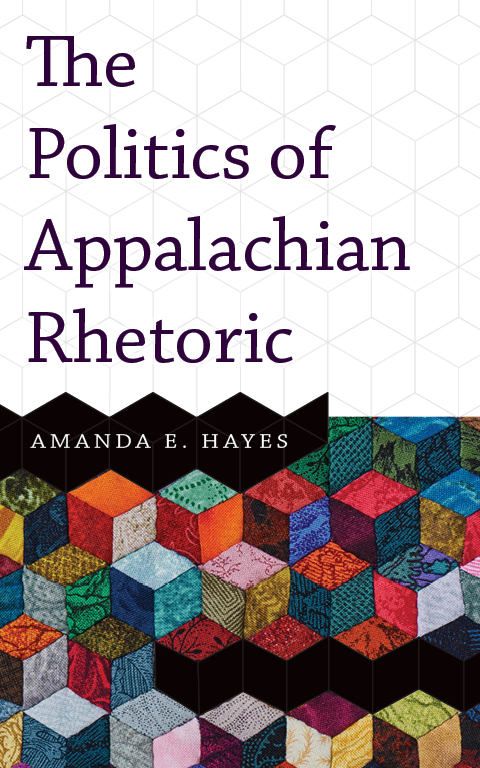
The Politics of Appalachian Rhetoric

Amanda E. Hayes

October 2018
228pp 
PB 978-1-946684-46-2
$29.99
CL 978-1-946684-45-5
$99.99
eBook 978-1-946684-47-9
$29.99

Summary

2019 College English Association of Ohio's Nancy Dasher Award winner

In exploring the ways that Appalachian people speak and write, Amanda E. Hayes raises the importance of knowing and respecting communication styles within a marginalized culture. Diving deep into the region’s historical roots—especially those of the Scotch-Irish and their influence on her own Appalachian Ohio—Hayes reveals a rhetoric with its own unique logic, utility, and poetry.

Hayes also considers the headwinds against Appalachian rhetoric, notably ideologies about poverty and the biases of the school system. She connects these to challenges that Appalachian students face in the classroom and pinpoints pedagogical and structural approaches for change. 

Throughout, Hayes blends conventional scholarship with autobiography, storytelling, and dialect, illustrating Appalachian rhetoric’s validity as a means of creating and sharing knowledge.

Contents

Acknowledgments

Introduction: Writing Takes Place     

1. Ethos       

2. Language   

3. Celtic Rhetoric      

4. Celtic Rhetoric in Appalachia        

5. Writing an Appalachian Rhetoric

6. When Rhetoric Is a Deficit

7. Categorizing Education      

8. Education and Rhetorical Identity  

9. Rhetoric and Repercussions           

Notes   

Bibliography  

Index   

Author

Amanda E. Hayes is an assistant professor of English at Kent State University–Tuscarawas.

Reviews

“In this book, Hayes takes a critical approach in her examination of traditional writing pedagogy and its tendency toward resistance to Appalachian rhetoric, which has a complex history worth exploring. Teachers of writing—particularly those in rural Appalachia—will benefit from Hayes’s important work. This exciting book fills a need for more conversation about what constitutes Appalachian rhetoric and why teachers at all levels should know more about it to better understand the diverse voices their students bring to the classroom.”
Amy D. Clark, coeditor of Talking Appalachian: Voice, Identity, and Community

EmailFacebookInstagramPinterestTwitter

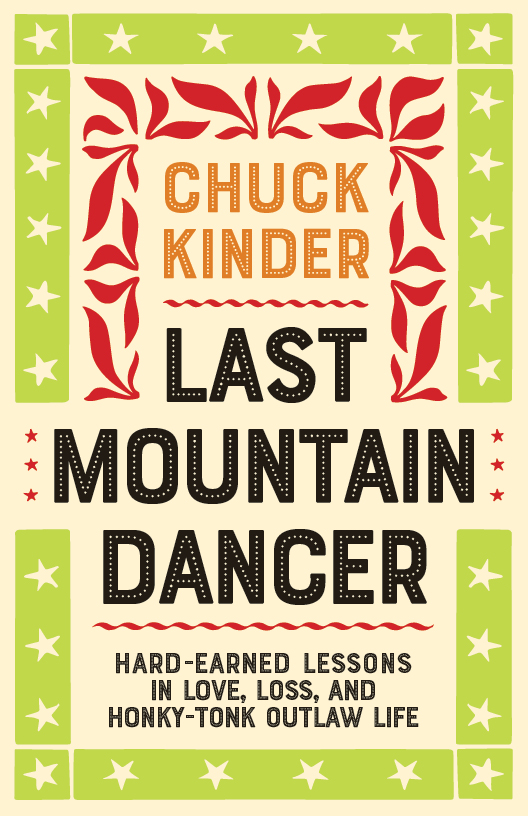
Last Mountain Dancer: Hard-Earned Lessons in Love, Loss, and Honky-Tonk Outlaw Life

Chuck Kinder

August 2018
480pp
PB 978-1-946684-51-6
$23.99
eBook 978-1-946684-52-3
$23.99


Summary

This gonzo-style metamemoir follows Chuck Kinder on a wild tour of the back roads of his home state of West Virginia, where he encounters Mountain State legends like Sid Hatfield, Dagmar, Robert C. Byrd, the Mothman, Chuck Yeager, Soupy Sales, Don Knotts, and Jesco White, the “Dancing Outlaw.”

Contents


Author

Chuck Kinder is the author of four novelsSnakehunter, The Silver Ghost, Honeymooners, and Last Mountain Dancer—and three collections of poetry—Imagination Motel, All That Yellow, and Hot Jewels.

Kinder was born and raised in West Virginia. He received a BA and MA in English from West Virginia University, where he wrote the first creative writing thesis in school history, which evolved into his first novel, Snakehunter. He later caught a Greyhound and headed west to join friends living in San Francisco.

In 1971 Kinder was awarded the Edith Mirrielees Writing Fellowship to Stanford University, followed by the Jones Lectureship in Fiction Writing. He has been a writer-in-residence at the University of California, Davis, and at the University of Alabama, and he is the recipient of a National Endowment for the Arts grant and Yaddo’s Dorothy and Granville Hicks Fellowship.

At Stanford, Kinder became close friends with fellow students Raymond Carver, Scott Turow, and Larry McMurtry. His relationship with Carver inspired Honeymooners. His struggle to complete this book inspired the character Grady Tripp in Michael Chabon’s Wonder Boys.

As a professor of creative writing at the University of Pittsburgh for more than three decades, Kinder served as the director of the creative writing program and helped foster the careers of Michael Chabon, Earl H. McDaniel, Chuck Rosenthal, Gretchen Moran Laskas, and Keely Bowers.

He now lives in Key Largo, Florida, with Diane Cecily, his wife of over forty years.

Reviews

“Novelist Kinder pours out sudden, undomesticated, melancholy word songs from his home place, where he’s returned to gather stories for stewing in his imagination and memory.” 
Kirkus Reviews

“Colorful enough to inspire Michael Douglas’ character, Grady Tripp, in the movie Wonder Boys, Kinder starts with the most interesting West Virginian available: himself.”
Alan Moores, Booklist

“Sparks fly, plans are hatched, threats are made, and a lot of legally questionable activity is engaged in, and Kinder’s fine prose relates it all.”
Publishers Weekly

“Unapologetic, honest, and blunt, Kinder tells stories of living life by the mountain code.”
San Francisco Gate

EmailFacebookInstagramPinterestTwitter

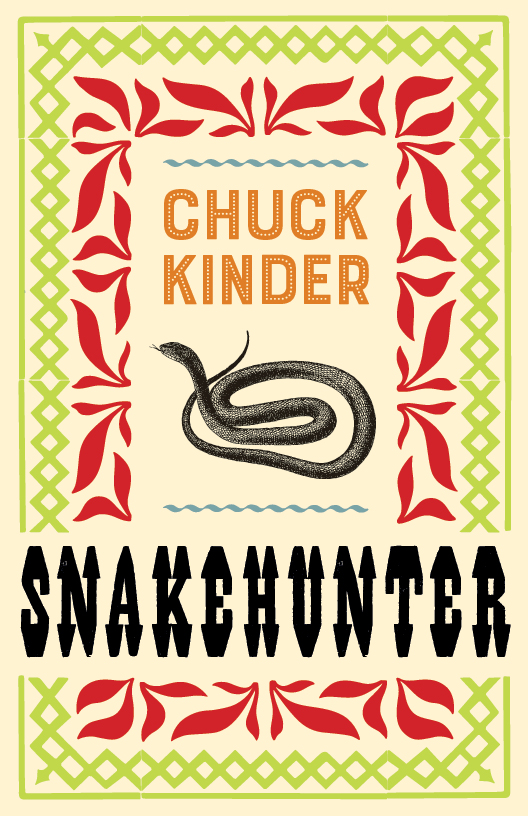
Snakehunter

Chuck Kinder

August 2018
216pp 
PB 978-1-946684-53-0
$19.99
eBook 978-1-946684-54-7
$19.99


Summary

First published in 1973, this debut novel is the deeply moving coming-of-age story of Speer Whitfield, whose recollection of his upbringing and his large, remarkable, and often peculiar family evokes the forces that set the path for a boy’s growth into manhood in 1940s Appalachia.

Contents

Coming soon.     

Author

Chuck Kinder is the author of four novelsSnakehunter, The Silver Ghost, Honeymooners, and Last Mountain Dancer—and three collections of poetry—Imagination Motel, All That Yellow, and Hot Jewels.

Kinder was born and raised in West Virginia. He received a BA and MA in English from West Virginia University, where he wrote the first creative writing thesis in school history, which evolved into his first novel, Snakehunter. He later caught a Greyhound and headed west to join friends living in San Francisco.

In 1971 Kinder was awarded the Edith Mirrielees Writing Fellowship to Stanford University, followed by the Jones Lectureship in Fiction Writing. He has been a writer-in-residence at the University of California, Davis, and at the University of Alabama, and he is the recipient of a National Endowment for the Arts grant and Yaddo’s Dorothy and Granville Hicks Fellowship.

At Stanford, Kinder became close friends with fellow students Raymond Carver, Scott Turow, and Larry McMurtry. His relationship with Carver inspired Honeymooners. His struggle to complete this book inspired the character Grady Tripp in Michael Chabon’s Wonder Boys.

As a professor of creative writing at the University of Pittsburgh for more than three decades, Kinder served as the director of the creative writing program and helped foster the careers of Michael Chabon, Earl H. McDaniel, Chuck Rosenthal, Gretchen Moran Laskas, and Keely Bowers.

He now lives in Key Largo, Florida, with Diane Cecily, his wife of over forty years.

Reviews

“A beautifully achieved novel, wrought in a prose warmed and contoured with kind of a sculptor’s touch, evoked in crystal-bright incidents which bend neither to sentiment nor easy bitterness.”
Scott Turow,  San Francisco Chronicle

“An excellent novel about a West Virginia childhood. Kinder has, to begin with, a good sense of his region: he has rested his story on the firmest possible bases, namely character and place. His dialogue, particularly that of his female characters, is first rate. One would like to secure for this excellently crafted book all the readers one can.”
Larry McMurtry, The Washington Post

“A beautiful novel.”
Gurney Norman, author of Kinfolks: The Wilgus Stories

“A language feast, sweet and sad as the West Virginia landscape it describes. Ahead of its time when first published, this important novel now at last has a chance to find its true audience.”
Ed McClanahan, author of The Natural Man

EmailFacebookInstagramPinterestTwitter

The Sound of Holding Your Breath: Stories

Natalie Sypolt

156pp
PB 978-1-946684-57-8
$18.99
eBook 978-1-946684-58-5
$18.99


Summary

The residents of The Sound of Holding Your Breath could be neighbors, sharing the same familiar landscapes of twenty-first-century Appalachia—lake and forest, bridge and church, cemetery and garden, diner and hair salon. They could be your neighbors—average, workaday, each struggling with secrets and losses, entrenched in navigating the complex requirements of family in all its forms.

Yet tragedy and violence challenge these unassuming lives: A teenage boy is drawn to his sister’s husband, an EMT searching the lake for a body. A brother, a family, and a community fail to confront the implications of a missing girl. A pregnant widow spends Thanksgiving with her deceased husband’s family. Siblings grapple with the death of their sister-in-law at the hands of their brother. And in the title story, the shame of rape ruptures more than a decade later.

Accidents and deaths, cons and cover-ups, abuse and returning veterans—Natalie Sypolt’s characters wrestle with who they are during the most trying situations of their lives.

Contents

Diving
Flaming Jesus 
Ghosts 
Get Up, June   
At the Lake     
Home Visit     
Handlers          
Love, Off to the Side  
Wanting Baby 
Lettuce                         
My Brothers and Me   
What Would Be Saved           
The Sound of Holding Your Breath    
Stalking the White Deer         
Acknowledgments      

Author

Natalie Sypolt is an assistant professor at Pierpont Community & Technical College. She coordinates the high school workshop for the West Virginia Writers’ Workshop at West Virginia University and has served as a literary editor for the Anthology of Appalachian Writers. Her work has appeared in Glimmer Train, Appalachian Heritage, Kenyon Review Online, and Willow Springs. She is the winner of the Glimmer Train new writers contest, the Betty Gabehart Prize, the West Virginia Fiction Award, and the Still fiction contest. This is her first book. Learn more at nataliesypolt.com.

Reviews

"Natalie Sypolt has written gorgeous stories about a much-maligned region and a people that are too often viewed from the interstate, in photographs, or on the screen. If these viewers were to slow down and open the pages of a book like this one, they would discover lives not so different from their own, and they would find a people hewn by place, tied to one another, defined by hope and rage and heart. This is an important book by an important writer."
Wiley Cash, author of The Last Ballad

“Sypolt writes with sober love and unselfconscious respect from the insides of people and a place too many writers touch only from the outside. An impressive debut.”
Ann Pancake, author of Strange As This Weather Has Been

“A bold and important debut that announces a major new voice. It's also the best story collection I've read in a long while.”
Silas House, author of Clay’s Quilt and Southernmost

"Full of powerful images."
Kirkus Reviews

"Examines the best and worst of humanity in modern-day Appalachia."
Publishers Weekly

"Sypolt catches her unassuming characters—friends, neighbors, and families—in the most trying times of their lives, and her vivid descriptions and masterful storytelling make every sentence, setting, and situation come alive."
Booklist 

"Full of inevitability and resignation and haunted by themes of class, family, and place, The Sound of Holding Your Breath penetrates a deep-rooted consistency that’s both a comfort and a curse."
Foreword Reviews

“These bold stories of individuals in conflict and love, rooted deep in their families and communities, echo those of Sherwood Anderson, Carson McCullers, and Breece Pancake. At the same time, Sypolt depicts contemporary Appalachia like no one else. This is a rich and astonishing debut.”
Laura Long, author of Out of Peel Tree and coeditor of Eyes Glowing at the Edge of the Woods: Fiction and Poetry from West Virginia

EmailFacebookInstagramPinterestTwitter

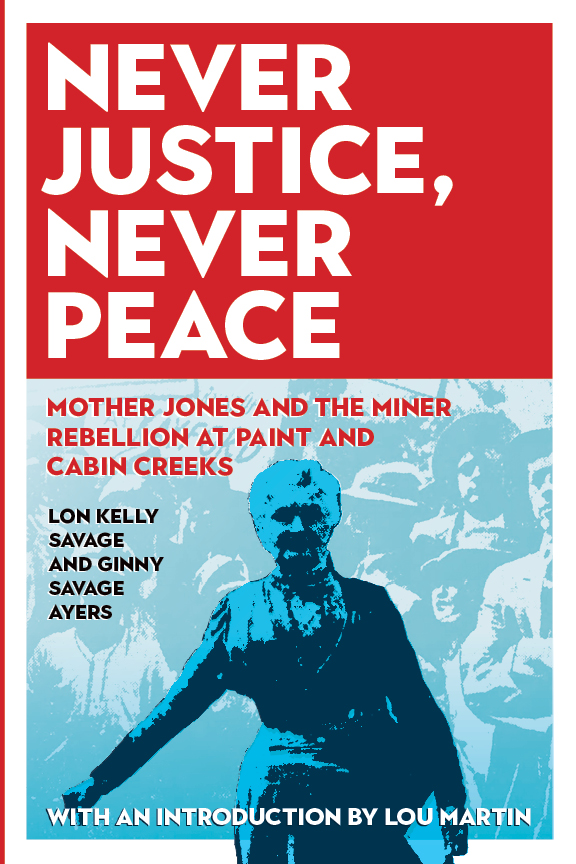
Never Justice, Never Peace: Mother Jones and the Miner Rebellion at Paint and Cabin Creeks

Lon Kelly Savage and
Ginny Savage Ayers

360pp 
PB 978-1-946684-37-0
$27.99
eBook 978-1-946684-38-7
$27.99

West Virginia and Appalachia 

Summary

In 1986 Lon Savage published Thunder in the Mountains: The West Virginia Mine War, 1920–21, a popular history now considered a classic. Among those the book influenced are Denise Giardina, author of Storming Heaven, and John Sayles, writer and director of Matewan. When Savage passed away, he left behind an incomplete book manuscript about a lesser-known Mother Jones crusade in Kanawha County, West Virginia. His daughter Ginny Savage Ayers drew on his notes and files, as well as her own original research, to complete Never Justice, Never Peace—the first book-length account of the Paint Creek–Cabin Creek Strike of 1912–13.

Savage and Ayers offer a narrative history of the strike that weaves together threads about organizer Mother Jones, the United Mine Workers union, politicians, coal companies, and Baldwin-Felts Detective Agency guards with the experiences of everyday men and women. The result is a compelling and in-depth treatment that brings to light an unjustly neglected—and notably violent—chapter of labor history. Introduced by historian Lou Martin, Never Justice, Never Peace provides an accessible glimpse into the lives and personalities of many participants in this critical struggle.

Contents

Preface            
Acknowledgments     
Introduction, Lou Martin       
1. Into the Fight          
2. As Hatred Mounted 
3. Evolution and Revolution   
4. “Take Your Hats Off to ‘Mother’ Jones!”  
5. “Organize Us!”       
6. “The Guards Have Got to Go!”      
7. A “Peace Proclamation”      
8. Walking the Creek  
9. A State of War        
10. Mountainsides to Meeting Rooms            
11. “That Scab Labor”            
12. A Tear in Each Lump of Coal      
13. Yuletide in Union Tents   
14. Pardons and Politics          
15. “Thirsty to Shed Human Blood” 
16. A Desperate Undertaking 
17. Under Arrest         
18. Life in the Bull Pen          
19. A Constitutional Obstacle 
20. The Trial   
21. “Here Is My Stake in This Country”        
22. “See Her Safe in ——”    
23. Freedom and Suppression 
24. “Fight Her All Over Again”         
Notes   
Index   

Author

Lon Kelly Savage (1928–2004) grew up in Charleston, West Virginia. He wrote Thunder in the Mountains: The West Virginia Mine War, 1920–21, a classic popular history. Savage worked as a reporter for the Richmond Times-Dispatch, a bureau chief for United Press International, and an administrator at Virginia Tech in Blacksburg.

Ginny Savage Ayers, daughter of Lon Savage, has worked for many years in scientific research and teaching. She currently resides in Maryville, Tennessee, where she is involved in several environmental and social causes.

Reviews

“Lon Savage and Ginny Savage Ayers have written an account of one of the seminal confrontations in the history of the American labor movement that is both exhaustively researched and a real page-turner. Especially compelling is their insight into Mother Jones, that human detonator in constant search of dynamite.”
John Sayles

"Fascinating and accessible."
Choice 

"A remarkable product of intricate, careful research that stands as the most detailed history of Paint Creek and Cabin Creek now available."
Journal of Southern History

EmailFacebookInstagramPinterestTwitter