Richard Kidwell Miller

Richard Kidwell Miller

Richard Kidwell Miller
Curated by John A. Cuthbert
January 2011
104pp
HC/J  978-0-975292-50-1
$29.95

Published by West Virginia University Libraries

Summary

With striking contrasts, bold colors, and powerful textures and lines, Richard Kidwell Miller’s art is abstract, yet integrated and powerful, while sensuous.  Born in the coal-mining region of Fairmont, West Virginia during the Great Depression, Miller displayed artistic talent as a young boy, holding his first solo exhibition by the age of sixteen. As his artistic training progressed, his paintings took on an array of subjects and mediums. He explored realism, abstraction, collage, portraiture, still life and constructed works. The scale of his work varied as well, as he produced huge still life compositions that challenge the very nature of the subject and exquisitely layered canvas on canvas and wood on canvas structures that cross the border between traditional painting and relief sculpture.

In 2004, Richard Kidwell Miller’s work was displayed at West Virginia University. This lushly illustrated book encompasses that exhibit, as curator John A. Cuthbert narrates Miller’s development as a student, artist, and teacher. With over twenty-five beautifully reproduced paintings, spanning over forty years of artistic development, this collection brings attention to the life and work of a contemporary artist.

Contents

  • Foreword
  • Richard Kidwell Miller: "What's Next?"
  • Catalogue of the Exhibition
  • Artist's Statment
  • Appendices
  •   Selected Exhibitions
  •   Selected Collections
  •   Awards
  • Bibliography
  • Acknowledgements

Author

Richard Kidwell Miller has exhibited work in countless museums, including The Phillips Collection, Hirshhorn Museum and Sculpture, the Whitney Museum, and the Smithsonian Institution. He is a recipient of the National Society of Arts and Letters Lifetime Achievement Award. 

John A. Cuthbert is Curator of the West Virginia and Regional History Collection and Director of the West Virginia Historical Art Collection at the West Virginia University Libraries.

Reviews

“This is the first book to describe Miller’s oeuvre and it does so handsomely.”
E.H. Teague, University of Oregon

An Appalachian New Deal: West Virginia In the Great Depression

An Appalachian New Deal

Jerry B. Thomas

March 2010
332pp
PB  978-1-933202-51-8
$28.99
PDF  978-1-933202-97-6
$23.99
PDF  (120 Days)
$10.00


Summary

In this paperback edition of An Appalachian New Deal: West Virginia in the Great Depression, Jerry Bruce Thomas examines the economic and social conditions of the state of West Virginia before, during, and after the Great Depression. Thomas’s exploration of personal papers by leading political and social figures, newspapers, and the published and unpublished records of federal, state, local, and private agencies, traces a region’s response to an economic depression and a presidential stimulus program. This dissection of federal and state policies implemented under Franklin D. Roosevelt’s New Deal program reveals the impact of poverty and hardship upon political, gender, race, and familial relations within the Mountain State—and the entire nation. Through An Appalachian New Deal, Thomas documents the stories of ordinary citizens who survived a period of economic crisis and echoes a message from our nation’s past to a new generation enduring financial turmoil and uncertainty.

Contents

  • Preface to the Paperback Edition
  • Acknowledgments
  • Introduction
  • 1. On the Eve
  • 2. Drought and Depression
  • 3. A Search for Order
  • 4. A “Jump in the Dark”
  • 5. The Blue Eagle
  • 6. A Failed Experiment in Federal Relief
  • 7. Reshaping the Welfare System
  • 8. The New Deal and Mountain Agriculture
  • 9. The New Deal and Families in Distress
  • 10. Reluctant New Dealers
  • Epilogue: From Nearly Perfect to Almost Heaven
  • Notes
  • Bibliography
  • Index
  •  

Author

Jerry Bruce Thomas is professor emeritus of history at Shepherd University. He earned a BA in political science at West Virginia University and, after Peace Corps service in the Dominican Republic, an MA and PhD in history from the University of North Carolina at Chapel Hill. In addition to An Appalachian New Deal, he is the author of An Appalachian Reawakening: West Virginia and the Perils of the New Machine Age, 1945–1972 (also available from West Virginia University Press).

Reviews

“ . . . Thomas’s account of the Great Depression in West Virginia is a welcome edition to the historiography both of the New Deal and of Appalachia.”
Thomas Kiffmeyer, associate professor of history, Morehead State University

“This book is well-researched, well-written, and gives readers unparalleled insight into the New Deal in West Virginia from the perspectives of state leaders, federal officials, and the state’s poor.”
Richard D. Starnes, Creighton Sossomon Associate Professor and Department Chair, Western Carolina University

“Thomas makes a persuasive case that West Virginia, with its chronic poverty, is an important laboratory for examining state and national efforts to end the Great Depression.”
Douglas Carl Abrams, professor of history and chair of the Department of Social Studies Education, Bob Jones University

“Amazing as it may seem, there is no history of the New Deal in West Virginia. With its excellent research and clear narration, this book will stand as the major work on the New Deal in West Virginia for a long time to come. . . . A mature work of scholarship.”
Ronald L. Lewis, professor emeritus of history, West Virginia University

“An important book that anyone interested in Appalachia’s twentieth-century history will want to read. Thomas provides a gracefully written account of a crucial decade in West Virginia history.”
John Alexander Williams, professor of history, Appalachia State University

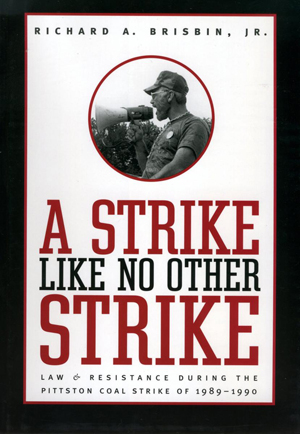
A Strike Like No Other Strike: Law and Resistance during the Pittston Coal Strike of 1989–1990

A Strike Like No Other Strike

Richard A. Brisbin, Jr.

August 2010
350pp
PB  978-1-933202-76-1
$24.95

Summary

The miners’ strike against Pittston Coal in 1989–1990, which spread throughout southwestern Virginia, southern West Virginia, and eastern Kentucky, was one of the most important strikes in the history of American labor, and, as Richard Brisbin observes, “one of the longest and largest incidents of civil disorder and civil disobedience in the United States in the second half of the twentieth century.” The company aggressively sought to break the strike, and workers and their families used a variety of tactics—lawful and unlawful—to resist Pittston’s efforts as the situation quickly turned ugly.

In A Strike like No Other Strike: Law and Resistance during the Pittston Coal Strike of 1989–1990, Richard Brisbin offers a compelling study of the exercise of political power. In considering the legal significance of the strike, Brisbin asks the larger question of whether even extreme transgression or resistance can fracture the “imagined coherence of the law.” He shows how each party in the strike invoked the law to justify its actions while attacking those of the other side as unlawful. In the end, both sides lost; although the US Supreme Court ultimately ruled in favor of the union, most of the strikers faced elimination of their jobs and an ongoing struggle for pensions and health benefits.

Contents

  • List of Illustrations
  • Preface and Acknowledgements
  • 1. A Tale of a "Strke like No Other Strike"
  • 2. The United Mine Workers and the Legal Contitution of American Labor
  • 3. The Legal Complex and Union Power
  • 4. Union and Management Define Their Stratedgies
  • 5. The Union Plans a Social Drama
  • 6. The Union Stages a Social Drama
  • 7. Lawbreaking
  • 8. Competing Exlanations of Resistance
  • 9. The Domestication of Resistance
  • 10. Resistance and the Lives of the Strikers
  • 11. The Power of Law and the Effectiveness of Resistance
  • Notes
  • References
  • Index

Author

Richard A. Brisbin Jr. is an associate professor of political science at West Virginia University. He is the author of Justice Antonin Scalia and the Conservative Revival.

Reviews

“Richard Brisbin’s excellent book sits at the intersection of law, political science, sociology, and history . . .  Brisbin is utterly convincing in his conclusion that the miners were in the end reduced to Arendtian animals laborans who worked only for sustenance rather than for the joy of creation and integration into a community.”
Julie Novkov, Law and Politics Book Review

“The book brims with insights into the history of the Pittston strike and into a miner's way of life . . . [Brisbin] describes hanging out at the picketing shacks, protests led by Jesse Jackson and Cesar Chavez, militant priests and nuns, and mine takeovers, complete with dancing and live country music.”
Henry S. Cohn, The Federal Lawyer

“Brisbin does an admirable job not only of conveying the historical events and their context, but also of making explicit the evolution and development that occurred on both sides of the struggle.”
Gordon Simmons, Appalachian Heritage

“It is clear that Brisbin’s personal experience with the 'American worker' informs his interpretation of the Pittston coal strike, and he leaves the reader at once inspired and dismayed by the subjectivity of American law.”
Virginia Libraries

“Gives fascinating insights for those involved in directing collective bargaining activities, both as managers and union activists.”
Michael Wald, Monthly Labor Review

“This excellent study describes the 1989–1990 Pittston coal strike . . . Brisbin avoids offering a traditional narrative in favor of a deeper analysis of the dispute that explores the strike’s significance as an exercise in civil disobedience and oppositional culture . . . Brisbin is to be commended for dissecting what happened here with an eye toward its wider implications.”
Richard P. Mulcahy, Journal of American History

“A comprehensive account and analysis of the lengthy Pittston coal strike of 1989—1990, focusing on the effects of the law and its apparatus on the actions of Pittston Coal, the United Mine Workers union, judges, and the miners themselves.”
Choice

“This book tells the story of a very important but little known recent episode in the history of labor and its unfortunate fate at the hands of corporate power. Brisbin presents a powerful but balanced interpretive account informed by cutting edge theory and compelling judgment. I know of no other work that better develops theoretically and illustrates empirically the complex, multi-dimensional workings of law as does Brisbin’s study of the United Mine Workers’ tragic battle with Pittston.”
Michael McCann, University of Washington

“A useful read for any student of the Appalachian region.”
Mark S. Myers, West Virginia History

“Richard Brisbin has done a service in putting together this book . . . a welcome new resource.”
Fran Ansley, Journal of Appalachian Studies

An Appalachian Reawakening: West Virginia and the Perils of the New Machine Age, 1945–1972

An Appalachian Reawakening

Jerry Bruce Thomas

November 2010
470pp
PB  978-1-933202-58-7
$28.99
PDF  978-1-933202-98-3
$23.99
PDF  (120 Days)
$10.00

Purchase the Kindle Edition at Amazon


Summary

As the long boom of post–World War II economic expansion spread across the globe, dreams of white picket fences, democratic ideals, and endless opportunities flourished within the United States. Middle America experienced a period of affluent stability built upon a modern age of industrialization. Yet for the people of Appalachia, this new era brought economic, social, and environmental devastation, preventing many from realizing the American Dream. Some families suffered in silence; some joined a mass exodus from the mountains; while others, trapped by unemployment, poverty, illness, and injury became dependent upon welfare. As the one state most completely Appalachian, West Virginia symbolized the region’s dilemma, even as it provided much of the labor and natural resources that fueled the nation’s prosperity.

An Appalachian Reawakening: West Virginia and the Perils of the New Machine Age, 1945–1972 recounts the difficulties the state of West Virginia faced during the post–World War II period. While documenting this turmoil, this valuable analysis also traces the efforts of the New Frontier and Great Society programs, which stimulated maximum feasible participation and led to the ultimate rise of grass roots activities and organizations that improved life and labor in the region and undermined the notion of Appalachian fatalism.

Contents

  • Acknowledgments
  • Introduction
  • 1. A New Machine Age in the Hills
  • 2. American Paradox, Appalachian Stereotype
  • 3. Civil Rights in the New Machine Age
  • 4. Good Intentions: The New Frontier and the War on Poverty
  • 5. Raising Hell in the Hills and Hollows: AVs, VISTAs, and Community Action
  • 6. From the Silver Bridge to Farmington and Rumblings at the Grassroots
  • 7. The Black Lung Association, Miners for Democracy, and the New Feminism
  • 8. The Strip Mining Dilemma and a Climactic Debate
  • 9. Buffalo Creek: Appalachian Apotheosis
  • Epilogue: Another Reawakening?
  • Notes
  • Bibliography
  • Index

Author

Jerry Bruce Thomas is professor emeritus of history at Shepherd University, Shepherdstown, WV.

Roll Out the Carpet: 101 Seasons of West Virginia University Basketball

Roll Out the Carpet

John Antonik
With a foreword by Rod Thorn and
afterword by Bob Huggins
September 2010
288pp
HC/J  978-1-933202-66-2
$39.95


Summary

Roll Out the Carpet is the story of West Virginia University basketball. This comprehensive history chronicles over one hundred seasons of the game, from the early years of the Tri-State and Eastern Conferences, to the golden era of Hot Rod Hundley, Jerry West, and Rod Thorn, to the Mountaineer’s most recent triumphs under coaches John Beilein and Bob Huggins.

For Mountaineers, it’s not just about winning a prize, trophy or title—it’s about the work ethic, pride, and loyalty that embodies the spirit of the state. With unparalleled insider access, alumnus and longtime athletic department official John Antonik details the vibrant history of the players, coaches, and fans that created the finest moments of Mountaineer basketball. These pages overflow with accounts of nail-biting tension leading to buzzer-beating shots, thrilling game-saving moments, and rich, intimate details of the superstar players and coaches that built an institution of gold and blue.

From the first game in 1904 against rival Pitt to West Virginia’s glorious return to the 2010 NCAA Final Four, Roll Out the Carpet celebrates the tradition of Mountaineer basketball. With over five hundred  photographs—many of which have never been published before—and articles of memorabilia from the WVU athletic department, university archives, and personal collections, this book is a must-have for any West Virginia University basketball fan. It’s a great day to be a Mountaineer!

Contents

  1. Foreword by Rod Thorn
  2. Introduction: Let's Roll Out the Carpet...
  3. The Early Years (1903-1919)
  4. S-t-a-d-s-v-o-l-d Spells Stability (1920-1933)
  5. The Marshall Plan (1934-1938)
  6. Taking a Bite Out of the Big Apple (1939-1942)
  7. The War Years (1943-1945)
  8. Triumph and Tragedy (1946-1950)
  9. Picking up the Pieces (1951-1954)
  10. A Golden Era (1955-1960)
  11. King and His Court (1961-1965)
  12. Running Waters (1966-1969)
  13. Years of Transition (1970-1978)
  14. The Years of the Cat (1978-2002)
  15. Beilein Brings 'em Back (2003-2007)
  16. Huggs Comes Home (2007-2010)
  17. Afterword by Bob Huggins
  18. Acknowledgements
  19. Bibliography

Author

A native of West Virginia, John Antonik received a Bachelor’s Degree in Journalism and a Master’s Degree in Sports Management from West Virginia University. He is Director of New Media for Intercollegiate Athletics, West Virginia University and author of West Virginia University Football Vault: The History of the Mountaineers.

With a foreword by Rod Thorn and an afterword by Bob Huggins.

Reviews

"...a well-researched work documenting 101 years of WVU lore."
Doug Huff, The Wheeling Intelligencer

"...a must for WVU basketball lovers of the past and present."
Mickey Furfari, The Beckley Register-Herald

"...a veritable encyclopedia, of all things West Virginia basketball."
Colin DunlapThe Pittsburgh Post-Gazette

"Antonik has turned out a fact-stuffed, story-enhanced read..."
Jack BogaczykThe Charleston Daily-Mail

"Sports enthusiasts will revel in the 100-plus seasons covered in this book..."
West Virginia Living

Vidcast

Still Life with Plums

Still Life with Plums

Marie Manilla
October 2010
172pp
PB  978-1-933202-60-0
$16.95
PDF  978-1-933202-61-7
$15.99
EPUB 978-1-943665-60-0
$15.99

Summary

Still Life with Plums is a vibrant collection of short stories that weaves together the outwardly distant lives of several strangers. With heaping doses of dark humor and magical realism, these ten stories enliven a cast of characters carefully speckled throughout the southern portion of the United States. From West Virginians, to Texans and Latinos, Still Life with Plums circles the paths of a Black-Irish West Virginian, a wise-cracking dog groomer, an emasculated husband, a Guatemalan widow, a Japanese-Latin-American poster child from WWII, and a meticulous predator. Marie Manilla’s accessible prose is deceptively layered, as she births and wrestles this quirky ensemble that unflinchingly probes the human psyche, while affirming a concrete connection to a shared place and identity.

Contents

  • Hand. Me. Down.
  • Childproof
  • Grooming
  • Amnesty
  • Distillation
  • Still Life with Plums
  • Counting Backwards
  • Crystal City
  • The Wife You Wanted
  • Get Ready

Author

West Virginia native Marie Manilla is a graduate of the Iowa Writers’ Workshop. Her stories have appeared in The Chicago Tribune, Prairie Schooner, Mississippi Review, Calyx Journal, Kestrel, Portland Review, GSU Review, and other journals. She is the author of the upcoming novel Shrapnel, a Fred Bonnie Award for Best First Novel winner.

Reviews

"Marie Manilla’s Still Life With Plums houses in its pages a repository of heartache and joy.  Its soul lies in life’s little moments, somehow still yet perpetually fleeing.  Manilla’s words take flight in the mind and dance “like paper birds in the wind.”  Inevitably, the words will root inside the reader, like the memory of a fossil or a Polaroid picture, and once there, they will cease to be still.  Just as the people in these stories, they will keep on humming."
Glenn Taylor, author of The Ballad of Trenchmouth Taggart  and National Book Critics Circle Award finalist

"This mesmerizing collection of stories is full of my favorite things: brilliantly vivid characters, rich cultural textures, bleak humor and surprising story turns. Manilla weaves a kind of literary magic that kept me reading late into the night."
Zoë Ferraris, author of Finding Nouf and City of Veils

"Any reader who cares about mature, intelligent, graceful storytelling should be thinking very seriously about getting Still Life with Plums into their life--buy it, download it, check it out of the library--whatever it takes to be able to read and savor and learn from Marie Manilla's fine and resonant stories."
Richard Currey, author of Fatal Light and Lost Highway

“This is an accomplished collection, displaying a variety of voices, settings, conflicts, and surprising resolutions. The writing is sure, and the stories demonstrate a writer who is confident in her vision.”
Kevin Stewart, author of The Way Things Always Happen Here

Perspectives on the Old Saxon Heliand: Introductory and Critical Essays, with an Edition of the Leipzig Fragment

Perspectives on the Old Saxon Heliand

Edited by
Valentine A. Pakis
May 2010
PB  978-1-933202-49-5
$44.95
PDF  978-1-935978-35-0
$43.99
PDF  (120 Days)
$20.00

Summary

Heliand, the Old Saxon poem based on the life of Christ in the Gospels, has become more available to students of Anglo-Saxon culture as its influence has reached into a wider range of fields from history to linguistics, literature, and religion. In Perspectives on the Old Saxon Heliand, Valentine Pakis brings together recent scholarship that both addresses new turns in the field and engages with the relevant arguments of the past three decades. Furthering the ongoing critical discussion of both text and culture, this volume also reflects on the current state of the field and demonstrates how it has evolved since the 1970s.

Volume 12 in the Medieval European Studies Series.

Contents

  1. Preface
    Valentine A. Pakis
  2. Introductions to the Heliand and its Language
    • The Historical Setting of the Heliand, the Poem, and the Manuscripts
        James E. Cathey
    • The Old Saxon Heliand
        G. Ronald Murphy
    • An Overview of Old Saxon Linguistics, 1992–2008
        Marc Pierce
  3. The Diatessaronic Tradition
    • The Parable of the Fisherman in the Heliand: The Old Saxon Version of Matthew 13:47-50
        Tjitze Baarda
    • (Un)Desirable Origins: The Heliand and the Gospel of Thomas
        Valentine A. Pakis
  4. Orality and Narrative Tradition
    • Was the Heliand Poet Illiterate?
        Harald Haferland
    • The Hatred of Enemies: Germanic Heroic Poetry and the Narrative Design of the Heliand
        Harald Haferland
  5. The Portrayal of the Jews in the Heliand
    • The Jews in the Heliand
        G. Ronald Murphy
    • Jesus Christ between Jews and Heathens: The Germanic Mission and the Portrayal of Christ in the Old Saxon Heliand
        Martin Friedrich
  6. The Discovery of the Leipzig Fragment (2006)
    • A New Heliand Fragment from the Leipzig University Library
         Hans Ulrich Schmid
  7. Plates
    1. 1. Leipzig, Universitätsbibliothek, omas 4073 (MS), outer side
    2. 2. Leipzig, Universitätsbibliothek, omas 4073 (MS), inner side
  8. Works Cited

Cross and Cruciform in the Anglo-Saxon World: Studies to Honor the Memory of Timothy Reuter

Cross and Cruciform in the Anglo-Saxon World

Edited by
Sarah Larratt Keefer,
Karen Louise Jolly, and
Catherine E. Karkov

May 2010
PB  978-1-933202-50-1
$44.95

Summary

Cross and Cruciform in the Anglo-Saxon World: Studies to Honor the Memory of Timothy Reuter is edited by Sarah Larratt Keefer, Karen Louise Jolly, and Catherine E. Karkov and is the third and final volume of an ambitious research initiative begun in 1999 concerned with the image of the cross, showing how its very material form cuts across both the culture of a society and the boundaries of academic disciplines—history, archaeology, art history, literature, philosophy, and religion—providing vital insights into how symbols function within society. The flexibility, portability, and adaptability of the Anglo-Saxon understanding of the cross suggest that, in pre-Conquest England, at least, the linking of word, image, and performance joined the physical and spiritual, the temporal and eternal, and the earthly and heavenly in the Anglo-Saxon imaginative landscape.

This volume is divided into three sections. The first section of the collection focuses on representations of “The Cross: Image and Emblem,” with contributions by Michelle P. Brown, David A. E. Pelteret, and Catherine E. Karkov. The second section, “The Cross: Meaning and Word,” deals in semantics and semeology with essays by Éamonn Ó Carragáin, Helen Damico, Rolf Bremmer, and Ursula Lenker. The third section of the book, “The Cross: Gesture and Structure,” employs methodologies drawn from archaeology, new media, and theories of rulership to develop new insights into subjects as varied as cereal production, the little-known Nunburnholme Cross, and early medieval concepts of political power.

Cross and Cruciform in the Anglo-Saxon World: Studies to Honor the Memory of Timothy Reuter is a major collection of new research, completing the publication series of the Sancta Crux/Halig Rod project. Cross and Culture in Anglo-Saxon England: Studies in Honor of George Hardin Brown, Volume 2 in this series, remains available from West Virginia University Press.

Volume 11 in the Medieval European Studies Series

Contents

  • Abbreviations
  • In Memoriam Timothy Reuter
  • Introduction
    Sarah Larratt Keefer, Trent Universty, Ontario
    Karen Louise Jolly, University of Hawai'i at Ma̅noa
    Catherine E. Karkov, University of Leeds
  • I. The Cross: Image and Emblem
    • The Cross and the Book: the Cross-Carpet Pages of the Lindisfarne gospels as Sacred Figurae
        Michelle P. Brown
    • A Cross and an Acrostic: Boniface's Prefatory Poem to his Ars grammatica
        David A. E. Pelteret
    • Abbot Ælfwine and the Sign of the Cross
        Catherine E. Karkov
  • II. The Cross: Meaning and Words
    • Sources or Analogues? Using Liturgical Evidence to Date The Dream of the Rood
        Éamonn Ó Carragáin
    • Writing/Sounding the Cross: The Dream of the Rood as Figured Poetry
        Helen Damico
    • Old English "Cross" Words
        Rolf H. Bremmer Jr.
    • Signifying Christ in Anglo-Saxon England: Old English Terms for the Sign of the Cross
        Urula Lenker
  • III. The Cross: Gesture and Structure
    • The Staff of Life: Cross and Blessings in Anglo-Saxon Cereal Production
        Debby Banham
    • The Anglo-Saxon Chapel at Bradford on Avon, Wiltshire
        David A. Hinton
    • New Media and the Numburnholme Cross
        Martin K. Foys
    • The Enkolpion of Edward the Confessor: Byzantium and Anglo-Saxon Concepts of Rulership
        Lynn Jones
  • Index

Reviews

This volume makes valuable contributions and should appeal not only to Anglo-Saxonists but also to those with interests in early medieval intellectual and cultural history, liturgy, and iconography.
Nicole Guenther Discenza, University of South Florida

Helvetia: The History of a Swiss Village in the Mountains of West Virginia

Helvetia

David H. Sutton

April 2010
192pp
PB  978-1-933202-56-3
$32.99


Summary

Helvetia: The History of a Swiss Village in the Mountains of West Virginia explores the unique founding and development of a community nestled within the wilderness of Appalachia. Established in 1869, this tiny Swiss settlement embodies the American immigrant experience, reflecting the steadfast desire of settlers to preserve cultural traditions and values while adapting to new and extraordinary surroundings. From ramp suppers to carnivals, traditional architecture, folk music, and cheese making, this book documents a living community by exploring the ethnic customs, farming practices, community organization, and language maintenance of Helvetia residents. Drawing upon a diverse body of resources such as Swiss and American archival documents and local oral accounts, this chronicle depicts the everyday social and economic life of this village during the past two centuries. Helvetia celebrates a small community where residents and visitors alike continue to practice a Swiss American culture that binds an international history to a local heritage.

Long out of print, this reissued edition of the history of Helvetia contains a new introduction, a concise index, a bibliography, an appendix of foreign-born immigrants, and an exquisite photographic essay featuring archival images of a Swiss village still thriving within the isolated backcountry of central West Virginia.

Contents

  • Acknowledgements
  • Author's Note
  • Introduction to the Second Edition
  • Preface
  • 1. The Immigration of Swiss to America and Migrations to the Central Appalachian Mountains
  • 2. Helvetia's Founding
  • 3. Building the New Community
  • 4. An Agricultural Way of Life
  • 5. Forces of Change
  • 6. Continuity and Change: Helvetia's Social and Cultural Life
  • 7. The Community in Context
  • 8. Helvetia Life: 1950–2009
  • Notes
  • Appendices
  • Bibliography
  • Index

Author

David H. Sutton is a native of Helvetia, WV. He received his bachelor's degree from Davis & Elkins College and a master's in history from West Virginia University. As an archivist and manuscripts curator, he has worked for the Washburn Norlands Foundation in Livermore Falls, ME, and the Balch Institute for Ethnic Studies in Philadelphia. 

Reviews

“David Sutton’s history of Helvetia, a small Swiss village founded in the wilderness of West Virginia, is a brilliantly researched, succinct account of individual fortitude and communal purpose. It is an important contribution to the history of immigration in the United States and to the study of cultural diversity in the Appalachian region. Most remarkable is Sutton’s subtle treatment of the interplay between the ideals of Swiss settlers and the challenging environment of a mountain frontier.”
George Parkinson, former curator and associate professor of history, West Virginia University

“A vivid portrait of the emergence of a Swiss settlement, drawn with impressive empathy and scholarly competence. It will delight the general reader and enrich the scholar’s understanding of Swiss migration.”
Leo Schelbert, professor of history emeritus, University of Illinois at Chicago

Vidcast

Old South, New South, or Down South?: Florida and the Modern Civil Rights Movement

Old South, New South, or Down South?

Edited by
Irvin D. S. Winsboro

November 2009
352pp
PB 978-1-933202-44-0
$24.95
PDF 978-1-935978-00-8
$23.99
PDF (120 days)
$10.00

Purchase the Kindle Edition at Amazon


Summary

How does a state, tarnished with a racist, violent history, emerge from the modern civil rights movement with a reputation for tolerance and progression? Old South, New South, or Down South?: Florida and the Modern Civil Rights Movement exposes the image, illusion, and reality behind Florida’s hidden story of racial discrimination and violence. By exploring multiple perspectives on racially motivated events, such as black agency, political stonewalling, and racist assaults, this collection of nine essays reconceptualizes the civil rights legacy of the Sunshine State. Its dissection of local, isolated acts of rebellion reveals a strategic, political concealment of the once dominant, often overlooked, old south attitude towards race in Florida.

2010 Harry T. and Harriette V. Moore Award Recipient

Contents

  • Preface and Acknowledgements
  • Introduction: Image, Illusion, and Reality: Florida and the Modern Civil Rights Movement in Historical Perspective
      Irvin D. S. Winsboro
  • The Illusion of Moderation: A Recounting and Reassessing of Florida’s Racial Past
      Marvin Dunn
  • From Old South to New South, or Was It?: Jacksonville and the Modern Civil Rights Movement in Florida
      Abel A. Bartley
  • Brotherhood of Defiance: The State-Local Relationship in the Desegregation of Lee Country Public Schools, 1954–1969
      Irvin D. S. Winsboro
  • Toms and Bombs: The Civil Rights Struggle in Daytona Beach   
  •   Leonard R. Lempel
  • Planting the Seeds of Racial Equality: Florida’s Independent Black Farmers and the Modern Civil Rights Era
      Connie L. Lester
  • Justice Delayed Is Justice Denied: Florida’s “Public Mischief” Defense and Virgil Hawkins’s Protracted Legal Struggle for Racial Equality
      Amy Sasscer
  • “Wait” Has Almost Always Meant “Never”: The Long Road to School Desegregation in Palm Beach County
      Lise M. Steinhauer
  • The Triumph of Tradition: Haydon Burns’s 1964 Gubernatorial Race and the Myth of Florida’s Moderation
      Abel A. Bartley
  • From Old South Experiences to New South Memories: Virginia Key Beach and the Evolution of Civil Rights to Public Space in Miami
      Gregory W. Bush
  • Afterword: Old South, New South, or Down South?: Florida and the Modern Civil Rights Movement: Towards a New Civil Rights History in Florida
      Paul Ortiz
  • Contributors
  • Index

Author

Irvin D.S. Winsboro is professor of history, African American studies, and Florida studies at Florida Gulf Coast University. He is the author of Feminism and Black Activism in Contemporary America: An Ideological Assessment, and numerous other works and articles.

Contributors Include: Abel A. Bartley, Gregory Bush, Marvin Dunn, Leonard R. Lempel, Connie L. Lester, Paul Ortiz, Amy Sasscer, Lise M. Steinhauer.

Reviews

“Local histories, based on research in grass-roots communities, often challenge the stereotypes we have been taught. These superb essays explode the myth of Florida as an ‘exceptional’ state noted for its ‘moderation’ in race relations. Instead, they show vividly the degree to which racism—and black resistance—were as endemic to Florida as they were to Mississippi. Winsboro’s book is a powerful tribute to the long history of black struggle in Florida, the entrenched barriers that had to be overcome, and the effectiveness of historians of Florida in revealing the truth of the state’s past.”
William H. Chafe, Alice Mary Baldwin Professor of History, Duke University

“This is revisionism as it’s meant to be: careful research that examines a major issue and as a result fundamentally changes how we think about something we thought we knew. It will be an important, much cited, and respected book.”
John B. Boles, Professor of History, Rice University and Editor, Journal of Southern History

“This study stikes a serious blow at the misperception of Florida’s progressive past by examining its civil rights history. In this vein, it provides enriching essays that shed more light on the Jim Crow era and civil rights movement in Florida and places the Sunshine State in its proper historical place alongside other deep South states like Mississippi, Georgia, and Alabama.”
David H. Jackson, Professor of History & Chairman of Department of History, Political Science, Public Administration, Geography and African American Studies, Florida A&M University

“These thoroughly researched and well-written essays directly challenge the conventional wisdom that Florida followed a more moderate form of Jim Crow than its southern peers. This collection chronicles the agonizing history of segregation and repression in the state, and demonstrates conclusively that only after long and persistent struggles by African Americans at the community level and intervention by the federal government was Florida finally forced to modify its resistance to civil rights reform. By reconceptualizing the struggle for civil rights in Florida, this book also advances the national project of rewriting America’s racial history.”
Ronald L. Lewis, Stuart and Joyce Robbins Chair and Professor Emeritus of History, West Virginia University

“This collection of authors—all either Florida natives or professors in the state—outlines the contours of an interplay of repression and liberation that enriches the understanding of past battles (in curriculum, work, law, and public space) and provides context for those battles in the nation that are yet to be waged.”
Stephanie Y. Evans, The Journal of American History