
The Backyard Brawl: Stories from One of the Weirdest, Wildest, Longest Running and Most Intense Rivalries in College Football History

The Backyard Brawl

John Antonik
September 2012
352pp
60 color & b/w images
PB 978-1-935978-82-4
$19.99
ePub 978-1-935978-83-1
$19.99
PDF 978-1-935978-84-8
$19.99

Purchase the Kindle Edition at Amazon


Summary

The West Virginia University Mountaineers and the University of Pittsburgh Panthers, separated by less than eighty miles of highway, have battled it out on the football field for more than one hundred years. Now, with Pitt announcing its departure from the Big East Conference to join the Atlantic Coast Conference and West Virginia becoming a member of the Big 12 Conference, this intense rivalry has come to an abrupt end. Thousands of players and dozens of coaches - some among the very best to ever play the game - have been a part of this famous series known as the “Backyard Brawl.”  With fantastic tales about this feud’s star-studded rosters, including  White, Slaton, Harris, Luck, Huff, Nehlen, and Rodriguez for West Virginia and Fitzgerald, Marino, Dorsett, Green, Majors, and Sherrill for Pitt, The Backyard Brawl celebrates the tradition, heritage, and pride of two outstanding universities. With unparalleled access, John Antonik, a 20-year West Virginia University athletic administrator and WVU alumnus, unearths the fascinating and humorous stories that make up this revered, colorful, and cherished football game-and more importantly, the great passion and pride these schools exhibit every time they take the field.

Contents

Prologue

1943-1955: The Rivalry Resumes

1943 - The Long Shadow of Sutherland

1947 - Finally!

1952 - Pappy Makes 'em Happy

1954 - The Power of Positive Thinking

1955 - Pass the Sugar

1957-1965: Wild Times

1957 - West Virginia Survives

1959 - A “Pitt-iful” Performance

1961 - The Garbage Game

1963 - The Battle of the Brothers

1965 - Points Galore

1967-1979: The Birth of the Backyard Brawl

1967 - “Jusk” for Kicks

1970 - Bobby Blows It

1975 - McKenzie Kicks the Hell out of Pitt

1976 - Tony D Gets Tossed

1979 - Farewell, Old Mountaineer Field

1982-1991: A Changing of the Guard

1982 - A Classic Comeback

1983 - "Let's Do It!"

1985 and 1987 - A Tie and a Sigh

1989 - Kissing Your Sister; Clubbing Your Neighbor

1991-2011: The Big East Years

1991 - A Big East Blowout

1994 - E-I-E-I-O, Tractors and Corncob Pipes

1997 - For the Love of Pete

2002 - Collins Steals the Show

2007 - 13-9: Miracle in the Mountains

2009 and 2011 - Down to the Wire

 Epilogue

Acknowledgments

Bibliography

Index

About the Author

Author

John Antonik is Director of New Media for Intercollegiate Athletics, West Virginia University and author of West Virginia University Football Vault: The History of the Mountaineers and Roll Out the Carpet: 101 Seasons of West Virginia University Basketball.

Reviews

"If you enjoyed West Virginia University's football rivalry with the University of Pittsburgh, you want to get a copy of The Backyard Brawl."
Mickey Furfari, The Inter-mountain
 

EmailFacebookInstagramPinterestTwitter

New Deal Photographs of West Virginia, 1934-1943

New Deal Photographs

Edited by Betty Rivard
With a foreword by
Carl Fleischhauer
and an introduction by
Jerry Bruce Thomas

October 2012
240pp
158 b/w photographs
Lithocase 978-1-933202-88-4
$29.99

Summary

Upon entering the White House in 1933, President Franklin D. Roosevelt faced an ailing economy in the throes of the Great Depression and rushed to transform the country through recovery programs and legislative reform. By 1934, he began to send professional photographers to the state of West Virginia to document living conditions and the effects of his New Deal programs. The photographs from the Farm Security Administration Project not only introduced “America to Americans,” exposing a continued need for government intervention, but also captured powerful images of life in rural and small town America.

New Deal Photographs of West Virginia, 1934–1943 presents images of the state’s northern and southern coalfields; the subsistence homestead projects of Arthurdale, Eleanor, and Tygart Valley; and various communities from Charleston to Clarksburg and Parkersburg to Elkins. With over 150 images by ten FSA photographers, including Walker Evans, Marion Post Wolcott, Arthur Rothstein, and Ben Shahn, this collection is a remarkable record of hardship, hope, endurance, and, above all, community. These photographs provide a glimpse into the everyday lives of West Virginians during the Great Depression and beyond.

Contents

  • Editor’s Note
  • Foreword, Carl Fleischhauer
  • West Virginia in the Era of the Great Depression and World War II, Jerry Bruce Thomas
  • Chapter 1. On the Road
  • Chapter 2. Towns and Cities
  • Chapter 3. Non-Coal Industries
  • Chapter 4. Northern Coalfields: 1935
  • Chatper 5. Northern Coalfields: 1938
  • Chapter 6. Arthurdale
  • Chapter 7. Eleanor
  • Chapter 8. Tygart Valley Homesteads
  • Chapter 9. Southern Coalfields: 1935
  • Chapter 10. Southern Coalfields: 1938
  • Chapter 11. Wartime Photo-Essays: Richwood and Point Pleasant
  • A West Virginia Perspective, Betty Rivard
  • Acknowledgments
  • Bibliography
  • About the Authors

Author

Betty Rivard is an award-winning fine art landscape photographer (http://www.bettyrivard.com). She has researched and coordinated three exhibits of FSA photographs of West Virginia and contributed articles about the FSA Project to Wonderful West Virginia, Goldenseal, and West Virginia South magazines. She is a social worker emerita with graduate degrees in education and social work from West Virginia University and a BA in political science from the University of California at Berkeley. She traveled to every county in West Virginia during her twenty-five-year career as a social worker and planner with the state.

Jerry Bruce Thomas, Professor Emeritus, Shepherd University, is the author of An Appalachian Reawakening: West Virginia and the Perils of the New Machine Age, 1945–1972 and An Appalachian New Deal: West Virginia In the Great Depression.

Carl Fleischhauer is a digital preservation specialist at the Library of Congress. He is the coauthor of Documenting America, 1935–1943, a book about the Farm Security Administration/Office of War Information photographs. In the 1970s, he worked for the public television station based at West Virginia University and contributed to a Library of Congress documentary project about the Hammons family of Marlinton, West Virginia.

Reviews

“What Rivard offers in this beautifully presented book, is a collection of images by photographers whose work I know well of West Virginia at a time I never knew. I’m fascinated with how others see my home state. None of the photographers are from West Virginia, yet they managed to capture its essence, its livelihood.

“Perhaps one of the things I appreciate most about these pictures is that they were made at a time when photographs weren’t nearly as prevalent as they are today (Instagram, Facebook and the like). Unlike the War on Poverty images of Appalachia, these pictures were made with a different intent. I sense a true collective effort to document the people and stories of West Virginia when I look at these photographs and think about the photographers who made them.

New Deal Photographs of West Virginia is a brilliant book, extremely well edited and designed. The photographic reproductions are sharp and well printed and with every image, the Library of Congress negative file number is included, which makes finding them online incredibly easy. I can only hope for a second volume.”
Roger May, www.walkyourcamera.com

“During the Great Depression, FSA photographers reminded urban Americans of something they didn’t see every day—a rural way of life, troubled by circumstance. Now, Rivard hopes the photographs will remind West Virginians themselves of what negative stereotypes can obscure—the beauty and spirit of those who survived hard times. Some other states had New Deal photography books out years ago. It has taken West Virginia a bit longer, but the thoughtful essays by Rivard and others that accompany the photos are worth the time it has taken to get it right.”
C.V. Moore, Beckley Register-Herald

EmailFacebookInstagramPinterestTwitter

Centerville

Centerville

Karen Osborn
October 2012
192pp
PB 978-1-935978-64-0
$16.99
ePub 978-1-935978-65-7
$16.99
PDF 978-1-935978-66-4
$16.99

Purchase the Kindle Edition at Amazon

Summary

It is 1967 at the end of a long, hot summer. On a Saturday afternoon in Centerville, a sleepy Midwestern town, a disaffected husband enters a busy drugstore where his estranged wife works and sets a bag with a homemade bomb on the floor. Outside the drugstore, a fourteen-year-old girl places her hand on the door, then inexplicably turns away and keeps walking. Moments later, standing safely inside a bowling alley with her best friend, she hears a sound like thunder.

With one devastating explosion, the town is changed forever. In the next few days, four lives become entwined, as the townspeople face sudden loss and new, unpredictable realities.

Set against the backdrop of the Civil Rights Movement and the escalating Vietnam War, Centerville forms an engrossing meditation on the complex questions that arise in the wake of senseless violence.

Learn more about Karen Osborn at www.karenosborn.net.

Author

Karen Osborn is the author of three previous novels, Patchwork (a New York Times Notable Book of the Year), Between Earth and Sky, and The River Road. She lives in Amherst, Massachusetts with her husband and teaches fiction writing at Mt. Holyoke College and Fairfield University. While growing up in the Midwest, she witnessed a bombing and the resulting conflagration in her small town. 

Learn more about Karen Osborn at www.karenosborn.net.

Reviews

"A unique novel of smalltown America that begins with an explosion so wonderfully described you won't be able to put the book down. Karen Osborn combines considerable literary gifts with a storyteller's skills to produce the unforgettable Centerville."
Anita Shreve, Resistance, The Weight of Water, and Rescue

“Karen Osborn’s deeply affecting novel Centerville keeps the incomprehensibility of evil always in focus, as her characters—young, old, brave, cowardly, driven by doubt, and committed to faith—struggle to find a way back to the innocence they once took for granted. In this subtle, beautifully written novel, the reader can almost hear the gates of paradise slamming closed on the American dream.”
 Valerie MartinTrespass, Mary Reilly, Italian Fever, Property, and Salvation.

“Most writers would stumble over the top describing a blast that literally explodes the personality of a small town. In the hands of a master of craft, like Karen Osborn, devastation is rendered with devastating restraint. You may try to forget Centerville, but you never will.”
Jacquelyn Mitchard, The Deep End of the Ocean

"A novel that seems as if its subject isn't past at all but rather pulled right from America's latest cycle of mass murder and senseless carnage, a novel of brilliant prose and deep insight into the dark alleys of our twisted nature. . . . As with In Cold Blood or The Sweet Heareafter, Karen Osborn's beautifully written Centerville uses a single, horrific, smalltown act of violence to dissect the values and morals of an entire culture—a culture that is at once violent and brutal, materialistic and superficial, yet capable of moments of heroism, compassion, and redemption."
Michael White, author of Beautiful Assassin and Soul Catcher

"Osborn’s powerful novel, set during the dog days of summer in a small Midwestern town in 1967, begins with a bang when a man bombs the drugstore employing his estranged wife. The tragedy devastates a community just beginning to feel the repercussions of the escalating Vietnam War and the growing civil rights movement, and Osborn focuses on four individuals to map the intersections of local drama and a world in upheaval. Already troubled by decisions confronting members of his flock, a minister falls from grace when the presumed dead bomber surreptitiously seeks his counsel. The minister’s own daughter narrowly escaped the bombing, a coincidence that leaves her confused and ignites her adolescent anger and angst, framing her as a compelling window into the ’60s youth movement. The druggist’s widow quells her grief with an act of redemptive creation, and a policeman desperately hunts the bomber, all the while struggling to train the force’s first black officer amid an atmosphere of casual racism. Osborn, employing a restrained ruthlessness, maintains the tension throughout, and appropriately refuses easy outs for a satisfying conclusion."
Publishers Weekly

Osborn opens her novel in a small, quaint, Jan Karon-style town in 1967, then has a vengeful ex-husband set off a bomb in the drugstore where his former wife works. Centerville is quickly transformed into a devastated community of residents trying to understand how this could have happened and figure out how to put their lives back together. The story is told from the points of view of four survivors: the reverend who married the murderer and his wife years ago; his teenage daughter, who almost entered the drugstore at the time of the disaster; a victim's widow, who now has three children to raise on her own; and a police officer who was at the scene of the tragedy. VERDICT Lovers of realistic fiction will be pulled into this tiny town to experience its loss and confusion along with its residents. Osborn portrays the emotions surrounding this destructive event in a heartfelt and vivid style, while leaving room for the hope of regrowth and recovery."
Katie Wernz, Kent State University, for Library Journal

"Luckily, Centerville, a new novel by American author Karen Osborn, has been published at just the right time to remind us that sometimes the out-of-the-ordinary is what fiction needs. Centerville takes an idyllic Midwestern town in 1967 and drops a bomb into it—a downtown drugstore explodes in the middle of the day, killing many and changing everyone. Osborn introduces us to the citizens of Centerville after the tragedy, once their lives have been atomized, and she wisely leaves us to imagine the peace that existed before. The characters—a young widow, a police officer, a reverend, a young girl who considered going into the drugstore moments before the explosion but walked away instead—are all introduced to us at the same time that they're forced by terrible circumstances to become different people. As a metaphor for the '60s in America, it's appropriate, and it doesn't feel heavy-handed. As a meditation on everyday violence, it's affecting. ('Sometimes one of them would have a weapon, but this guy didn't,' a police officer recalls of his not-too-far-away time fighting the Vietcong. 'He had these thin arms that felt like they could break under my hands.') As a novel, it's brief, startling, and successful. Osborn, it seems, is more McEwan than McEwan these days."
Paul Constant, The Stranger

Vidcast

EmailFacebookInstagramPinterestTwitter

West Virginia History: A Journal of Regional Studies, Vol. 6
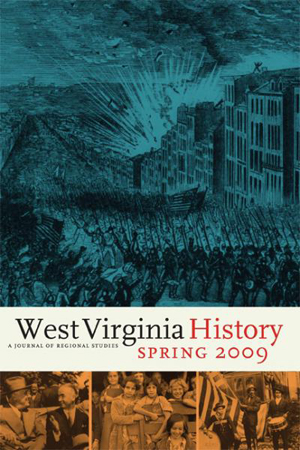
West Virginia History Editors: Ken Fones-Wolf and Ronald L. Lewis
E-ISSN: 1940-5057
Print-ISSN: 0043-325X
Frequency: Biannual
Institutional (US): $65.00
Individual (US): $45.00
Institutional (Outside US, including Canada): $75.00
Individual (Outside US, including Canada): $55.00
This volume is out of print.