California Dreaming: Boosterism, Memory, and Rural Suburbs in the Golden State
California Dreaming

Paul J.P. Sandul

October 2014
220pp
PB  978-1-938228-86-5
$27.99
ePub 978-1-938228-87-2
$27.99
PDF 978-1-938228-88-9
$27.99

Summary

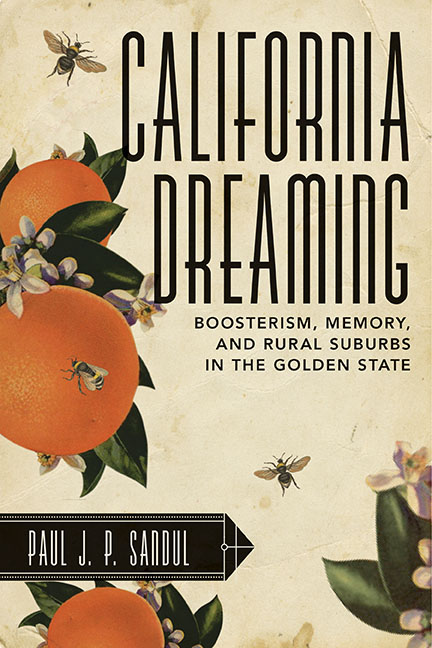
At the turn of the 20th century, the California dream was a suburban ideal where life on the farm was exceptional. Agrarian virtue existed alongside good roads, social clubs, cultural institutions, and business commerce. The California suburban dream was the ultimate symbol of progress and modernity.

California Dreaming: Boosterism, Memory, and Rural Suburbs in the Golden State analyzes the growth, promotion, and agricultural colonization that fed this dream during the early 1900s. Through this analysis, Paul J. P. Sandul introduces a newly identified rural-suburban type: the agriburb, a rural suburb deliberately planned, developed, and promoted for profit. Sandul reconceptualizes California’s growth during this time period, establishing the agriburb as a suburban phenomenon that occurred long before the booms of the 1920s and 1950s.

Sandul’s analysis contributes to a new suburban history that includes diverse constituencies and geographies and focuses on the production and construction of place and memory. Boosters purposefully “harvested” suburbs with an eye toward direct profit and metropolitan growth. State boosters boasted of unsurpassable idyllic communities while local boosters bragged of communities that represented the best of the best, both using narratives of place, class, race, lifestyle, and profit to avow images of the rural and suburban ideal.

This suburban dream attracted people who desired a family home, nature, health, culture, refinement, and rural virtue. In the agriburb, a family could live on a small home grove while enjoying the perks of a progressive city. A home located within the landscape of natural California with access to urban amenities provided a good place to live and a way to gain revenue through farming.

To uncover and dissect the agriburb, Sandul focuses on local histories from California’s Central Valley and the Inland Empire of Southern California, including Ontario near Los Angeles and Orangevale and Fair Oaks outside Sacramento. His analysis closely operates between the intersections of history, anthropology, geography, sociology, and the rural and urban, while examining a metanarrative that exposes much about the nature and lasting influence of cultural memory and public history upon agriburban communities. 

Contents

Acknowledgments

Introduction: Bourgeois Horticulturists in an Agricultural Wonderland

Part One: The Suburban Ideal and the California Dream

The Market Revolution and Romanticism

Chapter One: The Suburban Ideal

Boosterism

Chapter Two: The California Dream

Part Two: Harvesting Suburbs

Suburban Definitions, Archetypes, and Limitations

Chapter Three: The Model Colony of Ontario as the Model Agriburb

Chapter Four: The Agriburbs of Sacramento

Welcome to the Growth Machine

Chapter Five: The Boosters

Part Three: Cultivating Memory

Coming to Terms with Memory

Chapter Six: The Ongoing Legacies of Boosterism

Chapter Seven: Collected Memory and the Continued Legacies of Boosterism

Conclusion: Harvesting Suburbs, Cultivating Memory

Notes

Selected Bibliography

Index

Author

Paul J. P. Sandul is an Assistant Professor of History at Stephen F. Austin State University where he co-directs the public history program. Sandul is heavily involved in public history projects and local heritage organizations and oral history, which often provide opportunities for students, and serves on advisory committees and boards for both professional and local historical societies and journals.

Reviews

“A bold debut by a talented and energetic Generation X historian who dares think for himself.  A fresh interpretation of rural life and the rise of the agriburb as a variation of sub/urban America in the 19th and early 20th century."
Kevin Starr, University of Southern California

“The agriburb is a historic suburban landscape virtually overlooked until now.  In California Dreaming, Paul Sandul recovers its rich history, situating this quintessential California landscape within the broad narrative of suburban history. This book extends our working concept of “suburb” by adding a new, fascinating dimension.”
Becky M. Nicolaides, author of My Blue Heaven: Life and Politics in the Working-Class Suburbs of Los Angeles, 1920-1960

“If you want to know out of what stuff the California Dream was made, this book is for you. In his vigorous and searching analysis, Sandul shows how special California landscapes he calls “agriburbs” took hold of collective imagination, convincing many that their quest for success and well-being could best be met by moving to these places where growing fruit and growing the good life seemed to go hand in hand. Looking closely at three agriburbs from northern and southern California—Ontario, Orangevale, and Fair Oaks (my hometown)—Sandul uncovers who had a hand in the creation of these communities, and how they profited by transforming their visions into realities on the ground. Moreover, Sandul passionately argues that we all have a stake in how society remembers these landscapes, for those memories reflect power as well as shape our dreams for the future.”
Douglas C. Sackman, University of Puget Sound, author of Orange Empire: California and the Fruits of Eden.

"As the title suggests, Paul Sandul's California Dreaming is an ambitious attempt to harness the three great forces in the development of the Golden State – land speculation, agriculture and suburbanization – to drive the story of three agro-urban colonies.  It is, at the same time, a far-reachng disquisition on American habits of mind concerning agrarianism, suburbia and historical memory, as filtered through the myth-making machinery of local boosters.  The unified vision of northern and southern California here should be particularly welcome to those attuned to the schismatic nature of so much of the state's historiography.”
Richard Walker, University of California, Berkeley, author of The Conquest of Bread: 150 Years of California Agribusiness and The Atlas of California: Mapping the Challenges of a New Era.

“Paul Sandul’s book offers a pivotal, innovative expansion of our understanding of the process of town building in America. In rich detail, he reveals how diverse trajectories of multiple interests, such as agribusiness, real estate development, boosterism, the suburban ideal, the California dream, and regional growth, all intersect in the private and collective efforts of settlers and residents to establish and maintain their civic enterprise. Focusing pointedly on the efforts and actions of local actors, Sandul shows how their work in town-building is instrumental in generating and realizing broader economic interests and social currents.

In this incisively detailed examination of the California agriburb, Sandul also radically expands our understanding of suburbs, demonstrating how they encompass a much broader and more varied typology than traditionally presented. Through fine-grained investigation of diverse modes of “local meaning-making,” including pageantry, memorialization, historic preservation, public performances, and other forms of public history, Sandul produces a penetrating analysis of the social processes by which place and local identity are constituted and maintained, and simultaneously a recognition of the diversity of locales in which suburban place and community are established.”
John Archer’s prize-winning book Architecture and Suburbia (2005) examines the history of suburbia from late seventeenth-century England to its emergence as the ideal of the American dream.

“This is a fine-grained and very thoughtful exploration of the horticultural worlds and horticultural ideals of California’s “agriburbs” lying just beyond the metropolitan core.  What’s especially insightful here is the author’s careful rendering of what constituted “agriburban” boosterism.”  We have a better portrait of landscape change, memory, and nostalgia thanks to Paul Sandul’s careful scholarship. Thoughtful and thorough, this is an excellent portrait of “agriburban” memory, nostalgia, and boosterism across the mental and horticultural landscapes of rural California.

What’s especially good about Paul Sandul’s work is that he reminds us of the complexities and variables that cut across any monolithic understanding of the California Dream.  Here’s a variant of that Dream: rural, “agriburban,” tinged with equal parts exuberant boosterism and wishful nostalgia.  I learned a lot from this book.”
William Deverell, Director, Huntington-USC Institute on California and the West

“By developing a new concept--agriburb--and integrating it into the literature, Paul Sandul argues, convincingly and engagingly, that rural and suburban development in California in the late nineteenth and twentieth century must be understood as interlinked processes--each drove the other. This book is a must read for agricultural, urban, and environmental scholars alike interested in the Golden State’s controversial history. Those looking to liven up their reading lists for their California and U.S. history seminars would also do well to consider it.”
David Vaught, Professor & Head Department of History, Texas A&M University

“Today we see suburbs and farms as worlds apart, inherently at odds.  But Paul Sandul’s California Dreaming uncovers how, in late nineteenth- and early twentieth-century California, they did more than just get along; they were one and the same.    With wry forthrightness, rich detail, and scholarly discernment, he plumbs the agricultural visions that animated suburban development in this time and place, as well as the forgetting that accompanied the ways these places came to be remembered.  A unique and vital addition to a “new suburban history,” California Dreaming broadens our awareness of what “suburbia” has been in ways that suggest new alternatives for our suburbs’ future, in which crops and chickens may proliferate among the lawns.”  
Christopher C. Sellers, author of Crabgrass Crucible: Suburban Nature and the Rise of Environmentalism in 20th-Century America

“Sandul uses the lens of memory to help us better understand the origins and development of Ontario and other of California’s “agriburbs,” filling a gap in the history of the state’s suburbanization. While many imagine suburban California filled just with bedrooms, Sandul thoughtfully brings agriculture back into the discussion.”
David C. Sloane, Professor, Price School of Public Policy, University of Southern California

“Sandul unearths three fascinating case studies to examine the origins and legacies of California’s “agriburbs” – early twentieth-century suburban developments marketed with equal parts romantic agrarianism and genteel urbanism.  California Dreaming makes provocative connections between booster visions for the future and the creation of local memory in later decades, writing the imagined picturesque rural aesthetic, nostalgia for small-scale horticulture, and exclusively white pioneer identity into the history.  These insights contain valuable lessons for today’s exurban entrepreneurs and public historians alike.” 
Phoebe S.K. Young is Associate Professor of History at the University of Colorado at Boulder and author of California Vieja: Culture and Memory in a Modern American Place

“Sandul provides an insightful examination of the power of the historical narrative and the production of history.  It compels us to reconceptualize how the California Dream influenced local communities that lay beyond the southern part of the state and consider boosters’ tremendous influence to define landscapes and market lifestyles.”
Lydia R. Otero is an associate professor in the Department of Mexican American Studies at the University of Arizona and author of La Calle: Spatial Conflicts and Urban Renewal in a Southwestern City

"Sandul has a lot to offer readers interested in Caliornia's urban past."
Lisa Krissoff Boehm, The Public Historian

"California Dreaming makes a provocative addition to the history of the American West and to suburban studies, and is essential reading in both fields."
Matthew Gordon Lasner, The Journal of American History

"An important contribution to the history of the Golden State, as well as the fields of U.S. urban and the "new suburban" history, memory studies, and the interpretation of the historic cultural resources."
Tom Sitton, American Historical Review

The Psalms of Israel Jones

The Psalms of Israel Jones

Ed Davis

September 2014
218pp
PB  978-1-940425-13-9
$16.99
ePub 978-1-94025-14-6
$16.99
PDF 978-1-94042-15-3
$16.99

Summary

The Psalms of Israel Jones is the story of a father and son’s journey towards spiritual redemption. This novel tells the tale of a famous father trapped inside the suffocating world of rock and roll, and his son who is stranded within the bounds of conventional religion.

When Reverend Thomas Johnson receives an anonymous phone call, he learns his Dylanesque rock star father is acting deranged on stage, where he’s being worshipped by a cult of young people who slash their faces during performances. In his declining years, Israel Jones has begun to incite his fans to violence. They no longer want to watch the show—they want to be the show.

Eager to escape troubles with his congregation as well as gain an apology from his dad for abandoning his family, Reverend Thom leaves town and joins Israel Jones’s Eternal Tour. This decision propels him to the center of a rock and roll hell, giving him one last chance to reconnect with his father, wife, congregation—and maybe even God.

The Psalms of Israel Jones is the 2010 Hackney Literary Award winner for the novel.

Contents

Coming Soon.

Author

Ed Davis taught writing and humanities courses at Sinclair Community College in Dayton, Ohio for thirty-five years before retiring in 2011. He has also taught both fiction and poetry at the Antioch Writers’ Workshop and is the author of the novels I Was So Much Older Then and The Measure of Everything, four poetry chapbooks, and many published stories and poems in anthologies and journals. He is also the author of Time of the Light, a poetry collection. 

Learn more about Ed Davis on his website.

Reviews

“In this outstanding novel Ed Davis takes a deep, dark look at the sometimes fatal wounds that separate parent from child, husband from wife, and body from soul.  In setting hard-core religion against hard-core rock & roll, he demonstrates that the line between death and redemption can be a fine one, indeed. I loved this book.” 
Clint McCown, author of HaintsWar Memorials, The Member-Guest, and The Weatherman

“The Psalms of Israel Jones is a raucous yet spiritual journey where religion and rock ‘n roll duke it out in the hearts and minds of a father and son trying to find new identities, or to reclaim the identities they’ve lost. You might think you know how religion and rock ‘n roll are connected, but Ed Davis tells a unique story here that’s going to spin those connections into their own funky dance full of moves you’ve never seen before. It’s a rollicking read with a great big heart.”
Jim Daniels, author of Eight Mile High and Birth Marks

“Is Israel Jones a nearly mythic figure come to redeem us?  Sure.  But he’s also a fellow who respects an art form born of anger and woe and desperate times.  His story obliges us to look back even as we drift farther and farther from the promises we once upon a time made. I love this book, not least for the zillion writers and religious thinkers I find in it, among them Dickens, Melville, Jonathan Edwards, Increase Mather, Jimmy Swaggart, and Walker Percy. The plot is straight out of On the Road with the same moral risk and ambiguities and the prose is rich.”
Lee K. Abbott, author of Dreams of Distant Lives, Strangers in Paradise, and Love is the Crooked Thing

“An excellent, lively read.”
William J. Cobb, author of The Bird Saviors and The Lousy Adult

“Reading Ed Davis’s elegant prose is a little like listening to a Bob Dylan album: it’s nearly impossible to choose a favorite line. Between the tears and the laughs is a moving story of two men seeking to understand the world and to be understood themselves. That’s the heart of songwriting, and storytelling. With The Psalms of Israel Jones, Davis contributes to this greater understanding of ourselves and our world with a masterpiece that hits all the right notes.”
Sheila M. Trask, ForeWord Reviews

“From the opening power chord to the feedback echoes that keep crashing through the mind after the last sentence, this novel is a rock testament to the power of music and the Word. Tight as a spring coiled to release and generous as an open hand, this is a book for fathers and sons, lovers, losers, doubters and believers – in short, for us all. “
Valerie Nieman, author of Blood Clay and Fidelities

“Reverend Thomas Johnson has a lot of reconciling to do. Estranged from his wife, under suspicion by the deacons of Suffering Christ Church of Holy Martyrs for carrying on an illicit affair with a parishioner, he’s been summoned to join the tour of Israel Jones, fading rock legend. Israel happens to be Thom’s father and happens to have abandoned his son at an early age. Thom blames him for his mother’s suicide and many other sins. Ed Davis’ novel The Psalms of Israel Jones takes us on a wild ride—from snake handling holy rollers in a West Virginia chapel, to sleazy roadhouses in Ohio, Kentucky, and North Carolina, pursued by Furies, a self-destructive tribe of Israel’s fans. A particularly American blend of religion and rock & roll infuses the book with lyricism and rage on the road to the protagonist’s salvation.”
Deborah Clearman, author of the novel Todos Santos

“If you’ve ever wondered how the transport of searching, Bob Dylanesque rock and roll differs or is similar to what religion aspires to, this novel of healing through faith and music is for you. It’s also at heart a raw and absorbing father-son combat. Just imagine Abraham as the lead singer of an edgy Appalachian band and Isaac the admiring, angry, terrified son, with his very own knife, standing in the wings.”
Allan Appel, author of High Holiday Sutra and The Hebrew Tutor of Bel Air

"The Psalms of Israel Jones travels to the universal intersection of personal and cultural legacy, both of which have wounds that fester up through the blood of offspring. Music and performance become rituals of redemption for father, son, and a host of interesting, flawed, and interconnected characters that illuminate the deepest sense of human conflict in juxtaposition to the urgent desire for a Heavenly boon."
J. Frederick Arment, author of Backbeat: A Novel of Physics, The Elements of Peace, and The Economics of Peace

“This tightly woven novel, full of surprising reversals and sudden drops into new layers of understanding, carries the passions of Appalachia in its bones.”
Susan Streeter Carpenter, author of Riders on the Storm

"The book is many things, and delightful in many ways. It's a funny, scary road trip/love story/religio-socio portrait of America set to roots-rock music. Put some old LP's on the record player and enjoy."
Independent Publisher

New PB Edition: Monongah: The Tragic Story of the 1907 Monongah Mine Disaster

Monongah

Davitt McAteer
With an introduction by
Robert B. Reich

2014
332pp
PB 978-1-938228-89-6
$24.99
ePub 978-1-938228-98-8
$24.99
PDF 978-1-938228-97-1
$24.99

Summary

New paperback edition with an introduction by Robert B. Reich

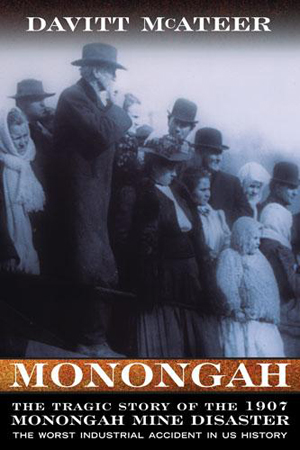
Monongah: The Tragic Story of the 1907 Monongah Mine Disaster documents the events and conditions that led to the worst industrial accident in the history of the United States. This mining accident claimed hundreds of lives on the morning of December 6, 1907, and McAteer, an expert on mine and workplace health and safety, delves deeply into the economic forces and social-political landscape of the mining communities of north central West Virginia to expose the truth behind this tragedy. After nearly thirty years of exhaustive research, McAteer determines that close to 500 men and boys—many of them immigrants—lost their lives that day, leaving hundreds of women widowed and more than one thousand children orphaned. 

The tragedy at Monongah led to a greater awareness of industrial working conditions, and ultimately to the Federal Coal Mine Health and Safety Act of 1969, which McAteer helped to enact. This new paperback edition includes an introduction by Robert B. Reich, Chancellor’s Professor of Public Policy at the University of California at Berkeley and Secretary of Labor during the Clinton administration.

Purchase the jacketed cloth edition.

Contents

Author

Davitt McAteer is internationally recognized as an expert on mine and workplace health and safety. He worked with consumer advocate Ralph Nader to help enact the landmark 1969 Federal Coal Mine Health and Safety Act. During the 1970s, he led the safety and health programs of the United Mine Workers of America and founded the Occupational Safety and Health Law Center. During his career, Mr. McAteer has consulted and lectured extensively on health and safety issues for governments, unions, and corporations in South Africa, China, Australia, Chili, Peru, and elsewhere. From 1994 to 2000, he served as assistant secretary for Mine Safety and Health at the US Department of Labor under President Clinton and for nearly two years, 1996 to 1997, also served as acting solicitor of the US Department of Labor. Shortly after the 9/11 terrorist attack on the World Trade Center in 2001, he was called on as an advisor to the recovery efforts at Ground Zero, consulting with union representatives of equipment operators and subway workers. Mr. McAteer served as vice president of Wheeling Jesuit University from 2005 until his retirement in June 2012.

On four occasions, at the request of two West Virginia governors, he has conducted independent investigations into mine disasters and accidents. Most recently in April of 2010, then West Virginia Governor Joe Manchin III requested that McAteer conduct an independent investigation into the Upper Big Branch mine disaster, the largest coal mine disaster in the United States in forty years, which resulted in the deaths of twenty-nine miners. He has testified before Congress on safety and health issues on numerous occasions.

Davitt McAteer maintains a law office and lives in Shepherdstown, West Virginia, with his wife Kathryn.

Review

Monongah is an important book, long overdue.”
Robert Reich, former U.S. Secretary of Labor

“McAteer skillfully analyzes the tragedy, examining players on the company side from the upper levels of the rich and powerful to the mine supervision and operations level, while giving equal weight and voice to the immigrant groups that provided the vast majority of the victims. . . . It is fortuante that a man of David McAteer’s caliber undertook to tell the tragic story.”
Charles McCollester, West Virginia History: A Journal of Regional History

Monongah is a major scholary work, and another in a series of WVU Press offerings that tells previously untold stories about the people who really built West Virginia, and often suffered in doing so.”
Ken Ward, Charleston Gazette-Mail

“A compelling, cautionary tale of avarice and corruption, as well as a testament to the ultimate resilience of exploited people.”
Shirley Stewart Burns, the Journal of Southern History

“McAteer’s work is undeniably significant and his extensive research is evident.”
Joshua Stahlman, Pennsylvania History: A Journal of Mid-Atlantic Studies

Virginia B. Evans: An All-Around Artist

John Cuthbert

May 2013
196pp
HC/J 978-0-975292-52-5 
$39.99
 

Summary

Virginia B. Evans (1894–1983) was an important figure in the field of art in the Upper Ohio Valley during the mid-twentieth century. A native of Moundsville, West Virginia, Evans was a talented impressionist and abstract expressionist painter, a skillful designer of art deco glass, and a teacher. 

Virginia B. Evans tells the story of this often overlooked, yet remarkable artist. Educated, willful, strongly opinionated, and independent, she enjoyed considerable acclaim in the Ohio Valley region of West Virginia, Ohio, and Pennsylvania, and beyond. Because of her focus on professional achievement and her disregard for the cultural and societal expectations of her era, she was often the subject of scorn and suspicion. Yet undaunted, she devoted her life to the field she loved, facilitated by a distinctive talent and unbridled energy.

Through an analysis of primary resources including correspondence, memoirs, newspaper articles, photographs, and other documents, Virginia B. Evans elucidates the compelling life and work of a versatile artist.

Contents

Coming Soon.

Author

John A. Cuthbert is the Director of West Virginia and Regional History Center at West Virginia University Libraries. He is the author of David Hunter Strother: One of the Best Draughtsmen the Country Possesses, Early Art and Artists in West Virginia, and Richard Kidwell Miller.

Reviews

"Before John Cuthbert published his Early Art and Artists of West Virginia in 2000, the artistic contributions of the state were essentially unexplored territory. Now Cuthbert has followed up his ground-breaking achievement with an in depth study of one of the state's finest and most well-rounded artists, Virginia B. Evans.  Cuthbert details her life story and the admirable variety of her themes--landscapes, domestic scenes, figure and portrait imagery, and pastoral and industrial subjects, while also demonstrating her increasingly free brushwork and exciting color symphonies.  Cuthbert  follows Evans's travels, both domestic and worldwide, while always returning her to the beautiful images she created in her native state. He has also introduced her unique involvement with the designs she contributed to Imperial Glass."
William H. Gerdts, Professor Emeritus of Art History,Graduate School of the City University of New York

The Old English Poem "Seasons for Fasting": A Critical Edition

Seasons for Fasting

Mary P. Richards

May 2014
220pp
PB  978-1-938228-43-8
$44.99
ePub 978-1-938228-45-2
$44.99


Summary

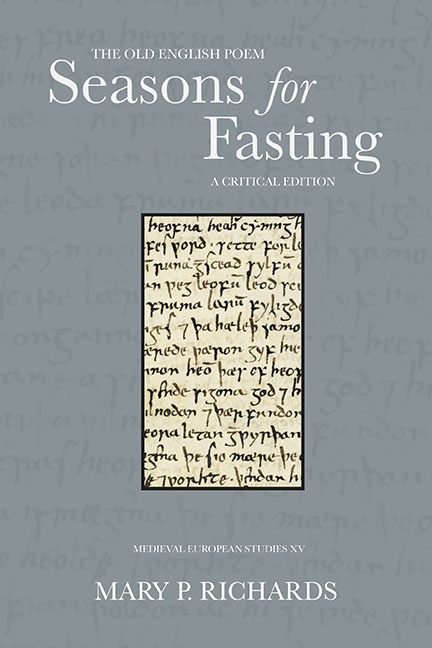
Seasons for Fasting, a late Old English poem probably composed in the early eleventh century, focuses on proper fasting observances in England. This poem, composed in eight-line stanzas, survives only in a sixteenth-century transcript made by the antiquary Laurence Nowell. With its topics, vocabulary, sources, and style derived from those of contemporary ecclesiastical prose, it belongs to a school of late tenth/early eleventh century poetry that only now is coming to be recognized and defined.

The Old English Poem Seasons for Fasting: A Critical Edition provides a new text and translation of the poem, accompanied by an extensive introduction, commentary, and glossary. The introduction includes analyses of the poem’s manuscript origins, sources, language, meter, style, and structure. The text is collated with all previous editions. The commentary elucidates points of grammar and style, and justifies all editorial decisions. The glossary covers every instance of each word in the poem.

Since its discovery among the papers of Laurence Nowell in 1934, the poem has had only four editions, two of the text with basic notes, and two in doctoral theses with more commentary and analysis. This new edition brings the latest resources on manuscript study, lexicon (through the Concordance and Dictionary of Old English A-G), poetics, and cultural milieu to bear on this fascinating poem. The apparatus, including the glossary, will allow fellow scholars to extend these findings through links to their own work.

Medieval European Studies: Volume 15

Contents

Coming Soon.

Author

Mary P. Richards is Professor of English Emerita at the University of Delaware. The author of four books and numerous essays and reviews, she has focused on Anglo-Saxon and early Norman manuscripts and texts, especially those associated with Rochester Cathedral Priory and Old English laws. Her book Texts and Their Traditions in the Medieval Library of Rochester Cathedral Priory, drew together all of these interests and laid the foundation for her recent work on Seasons for Fasting. Since 1986 she has published eight essays on the laws, three on Rochester materials, and two on Seasons: “Prosaic Poetry: Late Old English Poetic Composition” in Old English and New: Essays in Language and Linguistics in Honor of Frederic G. Cassidy, and “Old Wine in a New Bottle: Recycled Instructional Materials in Seasons for Fasting,” in The Old English Homily: Precedent, Practice, and Appropriation.

Reviews

Coming Soon.

Essays on the History of Transportation and Technology

Emory L. Kemp
Foreword by
Lance E. Metz
Introduction by
Robert J. Kapsch

June 2014
352pp
HC/J  978-1-938228-81-0
$49.99
ePub 978-1-904425-04-7
$49.99

Summary

Emory Kemp is the founder and director of the Institute for the History of Technology and Industrial Archaeology at West Virginia University, where he also served as a chair and professor of civil engineering and a professor of history. This collection of essays encompasses over fifty years of his research in the field of the history of technology.

Within these twelve essays, Kemp describes and analyzes nineteenth century improvements in building materials such as iron, steel, and cement; roads and bridges, especially the evolution of the suspension bridge; canals and navigable rivers, including the Ohio River and its tributaries; and water supply systems. As one of the few practicing American engineers who also researches and writes as an academic, Kemp adds an important historical context to his work by focusing not only on the construction of a structure but also on the analytical science that heralds a structure’s design and development.

Contents

Foreword, Lance E. Metz 
Preface
Introduction, Robert Kapsch 

1. The 1959 Wheeling Custom House: A Harbinger of Iron and Steel Skeletal Framing
2. Charles Ellet Jr. (1810-1862): Portrait of an Engineer
3. A Thoroughfare Through the Howling Wilderness: The Weston & Gauley Bridge Turnpike, Emory L. Kemp and Janet K. Kemp
4. The Pulaksi Skyway—Railway Economic Theory Applied to Superhighway Design, Dara Callender and Emory Kemp
5. James Finley and the Origins of the Modern Suspension Bridge
6. French Movable Dams in America
7. Building the Tennessee-Tombigbee Waterway
8. Bejamin Franklin Thomas and the Introduction of the French Needle Dam into the United States
9. John Jervis and the Hydraulic Design of the Old Croton Aqueduct, Emory Kemp and Edward Winant
10. The Muskingum Navigation
11. French Movable Dams on the Great Kanawha River
12. The Little Kanawha Navigation, Larry Sypolt and Emory Kemp

Acknowledgments
About the Authors

Author

Emory Kemp has been a practicing engineer for more than half a century, as both a chartered civil engineer and structural engineer in Great Britain, and elected a distinguished engineer in the American Society of Civil Engineers. He is the founder and director of the Institute for the History of Technology and Industrial Archaeology at West Virginia University, where he was also chair and professor of civil engineering in the College of Engineering, and a professor of history in the Eberly College of Arts and Sciences. He has served as president of the Public Works Historical Society, is a codirector of the Smithsonian Institution/West Virginia University Joint Project for the History of Technology, and has presented numerous papers and published many articles on industrial archeology, engineering, the history of technology, structural mechanics, and public works in journals such as the Journal of the Society for Industrial Archaeology, Public Historian, Essays in Public Works History, Public Works Magazine, and Canal History and Technology Proceedings. He lives in Morgantown, WV.

Reviews

Coming Soon.