Teaching Matters: A Guide for Graduate Students

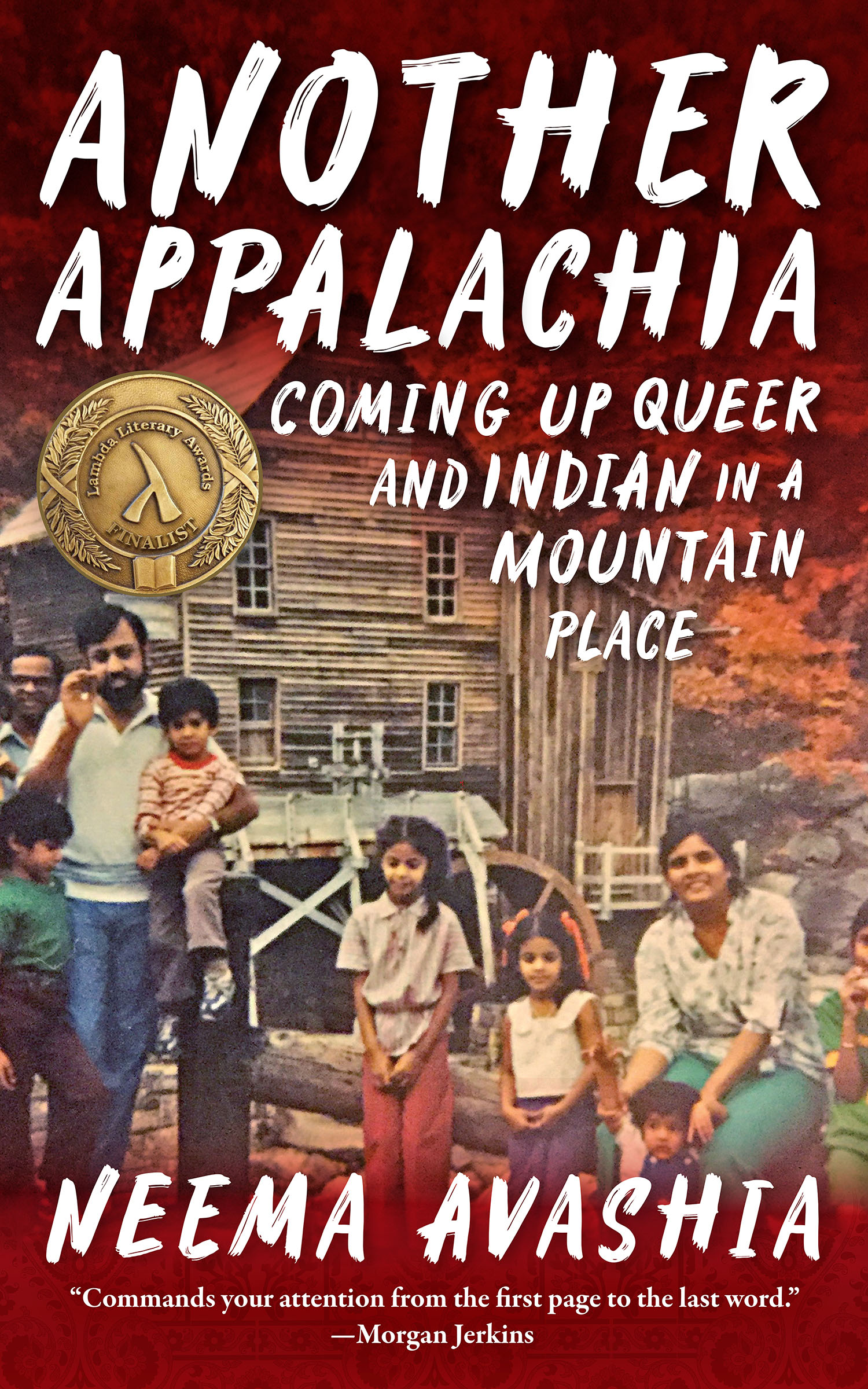
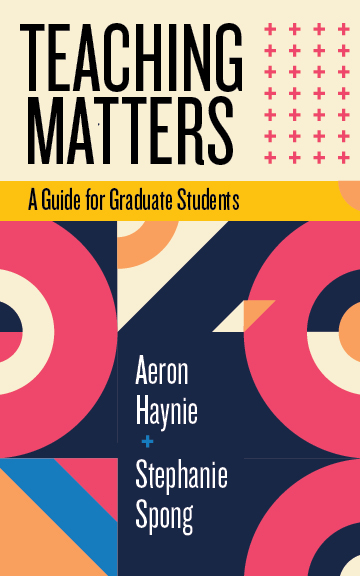
Teaching Matters book cover: pink, blue, orange, and yellow geometric shapes

Aeron Haynie and
Stephanie Spong

June 2022
240pp
PB 978-1-952271-55-7
$24.99
CL 978-1-952271-54-0
Out of print
eBook 978-1-952271-56-4
$24.99

Teaching and Learning in Higher Education Series

Teaching Matters

A Guide for Graduate Students

Summary

In a book written directly for graduate students that includes graduate student voices and experiences, Aeron Haynie and Stephanie Spong establish why good teaching matters and offer a guide to helping instructors-in-training create inclusive and welcoming classrooms.

Teaching Matters is informed by recent research while being grounded in the personal perspectives of current and past graduate students in many disciplines. Graduate students can use this book independently to prepare to teach their courses, or it can be used as a guide for a teaching practicum. With a just-in-time checklist for graduate students who are assigned to teach courses right before the semester starts, step-by-step directions for writing a compelling teaching philosophy, and an emphasis on teaching well regardless of modality, Teaching Matters will remain relevant for graduate students throughout their careers.


Receive a 30% discount on orders of 10 or more copies of this title with code HIGHEREDBULK30 at checkout.

Contents

Acknowledgments

1. Why Teaching Matters
2. How Do You Design a Course?
3. How Can You Create a Welcoming Classroom Community?
4. How Do You Develop a Classroom Practice?
5. Navigating Classroom Challenges
6. Creating Assignments and Responding to Student Work
7. What Are Other Graduate Students Experiencing?
8. Cultivating Well-Being

Appendix 1: Help! What If My Course Starts Next Week?
Appendix 2: How Can My Teaching Experience Help Me Get a Job?
Appendix 3: Resources

Notes
References
Index

Authors

Aeron Haynie is executive director of the Center for Teaching and Learning and associate professor of English at the University of New Mexico. She is coeditor of Exploring Signature Pedagogies and Exploring More Signature Pedagogies.

Stephanie Spong is an associate director for the Center for Teaching and Learning and affiliated faculty with the department of organization, information, and learning sciences at the University of New Mexico.

Reviews

“Empowering graduate students to savor teaching when higher education emphasizes research is no mean feat. I mentor graduate students from multiple disciplines, and this book, from its title to its student-focused chapters, resonates closely with my rallying call. Yes, indeed, teaching matters, and Haynie and Spong nicely address graduate student needs head on, warmly inviting the educators of the future to join the teaching commons and let the passion for teaching develop and shine unbridled.”
Regan A. R. Gurung, coauthor of Thriving in Academia: Building a Career at a Teaching-Focused Institution

“Indispensable.”
John Warner, Inside Higher Ed

Remembering and Forgetting in the Age of Technology: Teaching, Learning, and the Science of Memory in a Wired World

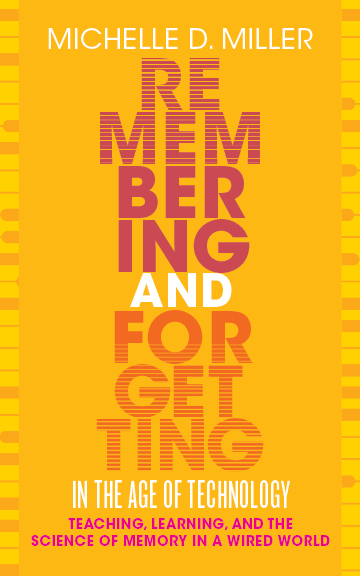
Remembering and Forgetting in the Age of Technology book cover: Book title and subtitle in red, white, orange, and pink against an orange background

Michelle D. Miller

April 2022
288pp
PB 978-1-952271-47-2
$24.99
eBook 978-1-952271-48-9
$24.99

Teaching and Learning in Higher Education Series

Remembering and Forgetting in the Age of Technology

Teaching, Learning, and the Science of Memory in a Wired World

Summary

Human minds are made of memories, and today those memories have competition. Biological memory capacities are being supplanted, or at least supplemented, by digital ones, as we rely on recording—phone cameras, digital video, speech-to-text—to capture information we’ll need in the future and then rely on those stored recordings to know what happened in the past. Search engines have taken over not only traditional reference materials but also the knowledge base that used to be encoded in our own brains. Google remembers, so we don’t have to. And when we don’t have to, we no longer can. Or can we?

Remembering and Forgetting in the Age of Technology offers concise, nontechnical explanations of major principles of memory and attention—concepts that all teachers should know and that can inform how technology is used in their classes. Teachers will come away with a new appreciation of the importance of memory for learning, useful ideas for handling and discussing technology with their students, and an understanding of how memory is changing in our technology-saturated world.


Receive a 30% discount on orders of 10 or more copies of this title with code HIGHEREDBULK30 at checkout.

Contents

Introduction: Machines, Memory, and Learning
1. What Technology Does to Us (and for Us): Taking a Critical Look at Common Narrative  
2. Why We Remember, Why We Forget
3. Enhancing Memory and Why It Matters (Even though Google Exists)
4. Memory Requires Attention
5. The Devices We Can’t Put Down: Smartphones, Laptops, Memory, and Learning
Conclusion: How Memory Can Thrive in a Technology-Saturated Future

Notes
Acknowledgments
Index    

Author

Michelle D. Miller is a professor of psychological sciences and President’s Distinguished Teaching Fellow at Northern Arizona University. She is the author of Minds Online: Teaching Effectively with Technology.

Reviews

“This is the book we need: a clear, lively, and authoritative examination of technology, memory, and learning—perhaps the most critical subjects in all of higher education right now.”
Kevin Gannon, author of Radical Hope: A Teaching Manifesto

Rogues in the Postcolony: Narrating Extraction and Itinerancy in India

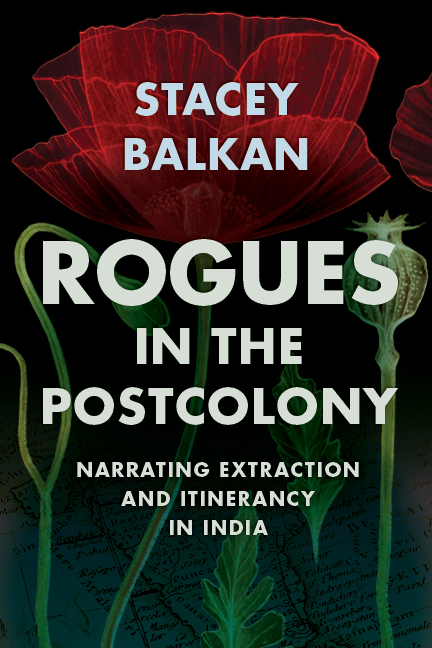
Rogues in the Postcolony cover, large transparent red poppy flower with green leaves on a black background

Stacey Balkan

February 2022
216pp
PB 978-1-952271-36-6
$29.99
CL 978-1-952271-35-9
Out of print
eBook 978-1-952271-37-3
$29.99

Histories of Capitalism and the Environment Series


Rogues in the Postcolony

Narrating Extraction and Itinerancy in India
 

Summary

Rogues in the Postcolony is a study of Anglophone Indian picaresque novels that dramatize the impacts of extractive capitalism and colonial occupation on local communities in several Indian states. In this materialist history of development on the subcontinent, Stacey Balkan considers works by Amitav Ghosh, Indra Sinha, and Aravind Adiga that critique violent campaigns of enclosure and dispossession at the hands of corporate entities like the English East India Company and its many legatees. By foregrounding the intersections among landscape ideology, agricultural improvement, extractive capitalism, and aesthetic expression, Rogues in the Postcolony also attends to the complicity of popular aesthetic forms with political and economic policy, as well as the colonial and extractivist logics that often frame discussions around the so-called Anthropocene epoch.

Bringing together questions about settler-colonial practices and environmental injustice, Rogues in the Postcolony concludes with an investigation of new extractivist frontiers, including solar capitalism, and considers the possibility of imagining life after extraction on the Indian subcontinent and beyond.

Contents

Acknowledgments
Abbreviations

Introduction: Why Can’t a Rogue Be a Hero?
1. Revisiting the Environmental Picaresque: Plantationocene Aesthetics and the Origins of Cheap Nature in Amitav Ghosh’s Ibis Trilogy
2. A Memento Mori Tale: Indra Sinha
s Animals People and the Politics of Global Toxicity
3. Slum Ecologies: Figuring (Energy) Waste in Aravind Adiga’s The White Tiger
Conclusion: Beyond Extraction: Imagining Solarity in India's Mineral Belt

Notes
Bibliography
Index 

Author

Stacey Balkan is assistant professor of English and environmental humanities at Florida Atlantic University. She is coeditor of Oil Fictions: World Literature and Our Contemporary Petrosphere.

Reviews

Rogues in the Postcolony is a marvelous study of how picaresque novels refract the violent dispossessions and rogue freedoms of extractive capitalism in India and beyond. In dialogue with cutting-edge conversations in environmental and energy humanities, Balkan argues convincingly that extraction is a pervasive dynamic within post/colonial modernity.”
Dominic Boyer, author of Energopolitics: Wind and Power in the Anthropocene

Victorian Poetry: Volume 60, Issues 1-4

Image

Victorian Poetry: Volume 60, Issues 1–4
Editor: John B. Lamb, West Virginia University
E-ISSN: 1530-7190
Print ISSN: 0042-5206

Click on listed price to corresponding product to order:
Institution (US): $140.00
Individual (US): $65.00
Institution (Outside US, including Canada): $165.00
Individual (Outside US, including Canada): $90.00


Victorian Poetry: Volume 58, Issues 1-4

Image

Victorian Poetry: Volume 58, Issues 1–4
Editor: John B. Lamb, West Virginia University
E-ISSN: 1530-7190
Print ISSN: 0042-5206

Click on listed price to corresponding product to order:
Institution (US): $140.00
Individual (US): $65.00
Institution (Outside US, including Canada): $165.00
Individual (Outside US, including Canada): $90.00


Victorian Poetry: Volume 59, Issues 1-4

Image

Victorian Poetry: Volume 59, Issues 1–4
Editor: John B. Lamb, West Virginia University
E-ISSN: 1530-7190
Print ISSN: 0042-5206

Click on listed price to corresponding product to order:
Institution (US): $140.00
Individual (US): $65.00
Institution (Outside US, including Canada): $165.00
Individual (Outside US, including Canada): $90.00


The Harlan Renaissance: Stories of Black Life in Appalachian Coal Towns

he Harlan Renaissance, black and white photo of five Black children arranged in heigh order in front of a front porch where a Black woman stands behind the railing

Add to cart button

William H. Turner

October 2021
352pp
PB 978-1-952271-21-2
$26.99
CL 978-1-952271-20-5
Out of print
eBook 978-1-952271-22-9
$26.99


The Harlan Renaissance

Stories of Black Life in Appalachian Coal Towns

Summary

Weatherford Award Winner, Nonfiction

The Harlan Renaissance is an intimate remembrance of kinship and community in eastern Kentucky’s coal towns written by one of the luminaries of Appalachian studies, William Turner. Turner reconstructs Black life in the company towns in and around Harlan County during coal’s final postwar boom years, which built toward an enduring bust as the children of Black miners, like the author, left the region in search of better opportunities.

The Harlan Renaissance invites readers into what might be an unfamiliar Appalachia: one studded by large and vibrant Black communities, where families took the pulse of the nation through magazines like Jet and Ebony and through the news that traveled within Black churches, schools, and restaurants. Difficult choices for the future were made as parents considered the unpredictable nature of Appalachia’s economic realities alongside the unpredictable nature of a national movement toward civil rights.

Unfolding through layers of sociological insight and oral history, The Harlan Renaissance centers the sympathetic perspectives and critical eye of a master narrator of Black life.

Contents

Foreword by Loyal Jones

Acknowledgments

Introduction

1. Alex Haley—The Taproot

2. Between Alex Haley, W. E. B. Du Bois, Ed Cabbell, and the Affrilachian Poets

3. Black Mountain Mantrips and Woman Trips

4. What’s in a Name?

5. Black Folk Done Lost Their Stuff

6. The Common Narrative of Black Appalachian Coal-Camp Families

7. Blacks Moving between Central Alabama and Central Appalachia

8. Close-Knit Central Appalachian Coal-Camp Black Communities

9. On Trash-Talking and Signifying along Looney Creek

10. In a Coal Mine, Everybody Is Black; Outside, Not So Much

11. School Integration Was Worse than a Kick in the Head by an Alabama Mule

12. The Principal of the White School Became a Lifelong Friend

13. Not Bad for Some Colored Kids from Harlan County, Kentucky

14. King Coal Leaves the Throne

15. The Graying of the Eastern Kentucky Social Club

16. Meditating on the Future at the Mountaintop

Notes

Index

Author

William H. Turner is a sociologist now based near Houston, Texas. He received a lifetime of service award from the Appalachian Studies Association in 2009, which joined other career highlights that include induction into the Kentucky Civil Rights Hall of Fame.

Reviews

“A warm and insightful memoir of Black life in Appalachia’s coal camps that offers a bounty of correctives to the persistent myth that all mountain people are white and all poverty is self-made.”
Elizabeth Catte, author of What You Are Getting Wrong About Appalachia and Pure America: Eugenics and the Making of Modern Virginia

“Heartfelt portraits that are original, compelling, revelatory, and deeply human.”
David Ritz, author of Respect: The Life of Aretha Franklin

“One of the oldest and most enduring myths about the Appalachian Mountains is that they are now and always have been overwhelmingly populated by white Scots-Irish. Dr. William H. Turner has written a new book, The Harlan Renaissance: Stories of Black Life in Appalachian Coal Towns, that kills that myth about whiteness and, for good measure, buries several more myths as well.”
Daily Yonder


“It’s a book only Turner could write, and without it, this slice of American culture would be lost forever.”
Berea College Magazine