Coal Digging Blues: Songs of West Virginia Miners
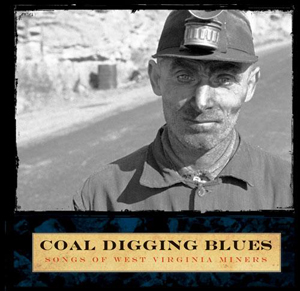
Coal Digging Blues

Mark Allan Jackson
CD  978-1-933202-11-2
$15.95

Summary

Coal Digging Blues: Songs of West Virginia Miners, compiled by Mark Allan Jackson, is the eighth addition to the WVU Press Sound Archive series. Drawing upon gospels, blues, and country musical influences, the musicians on this compilation explicate the hardships and hopes of Great Depression-era West Virginia coal miners. The songs and stories on the CD were collected by folklorist George Korson when he traveled to mining communities in northern and eastern West Virginia in the 1940s. Some of the songs from Korson's visit were released by the Library of Congress under the title Songs and Ballads of the Bituminous Miners, but the majority of them are being released to the public for the first time here on Coal Digging Blues. Many of the songs are performed by African-American miners, a marginalized group in the history of mining who bring to the collection their rich musical heritage and sui generis sound. A booklet of detailed notes on the performers, their songs, and the history of coal-camp songs in West Virginia, as well as contemporary photographs, is included with the CD.

Tracklist

  1. Drill Man Blues by George Curley Sizemore
  2. Going Democratic by George Curley Sizemore
  3. The Snitcher by George Curley Sizemore
  4. Bill Green Better Run On by The United Four Quartet
  5. I Can Tell the World What the Union Has Done by The United Four Quartet
  6. I Dont Want to Go Down Yonder by The United Four Quartet
  7. Coal Digging Blues by Jerrel Stanley
  8. The Brave and Trembling Motor Man by Jerrel Stanley
  9. A Little Lump of Coal by Orville O.J. Jenks
10. Its On in Washington by Orville O.J. Jenks
11. John L. Lewis Blues by Orville O.J. Jenks
12. Union Blues by Orville O.J. Jenks
13. How Beautiful Union Must Be by Orville O.J. Jenks
14. The Union Coal Mines in the Sky by Orville O.J.

Author

Mark Allan Jackson is Associate Professor of Folklore and English at Middle Tennessee State University who specializes in political expression in American music.  He has published essays, reviews, and commentaries in such journals as American MusicThe Journal of American HistoryPopular Music and SocietyThe Journal of American FolkloreJournal of Folklore Research, and The Tennessee Folklore Society Bulletin

Reviews

"This is the story of a country being formed, of a history being made."
Mike Jurkovic, Folk & Acoustic Music Exchange

West Virginia History: A Journal of Regional Studies

Coeditors: Hal Gorby and Lou Martin
E-ISSN: 1940-5057
Print-ISSN: 0043-325X
Frequency: Biannual

West Virginia History: A Journal of Regional Studies can be accessed online via Project MUSE.

As of 2023 (beginning with volume 17, issue 1), WVU Press is discontinuing print subscriptions to West Virginia History. WVH (volumes 17 and later) will be available in electronic format only. Existing print subscriptions will not be automatically converted. Current subscribers wishing to transition to an electronic subscription should renew their subscriptions as follows.

For institutions: Electronic subscriptions are managed by Project MUSE (https://about.muse.jhu.edu/librarians/) and single-title electronic sales by Johns Hopkins University Press Journals Division (JRNLCIRC@jh.edu). Contact Project MUSE for 2023 pricing and policies (https://about.muse.jhu.edu/about/contact/).

For individuals: Individual WVH articles and whole issues are available for purchase on Project MUSE (https://about.muse.jhu.edu/individuals/purchase-muse-content/). (Full-year subscriptions are not currently available to individuals but will be made available in the future.)

All orders and checks for subscriptions to volume 17 and later (2023 and later) will be returned to sender.

Submission Guidelines

Since 1939, West Virginia History has been the premier source of scholarship and research on the history of the Mountain State. Now published in a new series by the West Virginia University Press, West Virginia History: A Journal of Regional Studies will have two issues a year—in the spring and fall—and will continue to cover the political, social, economic, and cultural history of the state and its regional context. 

Back issues of volumes 14–16 are currently available for individual purchase, using the following links:

West Virginia History: A Journal of Regional Studies: Volume 16
West Virginia History: A Journal of Regional Studies: Volume 15, special double issue
West Virginia History: A Journal of Regional Studies: Volume 14
 

Customers located outside the United States, including Canada, will be charged international subscription rates.

Victorian Poetry

Editor: John B. Lamb, West Virginia University
E-ISSN: 1530-7190
Print ISSN: 0042-5206
Frequency: Quarterly

Beginning with volume 61, issue 4 (to be published in spring 2024), Victorian Poetry will be published by Johns Hopkins University Press. Inquiries about volume 62 (2024) should be directed to William Breichner, journals publisher at Johns Hopkins University Press (wbreich1@jh.edu).

Founded in 1962 to further the aesthetic study of the poetry of the Victorian Period in Britain (1830–1914), Victorian Poetry publishes articles from a broad range of theoretical and critical angles, including but not confined to new historicism, feminism, and social and cultural issues. The journal has expanded its purview from the major figures of Victorian England (Tennyson, Browning, the Rossettis, etc.) to a wider compass of poets of all classes and gender identifications in nineteenth-century Britain and the Commonwealth. Victorian Poetry is edited by John B. Lamb and sponsored by the Department of English at West Virginia University.

Current issues of Victorian Poetry are available to institutions throughout the United States and worldwide through Project Muse, which has published it in its electronic databases since 2000. Users may search at the article level, view related articles, and be informed of upcoming material with an RSS feed. Both PDF and HTML forms are available. Back issues of the journal from its inception in 1963 until five years from the current date are now mounted electronically in JSTOR’s Arts and Sciences V package.

For more information, contact journal editor Devin Garofalo at victorianpoetryjournal@gmail.com

 Submit to Victorian Poetry

Tolkien Studies: An Annual Scholarly Review

Tolkien Studies: An Annual Scholarly Review presents the growing body of critical commentary and scholarship on both J. R. R. Tolkien’s voluminous fiction and his academic work in literary and linguistic fields. The founding editors are Douglas A. Anderson (The Annotated Hobbit), Michael D. C. Drout (Beowulf and the Critics), and Verlyn Flieger (Splintered Light: Logos and Language in Tolkien’s World).

Current Editors: Michael D. C. Drout, Yvette Kisor, and David Bratman
E-ISSN:1547-3155
Frequency: Annual

Tolkien Studies is available on Project MUSE (https://muse.jhu.edu/journal/299) and in paperback. 

Electronic Subscriptions

Individuals may purchase electronic access to individual issues and articles on Project MUSE (https://about.muse.jhu.edu/individuals/purchase-muse-content/).

Institutions seeking electronic subscriptions or electronic & print packages should order from Project MUSE (https://about.muse.jhu.edu/librarians/).

Print Subscriptions

Individuals may order volume 20 (2023) and preorder volume 21 (2024) from our partner Duke University Press Journal Services: 

Institutions seeking print-only subscriptions should subscribe through their agents or contact Duke University Press Journal Services. For electronic & print packages, order from Project MUSE.

Questions about print subscriptions, including claims for replacement copies, should be directed to Duke University Press Journal Services.

Print Back Issues

To order print back issues (vol 18 or later), call Duke University Press Journal Services at (888) 651-0122 or +1 (919) 688-5134. Click here to order print back issues of volume 17. Volumes 1–16 are no longer available in print.

Digital Editions

Click here to order digital editions (vols. 2 through 11 only). (Vol. 1 and later can also be purchased on Project MUSE as indicated above.)

A special supplemental issue to volume 19 has been published: J.R.R. Tolkien, "The Chronology of The Lord of the Rings," edited, with introduction, notes, and commentary by William Cloud Hicklin; a preface by William Fliss; and a special introduction by the editors. The supplement is available in paperback and is available electronically on Project MUSE. Individuals who wish to receive the supplement in print should purchase a print subscription to volume 19 (which can be ordered as indicated above). Print subscribers to volume 19 will receive both the supplement and the regularly scheduled volume.


Reviews

“What else can one say? The reviews are full, numerous, by respected hands, and informative. . . .another magisterial addition to the growing corpus of Tolkienian scholarship.”
David Doughan, Mallorn

“A welcome addition to the growing library of Tolkien criticism.”
Mark Hooker, Mythprint

“A very important and highly readable addition to Tolkien scholarship.”
Carol A. Leibiger, Journal of the Fantastic in the Arts

“The best anthology of Tolkien criticism and commentary.”
Mike Foster, Mythopoeic Society  


Essays in Medieval Studies

Editor: Michael W. George, Millikin University
E-ISSN: 1538-4608
Print ISSN: 1043-2213
Frequency: Annual

This is an online-only journal and is available to libraries through Project Muse. Essays in Medieval Studies is an interdisciplinary journal of medieval studies. Contents for each volume are selected from papers delivered at the annual meeting of the Illinois Medieval Association. The annual volume appears in late spring each year and carries articles focused around the conference topic from scholars of both the literature and history of the period. Each volume focuses on the theme or topic of the annual meeting. Recent themes have included children and the family, medieval communities, and emotions in the Middle Ages. For more information on submitting papers to the annual conference, visit the website of the Illinois Medieval Association.

Education and Treatment of Children

Education and Treatment of Children is no longer published by West Virginia University Press. Please direct inquiries for volume 43 and later to Springer.

Volumes 30 (2007) through 42 (2019) are available through Project MUSE.
 

E-ISSN: 0748-8491

West Virginia University Press Journals

The West Virginia University Press publishes peer-reviewed journals in the humanities. For information on submitting articles for publication, please follow links to the individual journal. All of our journals are available electronically to institutions through Project Muse.

Journals

Ordering Information

Ordering information is provided on the individual journal page.

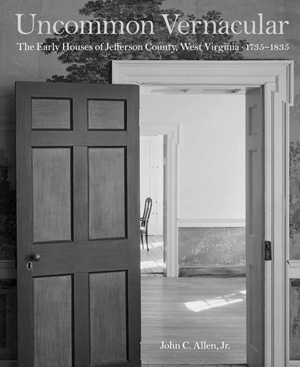
Uncommon Vernacular: The Early Houses of Jefferson County, West Virginia, 1735-1835

Uncommon Vernacular

John C. Allen, Jr.
September 2011
384pp
HC/J  978-1-933202-87-7
$49.99

Summary

Within the picturesque borders of Jefferson County, West Virginia remain the vestiges of a history filled with Civil War battles and political rebellion. Yet also woven into the historical landscape of this small county nestled within the Shenandoah Valley is an unusual collection of historic homes. 

In this fascinating architectural exploration, John C. Allen, Jr. details his expansive seven-year survey of Jefferson County’s historic residences.  By focusing on dwellings built from the mid-eighteenth century to the arrival of the railroad and canal in 1835, Allen unfolds the unique story of this area’s early building traditions and architectural innovations. The 250 buildings included in this work—from the plantation homes of the Washington family to the log houses of yeomen farmers—reveal the unique development of this region, as Allen categorizes structures and establishes patterns of construction, plan, and style.

Allen’s refreshing perspective illuminates the vibrant vernacular architecture of Jefferson County, connecting the housing of this area to the rich history of the Shenandoah Valley. Varying features of house siting, plan types, construction techniques, building materials, outbuildings, and exterior and interior detailing illustrate the blending of German, Scots-Irish, English, and African cultures into a distinct, regional style.

Adorned with over seven hundred stylish photographs by Walter Smalling and elegant drawings, floor plans, and maps by Andrew Lewis, Uncommon Vernacular explores and preserves this historic area’s rich architectural heritage.

2011 ForeWord Book of the Year Award Finalist

Contents

  • Preface
  • Chapter One
      From Settlement to Refinement: Houses in Context
  • Chapter Two
      Early Farmhouses, 1735–1815
  • Chapter Three
      Later Farmhouses, 1815–1835
  • Chapter Four
      Outbuildings: Farm Structures Serve the House
  • Chapter Five
      Town Houses, 1780–1835
  • Chapter Six
      Siting and Construction
  • Chapter Seven
      Exterior Features
  • Chapter Eight
      Interior Detailing
  • Chapter Nine
      The End of Local: Arrival of the Railroad and Canal, 1835–1850
  • Conclusion
  • List of Houses Surveyed
  • Notes
  • Acknowledgments
  • Contributors
  • Index

Author

John C. Allen, Jr. works as a preservation coordinator and architectural historian near Shepherdstown, West Virginia. He serves as the chairman of the Historic Landmarks Commission of Jefferson County, West Virginia.

Andrew Lewis, the illustrator, is a licensed architect living in Rectortown, Virginia. His architectural work has been recognized with many awards over his twenty-four-year career.

Walter Smalling, Jr., a Washington architectural photographer,began his professional career with the National Park Service and has worked as a freelance photographer since 1988.

Reviews

During my career at the West Virginia State Historic Preservation Office I have realized that while great architecture exists within the state’s boundaries, not many people knew about it.  Now they will.  And, although I have visited many buildings included in this book or read their National Register of Historic Places nominations, I could never turn to a reference volume that provided a comprehensive review through floor plans, drawn elevations and photographs. Now I can.  John Allen has captured the wonderful architecture of Jefferson County in this, the first publication that documents in great breadth the character and quality of architecture found in West Virginia’s eastern panhandle region of the Shenandoah Valley.  Focusing on the period 1735-1835, Allen confirms that architecture found in Jefferson County embraced the popular architectural styles of the era.  Each building’s description and analysis is accompanied by meticulous drawings and rich photographs. Walter Smalling, Jr., photographer, and Andrew Lewis, illustrator, have created a wonderful record of this architecture. Both serious student and casual reader will enjoy exploring these pages.  I look forward to adding this volume to my collection and sharing it with others.
Susan M. Pierce, Deputy State Historic Preservation Officer

Within this handsomely presented book, author John Allen shares his rapture for the eighteenth and early nineteenth century architectural gems he has uncovered in Jefferson County, West Virginia. Some known, others discovered; some sophisticated for their time and place, others a unique marriage of English precedents from coastal Virginia and German influences that flowed south through the Shenandoah Valley. Beautifully supported by Walter Smalling’s handsome photographs and Andrew Lewis’s excellent elevation drawings and abundant floor plans, Uncommon Vernacular opens for the casual reader and scholar alike a rich though largely underappreciated vein of America’s architectural heritage. In so doing, Allen has struck pure gold."
Dr. William J. Murtagh, First Keeper of the National Register of Historic Places

“Detailed text, extensive photographic documentation, and meticulously drawn plans and renderings collectively present early and extant conditions in a manner that provides a comprehensive historical record.”
Joan M. Brierton, Historic Preservation Specialist

“This book is beautifully and engagingly written.”
Keith D. Alexander, Historic Preservation Program Coordinator, Shepherd University

Gallery

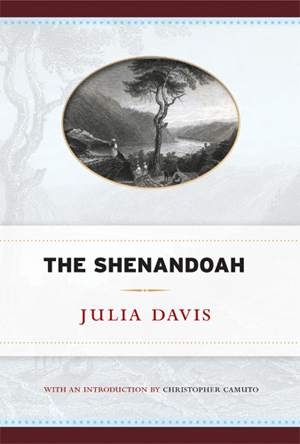
The Shenandoah

The Shenandoah

Julia Davis
Introduction by Christopher Camuto

October 2011
400pp
HC/J  978-1-933202-95-2
$24.99
PDF 978-1-933202-96-9
$24.99

Summary

In 1945, West Virginia author Julia Davis penned The Shenandoah as part of the Rivers of America Series, a landmark collection of books written by literary figures over a period of thirty years. In this classic reprint, now with an introduction by Christopher Camuto, Davis tells the history of the Shenandoah Valley and River, drawing on her own research and the experiences of ancestors who settled and lived in the area. Her book provides a poetic vision of both the river and the valley, preserving a fragment of America’s landscape.

Contents

  • Introduction
  •   Christopher Camuto
  • Map
  •   George Annand
     
  • Part I: Promise
  •   1. Song
  •   2. The Unrecorded Past
  •   3. Exploration
  •   4. Settlement
  •   5. Pioneers
  •   6. Washington
  •   7. Massacres
  •   8. Fort Loudoun
  •   9. Revolution
  •   10. Expansion
  •   11. Inventions
     
  • Part II: Holocaust
  •   12. The Fateful Lightning
  •   13. The Swift Sword
  •   14. Marching On
  •   15. The Invaded
  •   16. Valley Campaign I
  •   17. Valley Campaign II
  •   18. Valley Campaign III
  •   19. The Long Year
  •   20. The Burning
  •   21. The Starving Crows
     
  • Part III: The Recovery
  •   22. The Hero
  •   23. The Fait
  •   24. Fool’s Gold and True Gold
  •   25. Past Into Present
  •   26. Valley Tour I
  •   27. Valley Tour II
  •   28. Valley Tour III
  •   29. Epilogue
  •   30. Postscript
     
  • Acknowledgments
  • Bibliography
  • About the Author

Author

Julia Davis Adams (1901–1993) was born in Clarksburg, WV, attended Wellesley College, and graduated from Barnard College in 1922. She began her career as a reporter for the Associated Press in New York City, where she also headed the adoption service of the Children’s Aid Society in the early 1960s. She authored two dozen books.

Christopher Camuto is the author of a rough-hewn trilogy on the southern Appalachians—A Fly Fisherman’s Blue Ridge, Another Country: Journeying Toward the Cherokee Mountains, and Hunting from Home: A Year Afield in the Blue Ridge Montains—as well as Time and Tide in Acadia: Seasons on Mount Desert Island. He manages a biodiversity perserve, an 80-acre eco-restoration of old farm fields, woodlots, and wetlands, in Pennsylvania.

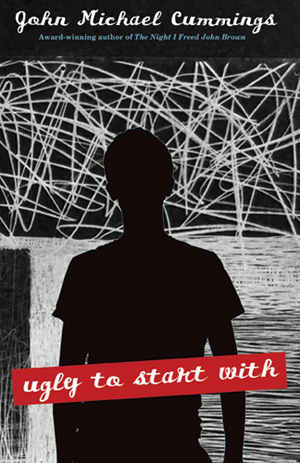
Ugly to Start With

John Michael Cummings
October 2011
144pp
PB  978-1-935978-08-4
$16.99
PDF  978-1-935978-09-1
$16.99
ePub 978-1-938228-34-6
$16.99

Summary

Jason Stevens is growing up in picturesque, historic Harpers Ferry, West Virginia in the 1970s. Back when the roads are smaller, the cars slower, the people more colorful, and Washington, D.C. is way across the mountains—a winding sixty-five miles away.

Jason dreams of going to art school in the city, but he must first survive his teenage years. He witnesses a street artist from Italy charm his mother from the backseat of the family car. He stands up to an abusive husband—and then feels sorry for the jerk. He puts up with his father’s hard-skulled backwoods ways, his grandfather’s showy younger wife, and the fist-throwing schoolmates and eccentric mountain characters that make up Harpers Ferry—all topped off by a basement art project with a girl from the poor side of town.

Ugly to Start With punctuates the exuberant highs, bewildering midpoints, and painful lows of growing up, and affirms that adolescent dreams and desires are often fulfilled in surprising ways.

Contents

  • The World Around Us
  • Two Tunes
  • Ugly to Start With
  • The Fence
  • We Never Liked Them Anyway
  • The Wallet
  • Rusty Clackford
  • Mountain Wake
  • John Brown the Quaker
  • Carter
  • Indians and Teddy Bears Were Here First
  • The Scratchboard Project
  • Generations

Author

John Michael Cummings is a short story writer and novelist from Harpers Ferry, West Virginia. He is the author of The Night I Freed John Brown, which won the 2009 Paterson Prize for Books for Young People (Grade 7-12) and was recommended by USA Today for Black History Month. His short story "The Scratchboard Project" received an honorable mention in The Best American Short Stories 2007. His novel, Don’t Forget Me, Bro, was excerpted in the Chicago Tribune. Mr. Cummings taught English at Seminole State College and was a reporter for The Fairfax Times.

Reviews

“Beautiful and gut-wrenchingly raw.”
Blake Nelson, author of Paranoid Park, Destroy All Cars, and Recovery Road

"The linked stories inUgly to Start With invite us into one boy's life on the margins of historic Harpers Ferry. With an appropriate balance of grit and wonder, John Cummings crafts a coming-of-age narrative of a son striving for the truest expression of his identity in the midst of a family and a place where he often feels like an outsider. These stories have a hard edge to them and a hard-earned wisdom, the sort we only get in retrospect if we're lucky."
Lee Martin, author of The Bright Forever and Break the Skin

"By turns tender, witty and unsettling, Ugly to Start With is a strong and memorable collection.  The stories are carried along by Cummings' graceful prose and pacing, and are charged with the class and racial tensions encoded in the DNA of the United States.  As a group they sketch a compelling portrait of a boy [adolescent?] trying to make sense of his town, his father, and ultimately himself."
Brendan Short, author of Dream City

"John Michael Cummings' prose is anything but Ugly to Start With - I read this book in two sittings, and  it was hilarious and melancholy and singular.  I've never read about a Harpers Ferry, or a family, like this, and their conversations, their houses, and their lives deserve a wide audience.  I can't wait to pass this book along."
Susan Straight is the author of seven novels, including Highwire Moon, a Finalist for the National Book Award and a Distinguished Professor of Creative Writing at University of California, Riverside.

"John Cummings’ collection of short stories, Ugly to Start With, breathes in the atmosphere of  Harper’s Ferry, West Virginia, which plays a central role in many of the conflicts over innocence and experience, development and preservation, insider and outsider, and nature and community.  In this lively and sufficient landscape are a trio—a young boy, his mother, and  his father, who face the complexities of  knowledge of place. Sometimes knowing is painful.  In other stories, there are momentary reprieves or insights provided by the boy’s sharp and wry view of life where “clocks had stopped long ago,” “one big tree” suffices to hide a multitude of sins, and in his crying he can hear his own future unhappiness echo through his body.  This a lovely, funny, melancholy, and important collection of coming-of-age stories."
Maxine Chernoff, author of A Boy in Winter

“In Ugly to Start With, John Michael Cummings has gathered a baker’s dozen of stories full of the warmth, innocence, and holy terrors of childhood. An auspicious debut.”
Peter Selgin, author of Drowning Lessons

“Pitch-perfect West Virginia voices.”
Enid Shomer, author of Tourist Season: Stories

“Like Faulkner, Cummings knows the strong undertow that blood exerts on ambition and self-preservation.”
Charlotte Holmes, Associate Professor, Penn State University. Her stories have appeared in many journals including Epoch, New Letters, Story, and The New Yorker

“Sparkling, deeply intelligent, and often heartbreakingly funny.”
Eileen Pollack, Director, MFA Program in Creative Writing, University of Michigan and author of The Rabbit in the Attic, In the Mouth, and Paradise

“Like Huck Finn and Holden Caulfield, John Michael Cummings’ teenage narrator reveals the troubled and tender and tough heart of a place both split and knit by class, race, and family.”
Wayne Karlin, author of Wandering Souls: Journeys With the Dead and the Living in Viet Nam and Prisoners

"In Ugly to Start With John Michael Cummings tells the story of a uniquely unhappy family with a gracious but disgruntled mother and an idiosyncratic, autocratic, sometimes brutal father who doesn’t believe in having guests or letting anything go to waste. The father with his extremism in self-reliance binds the family together for a while, but then is the cause of its flying apart. The stories embrace other painfully failed families and individuals– all richly human and somehow, seen though the eyes of the young main character, hopeful even in despair."
Meredith Sue Willis, author of Oradell at Sea

“John Cummings is a prolific American short story writer and among the most talented of the rising generation of new regionalists  who have inherited the mantle of Bobbie Ann Mason, Barry Hannah and Larry Brown.  In Ugly to Start With, a series of thirteen interrelated stories set in the eastern panhandle of West Virginia, he tackles the challenges of boyhood adventure and family conflict in a taut, crystalline style that captures the triumphs and tribulations of small-town life.  Not since John Brown's raid has Harpers Ferry generated such excitement for readers.   Cummings has a gift for transcending the particular experiences to his characters to capture the universal truths of human affection and suffering--emotional truths that the members of his audience will recognize from their own experiences of childhood and adolescence.  Cummings is a gifted author who has paid his literary dues, publishing numerous short stories in the nation's most prestigious journals.  As readers, we are fortunate that he has waited so long to produce a first collection, as he is now able to gather together the very best of his short prose  Needless to say, none of his stories disappoint.   Each story is a riveting psychological journey, a reminder of what it's like to be young and hopeful and uncertain.  This collection has defined West Virginia's eastern panhandle as Cummings country, as much as the Salinas Valley belongs to Steinbeck or working-class Albany belongs to William Kennedy. “
Jacob Appel, author of “Dyads” and “The Vermin Episode”