Submission Guidelines

Potential authors wishing to have their concept evaluated for future publication should email Spencer D. Wood at sdwood@ksu.edu with the following information:

  • - Tentative title for the book.
  • - Some consideration of the potential market for the book.
  • - Why is this book needed?
  • - Why is this book needed now? 
  • - For what audience is the book intended? 
  • - What benefits will this audience derive from reading this book?
  • - A detailed outline that provides an indication of the sections and chapters of the book.
  • - A description of competing books.
  • - How is this project different from and better than related books currently available? Even if there is nothing exactly like your project, you should situate it within the literature to show us why this fills an important niche.
  • - A description of how the book will contribute to public sociology.
  • - In what ways will the book critique current policies or suggest new ones to improve the lives of people living in rural areas?
  • - In what ways will the book suggest new programs or changes to existing ones to improve the lives of people living in rural areas?
  • - What is the motivation for writing this book as a means for improving the lives of people living in rural areas?
  • - Expected length of the work in words.
  • - Current status of the manuscript, or some sense of when a completed manuscript could be delivered.
  • - Brief autobiographical sketches of the authors/editors.
  • - Brief description of illustrations and graphic needs of the manuscript.

Call for Participation

The Rural Studies Series Editorial Board encourages scholars with an idea for a book-length manuscript to submit a prospectus outlining the book. The Rural Studies Series is especially interested in manuscripts that address the connections between the local and global, the embeddedness of social structure and social processes in the organization of social space, and the integration of rural places within the global system. RSS seeks diverse theoretical and methodological approaches and encourages scholars from all the social sciences to submit book proposals.

Learn about Submission Guidelines.

Contact

Spencer D. Wood, Associate Professor of Sociology, Kansas State University
Sociology, Anthropology, and Social Work
204 Waters Hall
1603 Old Claflin Place
Kansas State University
Manhattan, KS 666506
sdwood@ksu.edu


Civics in a Digital Republic: A Transformative Curriculum
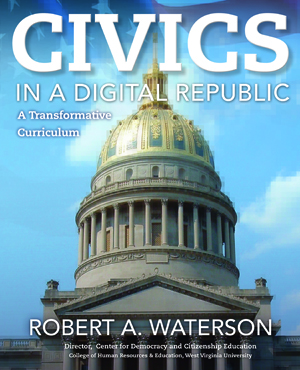
Civics in a Digital Republic

Robert Waterson
February 2012
232pp
PB 978-1-935978-54-1

$34.99
ePub 978-1-935978-55-8
$34.99
PDF 978-1-935978-56-5
$34.99

Summary

This innovative curriculum book provides key materials, resources, and tools to help secondary educators prepare their students to be engaged citizens of their community, state, nation and world. Five complete units of instruction, based on West Virginia Content Standards and Objectives, provide meaningful lessons while being mindful of the transition from tangible text to more digital curricula:

  • Rights of the Individual 
  • Freedoms of the Individual 
  • Responsibilities of the Individual 
  • Beliefs Concerning Societal Conditions 
  • Financial Literacy

Additional features of the curriculum include:

  • 24 lessons that provide specific teaching and learning strategies.
  • 4 culminating activities for enrichment opportunities. 
  • A matrix illustrating the West Virginia Content Standards and Objectives covered.
  • A matrix illustrating compliance with the National Council for the Social Studies Standards.
  • A curriculum toolbox that provides over 70 engaging web sites to visit and explore.

Published by the Center for Democracy and Citizenship Education.
 

Contents

Table of Contents
Introduction
Letter to the Student
Matrix of the National Council for Social Studies Standards
Matrix of West Virginia Content Standards and Objectives
Curriculum Toolbox

  • Digital Resources
  • Civic Resources
  • Financial Literacy Resources
  • Geography Resources

Civic Education Introduction

  • Lesson

Unit A: Rights of the Individual

  • Lesson 1: Media Literacy: Bill of Rights
  • Lesson 2: Creating Effective Citizens: Civic Resources
  • Lesson 3: Global Community: Human Rights Resources Center
  • Lesson 4: Civic Virtue: What Has Value?
  • Lesson 5: Service Learning: Volunteering and Reflection
  • Culminating Activity: Rights of the Individual

Unit B: Freedoms of the Individual

  • Lesson 1: Media Literacy: The First Amendment
  • Lesson 2: Creating Effective Citizens: Web Resources
  • Lesson 3: Global Community: Skype
  • Lesson 4: Civic Virtue: Digital Artistic Expression of Civic Heroes
  • Lesson 5: Service Learning: Online Safety and Voting
  • Culminating Activity: Freedoms of the Individual: WV Tech Steps

Unit C: Responsibilities of the Individual

  • Lesson 1: Media Literacy: State Officials
  • Lesson 2: Creating Effective Citizens: Facing History and Project Citizens
  • Lesson 3: Global Community: Digiteen Project
  • Lesson 4: Civic Virtue: The “Good” Leader
  • Lesson 5: Service Learning: Service as Responsibility
  • Culminating Activity: Cyber Bullying

Unit D: Beliefs Concerning Societal Conditions and Governmental Responsibilities

  • Lesson 1: Media Literacy: The Constitution
  • Lesson 2: Creating Effective Citizens
  • Lesson 3: Global Community
  • Lesson 4: Civic Virtue: Community Civic Virtue
  • Lesson 5: Service Learning: Our Community
  • Culminating Activity: Emerging Democracies

Unit E: Financial Literacy

  • Lesson 1: Council for Economic Education
  • Lesson 2: The Mint
  • Lesson 3: National Financial Capability Challenge
  • Lesson 4: iCivics

Author

Robert Waterson is an Assistant Professor at the College of Human Resources and Education at West Virginia University. His research areas include citizenship, human rights, history, democratic theory, and controversial public issues.

EmailFacebookInstagramPinterestTwitter

Request an Exam Copy

West Virginia University Press is now prioritizing a digital exam copy system. To request a digital exam copy of a title you're considering adopting for a course, please see instructions below.

TEXT EXAM COPIES

WVU Press will send you an examination copy of the book you wish to consider for course use. Please email your request to orders@press.uchicago.edu, specifying the title of the course, your expected enrollment, the semester or quarter in which the course will be offered, the course level (undergraduate or graduate), and any textbooks now currently being used for this course.

An e-book examination copy is free and will be viewable for 90 days, when it will expire.

For print books, our distributor (Chicago Distribution Company, CDC) will ship the book and an invoice at a 20% academic discount, plus shipping charges, payable in 90 days. If you adopt the book, contact CDC's customer service department by email  (orders@press.uchicago.edu), and the invoice will be cancelled. In your message, please include the name and enrollment of the relevant course, as well as the name of the bookstore who handles your textbook requirements. If you choose not to adopt the book, you may return it and have the invoice cancelled, or purchase it at the 20% discount price for your own use.

DESK COPIES

If you have adopted a West Virginia University Press book for course use, you are entitled to one free copy of the book for your own use. Desk copy requests may be submitted by email to our distributor  at orders@press.uchicago.edu. In your message, please include the name and enrollment of the relevant course, as well as the name of the bookstore who handles your textbook requirements.

WHERE TO SEND YOUR REQUEST

Send examination copy and desk copy requests to:
Email: orders@press.uchicago.edu
Fax: (800) 621-8476 or (773) 702-7212
West Virginia University Press
Chicago Distribution Center
11030 South Langley Ave.
Chicago, IL 60628 USA


EmailFacebookInstagramPinterestTwitter

How to Order: Journals

The press's journal are available for purchase online through Project Muse; Tolkien Studies is available for purchase in print. To order go to the Journals Section of this website by clicking here or by using the menu on the left hand side.

Working Class Radicals: The Socialist Party in West Virginia, 1898–1920
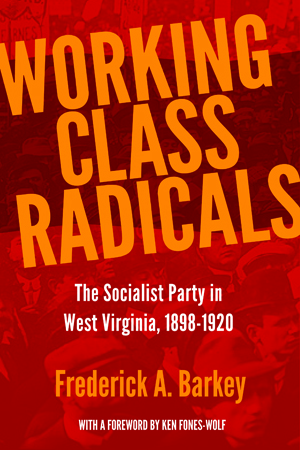
Working Class Radicals

Frederick A. Barkey
With a foreword by Ken Fones-Wolf

April 2012
244pp
PB 978-1-935978-45-9
$24.99
PDF 978-1-935978-46-6
$24.99
PDF (120 Days)
$12.99


Summary

Working Class Radicals: The Socialist Party in West Virginia, 1898–1920 examines the rise and fall of organized socialism in West Virginia through an exploration of the demographics of membership, oral interview material gathered in the 1960s from party members, and the collapse of the party in the wake of the Paint Creek-Cabin Creek coal-mining strike of 1912. The first local branch of the West Virginia Socialist Party was established in Wheeling in 1901, and by 1914 several thousand West Virginians were dues-paying members of local branches. By 1910 local Socialists began to elect candidates to office, and in 1912 more than 15,000 West Virginia voters cast their ballots for Socialist presidential candidate Eugene Debs. The progress that West Virginia socialists achieved on the electoral front was a reflection of the party’s strategy of increasing class-consciousness by working with existing unions to build the power of the labor movement. The party appealed to a fairly broad cross section of wage earners, and its steady growth also owed much to the fact that many members of the middle class were attracted to the cause. Several factors combined to send the party into rapid decline, most importantly deep fissures between class and craft factions of the party and 1915 legislation making third party political participation difficult. Working Class Radicals offers insight into the various internal and external forces that doomed the party and serves as a cautionary tale to contemporary political leaders and organizers.

Contents

  • Foreword
  • Acknowledgments
  • INTRODUCTION
  • I. THE ORIGINS OF WEST VIRGINIA SOCIALISM: 1898–1904
  • II. THE GROWTH AND APPEAL OF THE WEST VIRGINIA SOCIALIST MOVEMENT: 1905–1911
  • III. THE SUSCEPTIBILITY OF THE WEST VIRGINIA WORKING CLASS LEADERSHIP TO THE APPEAL OF SOCIALISM
  • IV. “WE HAD THE REVOLUTION” THE WEST VIRGINIA SOCIALIST PARTY AT ITS PEAK: 1912–1915
  • V. THE DECLINE OF THE WEST VIRGINIA SOCIALIST PARTY: 1915–1920
  • VI. TECHNOLOGICAL CHANGE AND THE DECLINE OF TRADE UNION STRENGTH FOR THE WEST VIRGINIA SOCIALIST PARTY
  • CONCLUSION
  • APPENDIX A: SOCIALIST – NON-SOCIALIST WORKING CLASS LEADERSHIP SAMPLE
  • APPENDIX B: SOCIALIST VOTING PATTERNS IN WEST VIRGINIA
  • Notes
  • Bibliography
  • Index

Author

Frederick A. Barkey is professor emeritus, Marshall University, and founder of the West Virginia Labor History Association. 

Ken Fones-Wolf is professor of history and Stuart and Joyce Robbins Chair, West Virginia University.

Reviews

“A catalyst inspiring additional research into West Virginia’s political past. A starting point for all current and future inquiry into West Virginia’s past and the history of socialism in the United States.”
Kevin T. Barksdale, assistant professor of history, Marshall University

EmailFacebookInstagramPinterestTwitter

The Scummers

Screaming with the Cannibals

Lee Maynard
April 2012
144pp 
PB 978-1-935978-47-3
$16.99
ePub 978-1-935978-48-0
$16.99
PDF 978-1-935978-57-2
$16.99

Purchase the Kindle Edition at Amazon

Summary

Crum Trilogy, Part 3

In the third part of the Crum trilogy, Jesse hits the road and heads West, looking to experience something—anything—that will fulfill his intrinsic desires to escape, and to belong. He ends up in California, where he fools around, mischievously fighting and drinking, yet always narrowly escaping punishment. Soon enough, Jesse runs out of luck. He finds himself arrested and is condemned to serve out his sentence under the supervision of the United States Army. Suddenly Jesse Stone can no longer run. Suddenly Jesse Stone is a solider. Full of intense violence and cutting humor, this tale is the culminating confession of a young man who has wandered from a small town in West Virginia and back again in the hopes of finding his home.

Learn more about the Crum trilogy.
Visit Lee Maynard's website.

Contents

PROLOGUE

Part I
THE ROAD WEST

Part II
SCUMMER TRAINING

Part III
THE SCUMMERS

Author

Lee Maynard was born and raised in the ridges and mountains of West Virginia, an upbringing that darkens and shapes much of his writing. His work has appeared in such publications as Columbia Review of Literature, Kestrel, Reader’s Digest, The Saturday Review, Rider Magazine, Washington Post, Country America, and The Christian Science Monitor. Maynard gained public and literary attention for his depiction of adolescent life in a rural mining town in his first novel Crum and received a Literary Fellowship in Fiction from the National Endowment for the Arts to complete Screaming with the Cannibals. Maynard serves as President and CEO of The Storehouse, an independently funded, nonprofit food pantry in Albuquerque, New Mexico. He received the 2008 Turquoise Chalice Award in honor his dedication to this organization.

Read more about Lee Maynard here.
 

Reviews

"Behold the final record of Jesse Stone, pure fire and tow. You’ll look at these pages sideways. You’ll wish to hit somebody in the temple with your beer bottle. Or maybe you won’t. But if you listen to the roar of this book, if you truly hear the music of Lee Maynard -- a writer who marches to no drummer, different or otherwise -- you’ll get to where you need to go."
Glenn Taylor, a Professor of Creative Writing at West Virginia University and author of The Ballad of Trenchmouth Taggart, a 2009 National Book Critics Circle Award finalist, and The Marrowbone Marble Company

“Funny, rousing, big-hearted, engagingly kooky, and truly memorable.”
Lee K. Abbott, Humanities Distinguished Professor of English, Ohio State University

“Lee Maynard is a genius.”
Stephen Coonts, author of Flight of the Intruder

“A roadmap of a never-ending quest for that elusive place in the heart we call home.”
Chuck Kinder, author of Last Mountain Dancer: Hard-Earned Lessons in Love, Loss, and Honky-Tonk Outlaw Life

EmailFacebookInstagramPinterestTwitter

Screaming with the Cannibals, New Edition

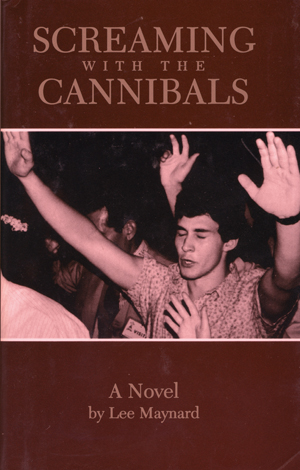
Screaming with the Cannibals

Lee Maynard
April 2012
262pp
PB 978-1-935978-49-7
$16.99
ePub 978-1-935978-43-5
$16.99
PDF 978-1-935978-58-9
$16.99

Purchase the Kindle Edition at Amazon

Summary

Crum Trilogy, Part 2

In this sequel to Crum, Jesse Stone is still on the move. He finds himself in a holy-roller church in Kentucky, on the other side of the Tug River from his native West Virginia, "screaming with the cannibals." From Kentucky he heads to Myrtle Beach, where he gets hired as a lifeguard, although he can’t even swim. Of course, trouble follows Jesse Stone. And so he is always in a hurry to leave—and he doesn’t much care where he is going. Throughout this tale, Jesse anxiously continues his search for a freedom and a future that he knows exists outside of his familiar world.

Learn more about the Crum trilogy.

Contents

FOREWORD

Part I
West Virginia
BLACK HAWK RIDGE

Part II
Kentucky
SCREAMING WITH THE CANNIBALS

Part III
South Carolina
BLEEDING ON THE SAND

Author

Lee Maynard was born and raised in the ridges and mountains of West Virginia, an upbringing that darkens and shapes much of his writing. His work has appeared in such publications as Columbia Review of Literature, Kestrel, Reader’s Digest, The Saturday Review, Rider Magazine, Washington Post, Country America, and The Christian Science Monitor. Maynard gained public and literary attention for his depiction of adolescent life in a rural mining town in his first novel Crum and received a Literary Fellowship in Fiction from the National Endowment for the Arts to complete Screaming with the Cannibals. Maynard serves as President and CEO of The Storehouse, an independently funded, nonprofit food pantry in Albuquerque, New Mexico. He received the 2008 Turquoise Chalice Award in honor his dedication to this organization.

Read more about Lee Maynard here.
Visit Lee Maynard's website.

Reviews

“[Maynard] once again succeeds in delivering a devastatingly soul-searching, scabrous and very funny literary experience."
Michael Shannon Friedman, The Charleston Gazette

"Between the first and last pages of Screaming with the Cannibals are characters so real you can see them bleed, smell their sweat, hear their cries of libido-provoked frustration, wallow with them in the darkness of their spirits and -- God help us all -- laugh when they die the most horrible deaths."
Dave Peyton, Charleston Daily Mail

EmailFacebookInstagramPinterestTwitter

Crum, New Edition

Crum

Lee Maynard
April 2012
180pp
PB 978-1-935978-50-3
$16.99
ePub 978-1-935978-42-8
$16.99
PDF 978-1-935978-59-6
$16.99

Purchase the Kindle Edition at Amazon

Summary

Crum Trilogy, Part 1

In Crum, a gritty coal town on the West Virginia-Kentucky border, the boys fight, swear, chase and sometimes catch girls. The adults are cramped in and clueless, hemmed in by the mountains. The weight of wonder, dejection, and even possibility loom over this tiny, suffocating town. This story is the tale of Jesse Stone, who doesn’t know where he’s going, but knows he is leaving, and whose rebellion against the people and the place of his childhood allows him to reject the comfort and familiarity of his home in search of his place in a larger world.

Learn more about the Crum trilogy.

Contents

INTRODUCTION
Meredith Sue Willis

Crum
SUMMER
AUTUMN
WINTER
SPRING
SUMMER . . . AGAIN

Looking for Benny

Author

Lee Maynard was born and raised in the ridges and mountains of West Virginia, an upbringing that darkens and shapes much of his writing. His work has appeared in such publications as Columbia Review of Literature, Kestrel, Reader’s Digest, The Saturday Review, Rider Magazine, Washington Post, Country America, and The Christian Science Monitor. Maynard gained public and literary attention for his depiction of adolescent life in a rural mining town in his first novel Crum and received a Literary Fellowship in Fiction from the National Endowment for the Arts to complete Screaming with the Cannibals. Maynard serves as President and CEO of The Storehouse, an independently funded, nonprofit food pantry in Albuquerque, New Mexico. He received the 2008 Turquoise Chalice Award in honor his dedication to this organization.

Learn more about Lee Maynard here.
Visit Lee Maynard's website.

Reviews

"The first couple of pages, I'm cringing. I'm tempted to put it down. I imagine a schoolteacher somewhere in the Midwest having all of these awful stereotypes about us confirmed. Yet, despite myself, I continue to read, and I am moved. It is literature. Its voice is true. It's a wonderful portrait of rural America. The book wins me over."
John O'Brien, author of At Home in the Heart of Appalachia

"Each time I read Lee Maynard’s Crum, I ask myself why this foul-mouthed, sexist, scatological, hillbilly-stereotyping novel is one of my all-time favorites."
Meredith Sue Willis, author Oradell at Sea

"Crum is great. Lee Maynard is a genius. No writing has captured rural America this well since Mark Twain. A masterpiece."
Stephen Coonts, author Flight of the Intruder

"It's a tale of growing up in and moving away from Crum, a jumble of shacks on the Tug River in the state's God-forsaken southern coal fields. As tales about coming of age in rural America go, Crum isn't that much out of place on a shelf next to Mark Twain and Harper Lee."
David Bean,  The Charleston Gazette

"Maynard presents a portrait of a young man's psyche which ranks just a small notch below great American portrayals of adolescence - Huckleberry Finn and The Catcher in the Rye."
Michael Shannon Friedman, The Charleston Gazette

"Whatever you do, don't read Crum."
Jack Cawthon, Hur Herald

"For all its faults, Crum creates a hilarious, poignant, recognizable picture of a place and time, and of people I've known."
Rodger Cunningham, Journal of Appalachian Studies

"[Maynard] writes like Jean Shepherd on acid...Crum is one twisted little novel."
Robert Beveridge, Critic

"Maynard is a Gonzo Mountaineer..."
Pops Walker, musician and writer

EmailFacebookInstagramPinterestTwitter

Sir Gawain and the Green Knight

Sir Gawain and the Green Knight

Translated by
Larry D. Benson

With the Middle English text edited by and with a foreword by Daniel Donoghue
May 2012
186pp
PB 978-1-933202-89-1
$12.99
ePub 978-1-935978-10-7
$12.99
PDF 978-1-935978-63-3
$12.99

Purchase the Kindle Edition at Amazon

Summary

Sir Gawain and the Green Knight is a late fourteenth-century Middle English alliterative romance outlining an adventure of Sir Gawain, a knight of King Arthur’s Round Table. In this poem, Sir Gawain accepts a challenge from a mysterious green warrior. In a struggle to uphold his oath along this quest, Gawain demonstrates chivalry, loyalty, and honor.  This new verse translation of the most popular English romance of the fourteenth century to survive to the present offers students an accessible way of approaching the literature of medieval England without losing the flavor of the original writing. The language of Sir Gawain presents considerable problems to present-day readers as it is written in the West Midlands dialect before English became standardized. With a foreword by Daniel Donoghue, the close verse translation includes facing pages of the original fourteenth-century text and its modern translation.

Medieval European Studies Series, Volume XIII

Contents

Acknowledgments
Foreword
Select Bibliography
A Note on the Middle English Original Text
Sir Gawain and the Green Knight

Author

Larry Benson is Emeritus Professor of English at Harvard University. The editor of the Riverside edition of Chaucer’s works, he is also the author of Contradiction: From Beowulf to Chaucer; King Arthur’s Death: The Middle English Alliterative; Morte Arthure and Stanzai Morte Arthur; Mallory’s Morte D’ Arthur; and The Learned and the Lewed: Studies in Chaucer and Medieval Literature.  

Daniel Donoghue is the John P. Marquand Professor of English, Harvard University and the editor of the Old English series for the Dumbarton Oaks Medieval Library of Harvard University Press.

Reviews

“The great virtue of this translation is its brilliant faithfulness to the original and the way it preserves much of the flavor and  stylistic vigor of the original.”
Robert J. Hasenfratz, Professor of English and Medieval Studies, University of Connecticut

EmailFacebookInstagramPinterestTwitter