

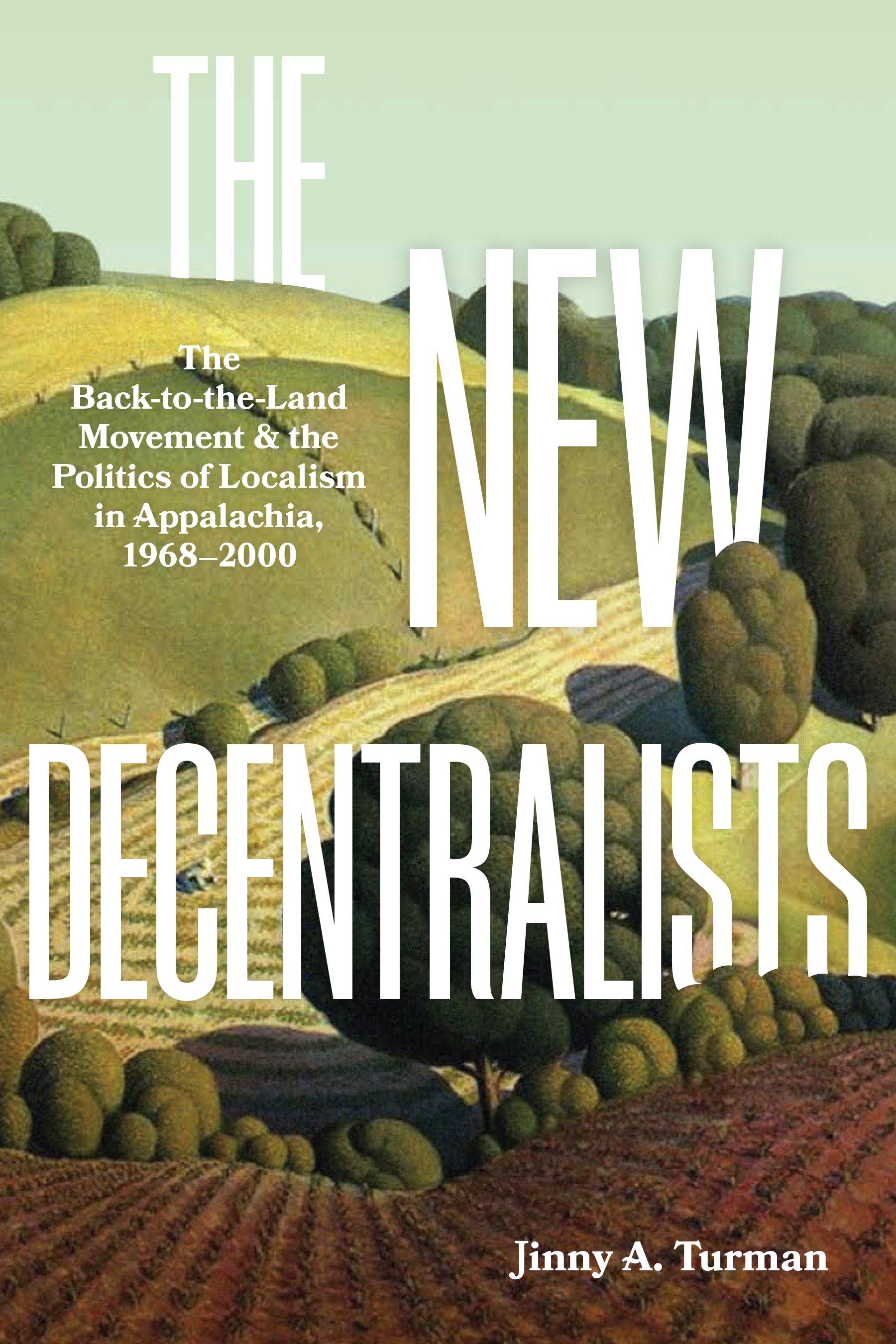

Jinny A. Turman
Pub date: 11/8/2026
308pp
24 b/w figures 2 maps
PB 978-1-959000-88-4
$31.99
EPUB 978-1-959000-89-1
$15.97
PDF 978-1-959000-90-7
$15.97
The New Decentralists
The Back-to-the-Land Movement and the Politics of Localism in Appalachia, 1968–2000
Summary
The late 1960s found young, middle-class, white Americans embracing localism to escape federal bureaucracies and an increasingly impersonal society. The “back-to-the-landers” took this one step further by moving to rural areas, including Appalachia, in pursuit of self-reliance, liberation, and community. They championed agrarian decentralization, a vision of reform based on self-provisioning, neighborly reciprocity, and small-scale manufacturing. And they shared an interest in preserving folkways and certain social conventions and in protecting their farming communities against the threat of surface coal mining. Although localism seemed to be the solution for democratizing these communities, a conservative political shift scaling back federal regulation instead placed power in the hands of a new local and state political elite that did not share their values, leaving these agrarian communities more vulnerable to the threat of surface mining.
Contents
List of Figures
Acknowledgments
Introduction: Decentralist Fever
Chapter 1 – Appalachian Localism and the Back-to-the-Land Movement
Chapter 2 – Going “Guerilla” in the War on Poverty
Chapter 3 – From Heathcote to Hamlin
Chapter 4 – Appalachia’s Heirs
Chapter 5 – Trust in the Hills
Chapter 6 – Hooray for the Outsiders!
Chapter 7 – Our Struggle Is a Barometer
Conclusion
Notes
Bibliography
Index
Author
Jinny Turman is associate professor of history at the University of Virginia’s College at Wise. She holds a PhD in history from West Virginia University. Her areas of interest include modern U.S., public, environmental, and Appalachian history. She has published in West Virginia History, Journal of Southern History, and Appalachian Journal. She is an active member of the National Council on Public History, the Appalachian Studies Association, and Society of Appalachian Historians. Turman resides with her partner and their many animals in Big Stone Gap, Virginia. This is her first book.
Praise
 |
“In the 1980’s, a strip-mining company was about to start destroying Lincoln County, West Virginia – starting in the middle of several dozen small farms owned by back-to-the land newcomers. Nothing managed to stop that corporate steamroller until the newcomers and some local allies re-invented what historian Jinny Turman calls locally-rooted “civic republicanism.” With The New Decentralists, the rethinking of Appalachia’s history receives a bracing shot in the arm.” —Paul Salstrom, author of Appalachia’s Alternative to Mainstream America “A fascinating read on a subject of vital historical importance—and one that has much to say about our contemporary political difficulties. It weaves together the story of rising regional consciousness in the Appalachians with the rising anti-urbanism of the 1960s. I know of no other work that so successfully places back-to-the-landers of this generation within the context of broad mainstream social currents." —Dona Brown, author of Back to the Land: The Enduring Dream of Self-Sufficiency in Modern America |